Yet, as the community that founded these clubs grows older, a new challenge is emerging. How is the Italian community to engage younger generations and ensure these spaces, so vital for preserving Italian traditions abroad, continue to thrive.
A special evening at the Sortino Social Club on Saturday, June 21 offered an inspiring answer to that question.
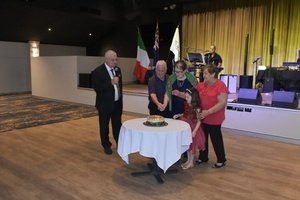
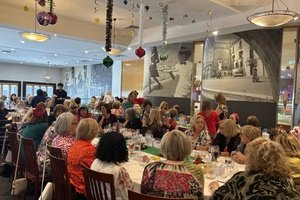
More than 160 people gathered for an event dedicated to the very best of Southern Italian cuisine. The evening’s menu was entirely written in Sicilian, including the festive sign-off, Sciallatevi e mangiati tuttu! (“Enjoy yourselves and eat everything!”) and lovingly prepared by the organisers.
The club’s dedicated committee put together a classic Sicilian spread featuring pasta alla Norma, Sicilian sausages and traditional antipasti. On the tables, exquisite decorations by club secretary Ottavia Marinacci showcased lemons, rosemary, pistachios and the Sicilian flag bearing the crest of Sortino.
But what truly set the evening apart was the collaboration among three organisations that joined forces to make it happen: the Sicilian Association of Australia, the Sicilian Arts Collective Australia (SACA) and the Sortino Social Club.
“It all started in February,” explained Marco Cimino of the Sicilian Association of Australia, one of the key organisers. “I was so impressed by how carefully and professionally the Sortino Club runs its events. Teaming up just felt natural. Without Sortino’s generosity, this evening wouldn’t have been possible.”
“Organising everything was actually easy,” shared Marinacci, “Marco was helpful and kind. We’re from the same generation, we get each other. There was an instant connection.”
The evening was not just a feast for the palate but also a delight for the senses, featuring live music from the group Solo Antico and the highlight of the night: the hilarious show Cumare Peppina, Psychic Extraordinare performed by actor and playwright Rosanna Morales. For decades, Morales has kept Sicilian popular theatre alive with her blend of humour and cultural heritage.
Centre stage, Morales brought to life commare Peppina, a Sicilian widow who claims to read the future and communicate with the dead thanks to her (fictitious yet entirely believable) degree from the “Istituto Siciliano De lu Malocchio”. Sharing the stage was her assistant Concetta, played by Cristina Neri. Together, the two actresses drew the audience into a trilingual performance in Sicilian, Italian and English filled with comedic exorcisms and anti-evil-eye rituals.
“This character was born back in 1978,” Morales explained. “We were students at Melbourne University, performing dialect theatre with the Broccoli Productions company.
“Commare Peppina has survived through every era. But this is the first time she’s become a medium. These days, I use humour as a powerful tool to keep the language alive.”
Yet the evening was not only a tribute to the past. The goal, as Deanna Zammit, president of the Sicilian Association, made clear, is to look ahead.
“We’re working to build bridges, not just between different clubs, but also between generations,” she said, “Younger people, in their 20s to 40s, have very different expectations; they don’t want to hang out in the same spaces as their parents or grandparents.
“So we’re creating opportunities just for them: morning coffee gatherings with language chats, small Zoom groups and spaces where they can rediscover Sicilian culture in an informal, social way.”
Zammit is not alone. Alongside her are numerous volunteers dedicated to adapting club life to modern times.
“The ageing of the Italian community is a reality,” said Paul Giuliano, president of the Sortino Social Club. “If we don’t evolve and collaborate, our culture risks disappearing. We need cooperation between clubs, resource sharing and open-mindedness.”
“We deeply respect the previous generation, but we can’t run clubs the way people did in the ‘60s,” argued Marinacci, “Today, there are so many permits, regulations and professional requirements. The costs are high, even for not-for-profit groups like ours.”
That’s why the Sortino event wasn’t just an evening of entertainment, but also an evening of strategy.
“We need events that keep culture alive but also make a social impact,” Marinacci added, “In July, we’re holding our general assembly, and there’s already a group of women planning a fundraiser for the Royal Children’s Hospital.”
For these associations, the future depends on staying rooted in tradition, standing firmly in the present and doing it all with plenty of teamwork.