

From the very beginning, he paved the way for a new generation of leaders and advocates for the rights of people with disabilities, sharing the many lessons he had to learn to overcome on his own challenges. Because, in life, there are those who open doors just for themselves and those who open them for others, too.
When I spoke with Natale Cutri, just a few days before he left for a trip to Northern Europe, I was immediately struck by the energy of someone who has made advocacy for others his second language. He is relentlessly pursuing the path towards inclusion and dignity for all. Because, as he says, “Everyone can travel, everyone can achieve anything.”
Recently honoured with the Public Service Medal on the King’s Birthday for his exceptional leadership and advocacy for people with disabilities, Cutri firmly reiterated the need to “fight to survive”, especially for others.
A founding member and co-chair of the Victoria Police Enablers Network, a group of employees with lived experience of disability and caregiving that promotes information-sharing and support for colleagues in need, and a person born with a vision impairment, Cutri decided early on to influence police leadership by actively proposing solutions to improve accessibility for all.
The son of Calabrian migrants, Domenico and Teresa Cutri, both from Sinopoli, in the province of Reggio Calabria, who arrived in Australia after World War II, he readily admits that his first language was Calabrian dialect, learned from his maternal grandmother who lived with the family.
English slowly came later at school, helped by an Italian-speaking classmate who acted as his interpreter. “I went to school and felt half Italian, half Australian. It was complicated,” he recalls.
In the 1970s, he was directed to the St Paul’s School for the Blind in Kew, even though the family lived in Moonee Ponds, on the other side of Melbourne. Those difficult days, however, instilled in him the conviction to transform obstacles into motivation and difficulty into a shared language.
“My parents worked as fruit and vegetable traders at the Queen Victoria Market. Every Monday, my father would go to Footscray to collect the produce, drop it at the market, then return to Moonee Ponds to pick me up and take me to Kew by 9 a.m.,” he explains.
“Fridays were intense. He’d leave my mother at the market, come to get me, take me home and return to work.
“My father eventually asked the principal if the school could provide a driver, but they had no resources. He reached out to friends, local MPs and associations until he connected with the Lions Club of Essendon, which allocated funds for a car and a driver,” he continues.
“The principal then asked if the service could be extended to other students, and my father made sure everyone could benefit. In a way, I learned from him.”
It was St Bernard’s College in Essendon where Cutri first encountered a teacher who truly believed in his potential, alongside a principal “deeply aware” of the challenges faced by the vision-impaired.
A young and sudden passion for numbers led him to university, and after an Arts degree in Italian, including some economics courses, he completed a master’s in accounting.
In 1996, following a successful interview with Victoria Police in which he impressed the panel, Cutri was hired.
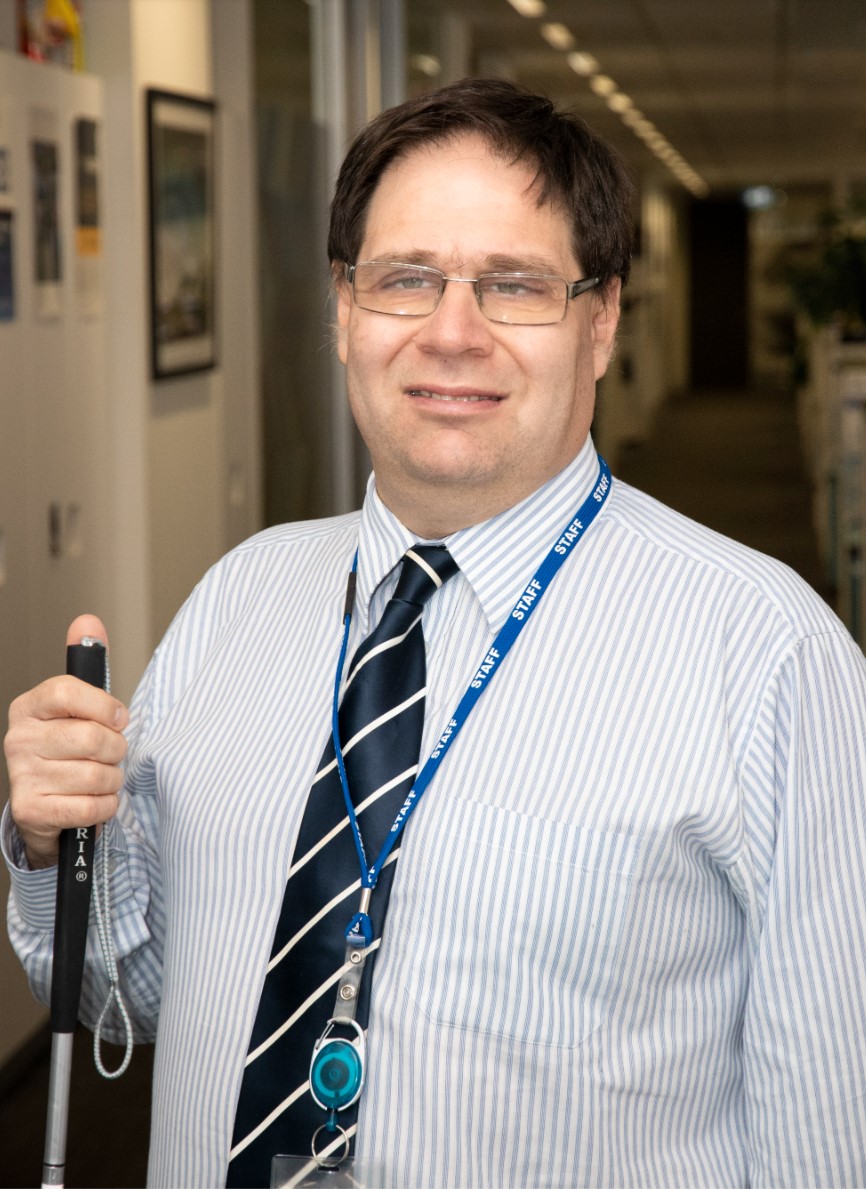
Natale Cutri, founding member and co-chair of the Victoria Police Enablers Network
Since then, almost 30 years have passed. Cutri has gone from administration to regional offices, all the way to his current role as business manager in the Victoria Police Capability Department, where he now focuses especially on policies and legislation.
“I noticed early on that Victoria Police had excellent accessibility policies,” he explains. “One of the first people I interviewed with was Tricia Malowney, an extraordinary advocate who brought disability to the heart of transport reform and the Family Violence Act.”
“However, there came a time when progress toward full accessibility seemed to slow down. Inclusion seemed to be regressing,” he adds. “Often, you’re rejected - for instance, in interviews - when they say you’re not suitable because you don’t have a driver’s license, as if that defines your abilities. I wanted to become a voice for those who couldn’t speak up.”
In 2016, the Victoria Police Enablers Network was born: a network of employees with disabilities or caregiving experience. From thirty founding members, it has grown to at least 150 today, becoming a true reference point for those seeking support and representation in the workplace. With Cutri and the network, seminars on disability awareness were launched, along with the Disability Confident Recruiter program to review hiring processes for real accessibility and IT support for those needing specific software.
“There are many programs about mental health, which is wonderful, but for other disabilities there’s still a long way to go. We need to create a culture of accessibility that isn’t only reactive,” he says. Because the mission is to make “organisations fairer, more inclusive and more focused on the person than on their limitations.”
Change is measured in concrete terms. Today, police stations are more accessible, as are websites and online training. Senior leaders have undertaken specific awareness programs, starting from a simple and unstoppable idea: exclude no one.
“I hope that one day, there will be no more barriers,” he declares firmly. “If you’re in a wheelchair, you should be able to get on a tram without obstacles. If you have a guide dog, you should be able to enter a restaurant without arguments. If you’re vision-impaired, you should have access to the same information with larger print or audio files.”
The future Cutri imagines is shaped by normality, not exceptions. By real equality, not permission. “The most important thing is that everyone can believe in others. If you believe someone is capable, they will succeed,” he declares.
To this day, his work has inspired a new generation of leaders, employees unafraid to ask for support and managers who have begun to see things differently. His efforts have even led Victoria Police to integrate accessibility principles into the design of their buildings.
“Police forces must be on the front line. Talking about disability in certain roles is still taboo, yet we need to consider the circumstances. If you’re not on the street, you can contribute in many other ways,” he adds.
This commitment to fighting for those who haven’t yet found their voice, recognised by his recent Public Service Medal, continues to guide Natale Cutri’s clear and determined path.
Cutri’s journey that began with the powerful example of his parents; his father arriving in Australia at sixteen, determined to make his own way and survive the challenges of migration; his mother, “deeply diplomatic”, keeping the family grounded.
He is a living testament to how one can grow through the cracks and become a foundation for others. Today, in the protective shadow of his steady stride, many others are learning to walk.