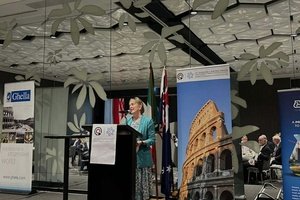
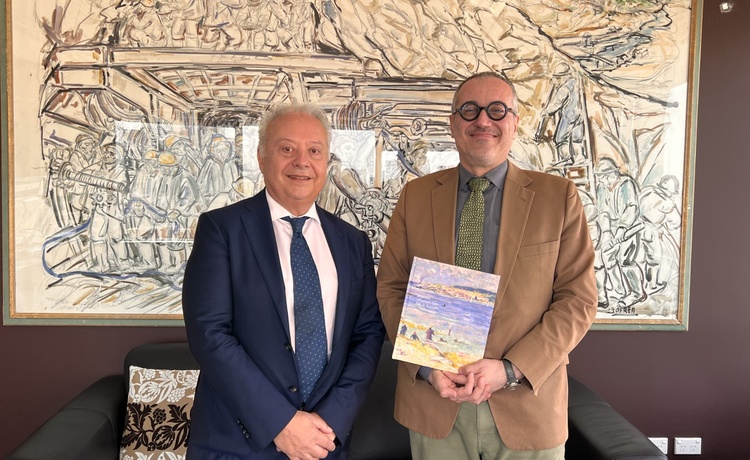
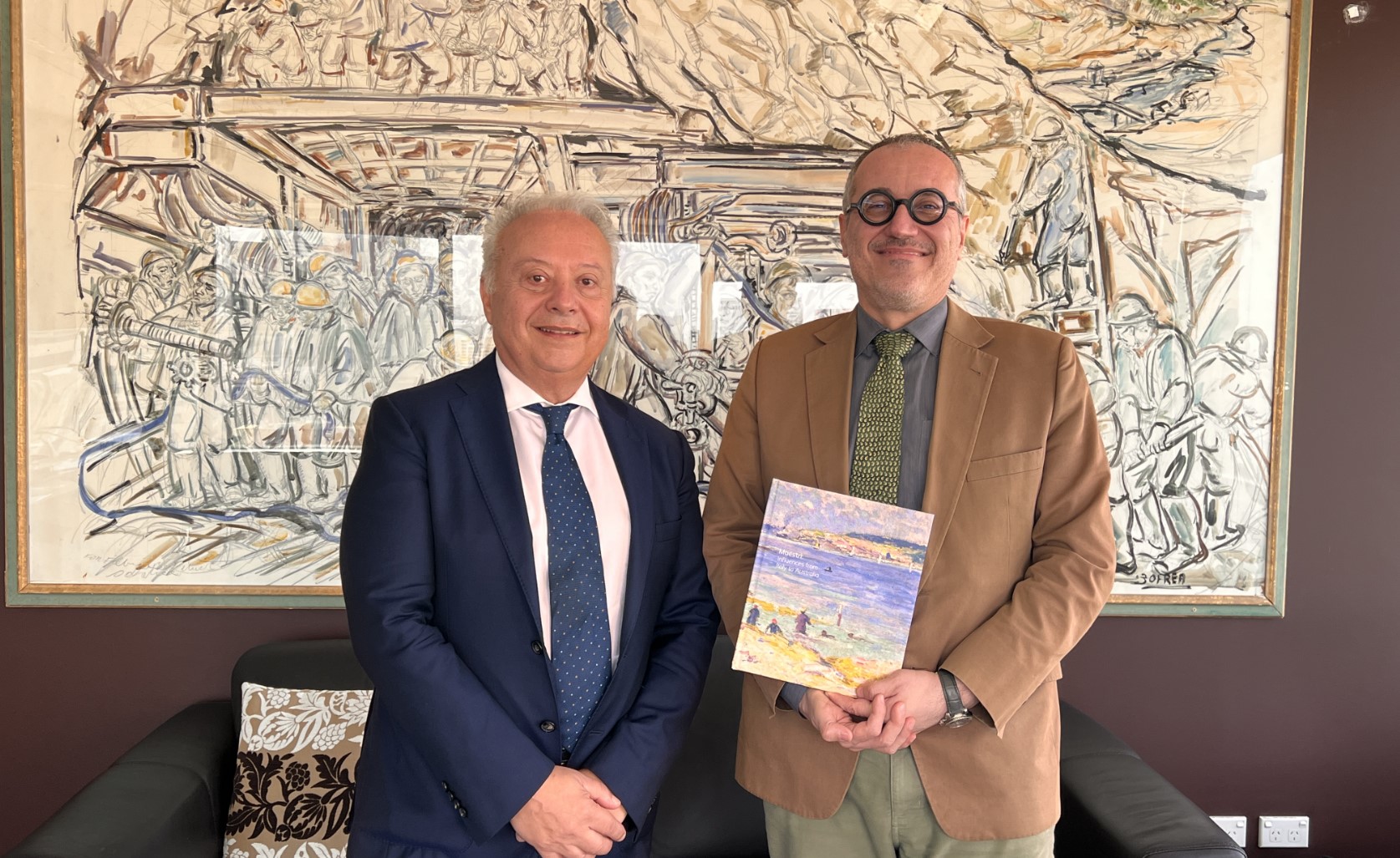
The announcement was attended by Consul General Gianluca Rubagotti, the new Director of the Italian Cultural Institute Marco Gioacchini and Professor Valerio Terraroli, along with representatives of the Italian media.
The initiative was promoted by the Consulate General itself in collaboration with the Italian Cultural Institute, which welcomed as guest of honour Professor Terraroli, a lecturer at the University of Verona and one of the leading scholars of 19th and 20th century art.
An art historian and curator of numerous international exhibitions, he is the author of important studies on Art Deco and the evolution of taste between Italy and European modernism.
“The goal of this initiative is to offer the Italian and italophone community of Sydney an opportunity to attend conferences entirely in Italian, rediscovering the pleasure of thinking and conversing in our language and within our culture,” explained Rubagotti.
The week then opened on Tuesday with a guided tour in Italian of the Manly exhibition, led by Professor Terraroli.
The event, followed by a conference on the iconography of Dante Alighieri in the twentieth century organised in collaboration with the Dante Alighieri Society, offered the public a reflection on representations of the poet in painting between the late nineteenth and early twentieth centuries, with references to D’Annunzio, Michetti and the symbolist tradition.
“Dante becomes, in that era, a modern archetype,” explained Terraroli. “A symbol of identity and spiritual research that crosses painting and literature.”
Then, at the University of Sydney, the professor gave a lecture entitled Art Déco in France and in Italy on the occasion of the centenary of the great Paris exhibition of 1925.
“Art Deco is fascinating because it condenses, in just a few years, an aesthetic that spans painting, architecture and design, combining decorative luxury with industrial modernity,” observed Terraroli.
“It’s the style that anticipates the cinema and fashion of the 1930s.”
This was followed by a conference at the Italian Cultural Institute called Exoticism: the Orientalist Taste in Italian Art between the Late Nineteenth and the First Half of the Twentieth Century.
The conference was enriched by musical interludes from Giacomo Puccini—an aural tribute to the Orientalism that influenced not only the visual arts but also music.
The week ended with another guided tour of the Manly exhibition conducted by Professor Terraroli together with Professor Kipiotis, in a bilingual Italian-English dialogue.
The exhibition, entitled Maestri: Influences from Italy to Australia, was inaugurated a few weeks ago on the occasion of the visit of the delegation from the Academy of Fine Arts of Naples, which collaborated on the production of the catalogue and an introductory video filmed in Naples.
Set up at the Manly Art Gallery & Museum, the exhibition tells of the journey from Italy to Australia through the work of Antonio Dattilo-Rubbo, a Neapolitan painter who emigrated to Sydney in the early twentieth century and trained a generation of modernist Australian artists.
The exhibition has already received excellent reviews, including an enthusiastic one by art critic Christopher Allen in The Australian Review, who described it as “intelligently conceived and beautifully constructed” and capable of offering “a rare glimpse of our Italian essence”.
It provides a rare opportunity to explore how Italy has helped shape Australian culture.
Allen highlighted Dattilo-Rubbo’s central role as a bridge between the Neapolitan school and early twentieth-century Australian painting, writing that, ‘In truth, we are all heirs of Italy, in the same way that we are ultimately indebted to Greece.’
“Rubbo represents the connecting link between the Neapolitan school and the formation of the first Australian modernists,” explained Terraroli.
“With him, Italian tradition meets Australian light and sensitivity, opening a new season for the visual arts of the country.”
The week served as a reminder of Italy's role as a cultural root and a universal source of inspiration.