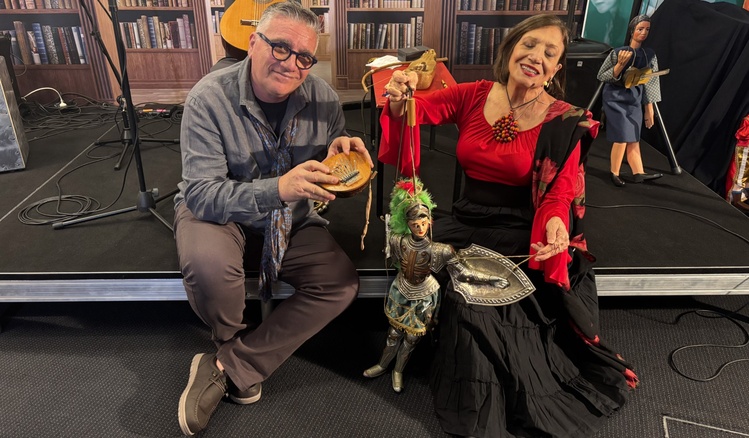
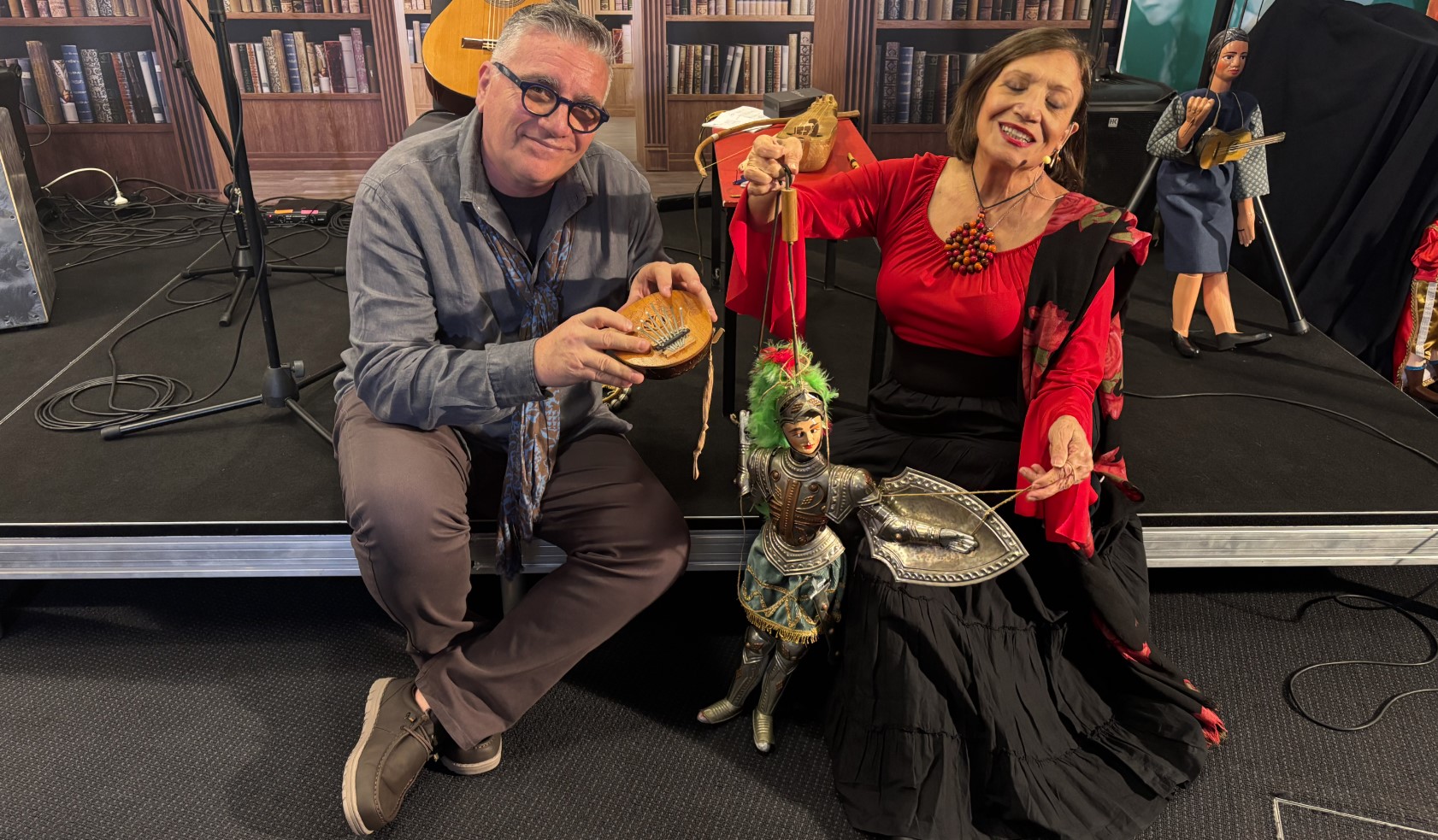
At Co.As.It in Carlton, musicians Fulvio Cama and Sara Cappello presented Mediterraneo Dream, a performance that blended music, storytelling and theatre, joined on percussion by Felice Paone.
More than a concert, the evening was a journey through the cultural soul of Southern Italy, between Calabria and Sicily, where song, narrative and performance naturally intertwine.
The project grew from the artistic collaboration between two performers who come from different regions—Reggio Calabria for Cama, Palermo for Cappello—but share the same mission: preserving and renewing the tradition of the Mediterranean cantastorie, travelling storytellers who for centuries passed on stories, myths and news through song.
On stage, Cama—a composer, multi-instrumentalist, writer and instrument maker—guided the audience through a rich musical landscape.
Winner of several international awards and founder of the cultural association Fabulanova, the Calabrian artist has long worked to research and promote the musical traditions of the Mediterranean.
During the performance he moved effortlessly between instruments from different cultures, including guitars and ancient lutes, the Calabrian lyre, kalimba, bouzouki, oud and even the didgeridoo. The result was a soundscape that combined ancient tones with a contemporary sensibility.
Beside him, the powerful and theatrical voice of Sara Cappello shaped the narrative. A singer-songwriter, storyteller and researcher, Cappello is among the most active figures in the revival of Sicily’s musical heritage.
Founder of Palermo’s Teatro Cantunera, she has spent years studying and promoting traditional Sicilian songs, work that earned her inclusion in the Register of Intangible Cultural Heritage of Sicily (REIS) in 2021.
Her performance, at times delicate, at times passionate, led the audience through a world of old stories, folk ballads and everyday life.
Yet the evening was not a nostalgic return to the past; in the hands of Cappello and Cama, tradition became a living language that still speaks to the present.
“Folk song is a precious memory,” Cappello explained. “These stories contain love, struggle, injustice and hope. Telling them today means giving voice to a human heritage that belongs to all of us.”
One of the evening’s most evocative moments focused on the tradition of the Sicilian Opera dei Pupi, the famous puppet theatre recognised by UNESCO as Intangible Cultural Heritage of Humanity.
The tradition draws on medieval epics such as Orlando Furioso and Gerusalemme Liberata, which flourished in 19th-century Sicily through performances in public squares and small theatres.
“Through the puppets of the paladins, storytellers recounted heroic deeds, battles and passions, turning the stage into a kind of early popular cinema,” Cappello explained.
The painted posters that once promoted the performances served as illustrated sequences of the story, allowing audiences, many of whom couldn’t read, to imagine the characters and events.
“Before cinema or social media existed, storytellers were how people saw and heard the stories of the world,” Cama added.
Throughout the performance these traditions were brought to life with music, narration and brief theatrical moments that engaged the audience naturally. The percussion of local musician Felice Paone added energy and rhythm to the performance.
The Australian tour also carries a broader purpose: connecting the Mediterranean storytelling tradition with the oral traditions of Aboriginal cultures, which likewise transmit memory through narrative, song and rhythm.
“Traditional cultures are like ancient rivers,” Cama observed. “They have flowed for centuries and continue to nourish those who know how to listen.”
It’s an ambitious vision that the Calabrian storyteller continues to pursue with passion.
“I would like to create a great world orchestra where every culture is represented and free to express its tradition,” he said, “For this reason, we have already started collaborating with local artists.”