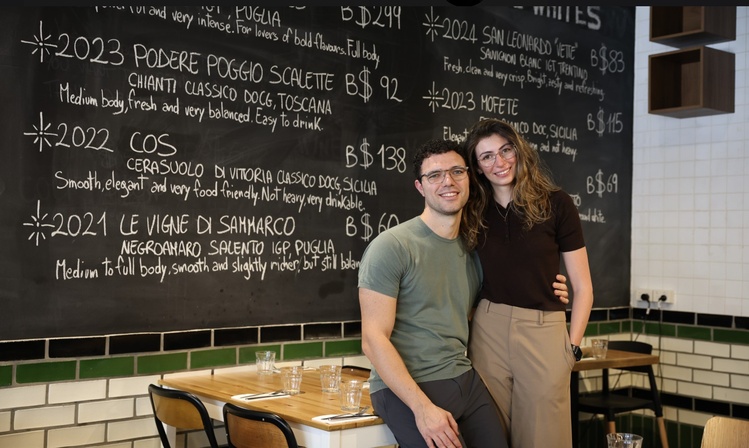
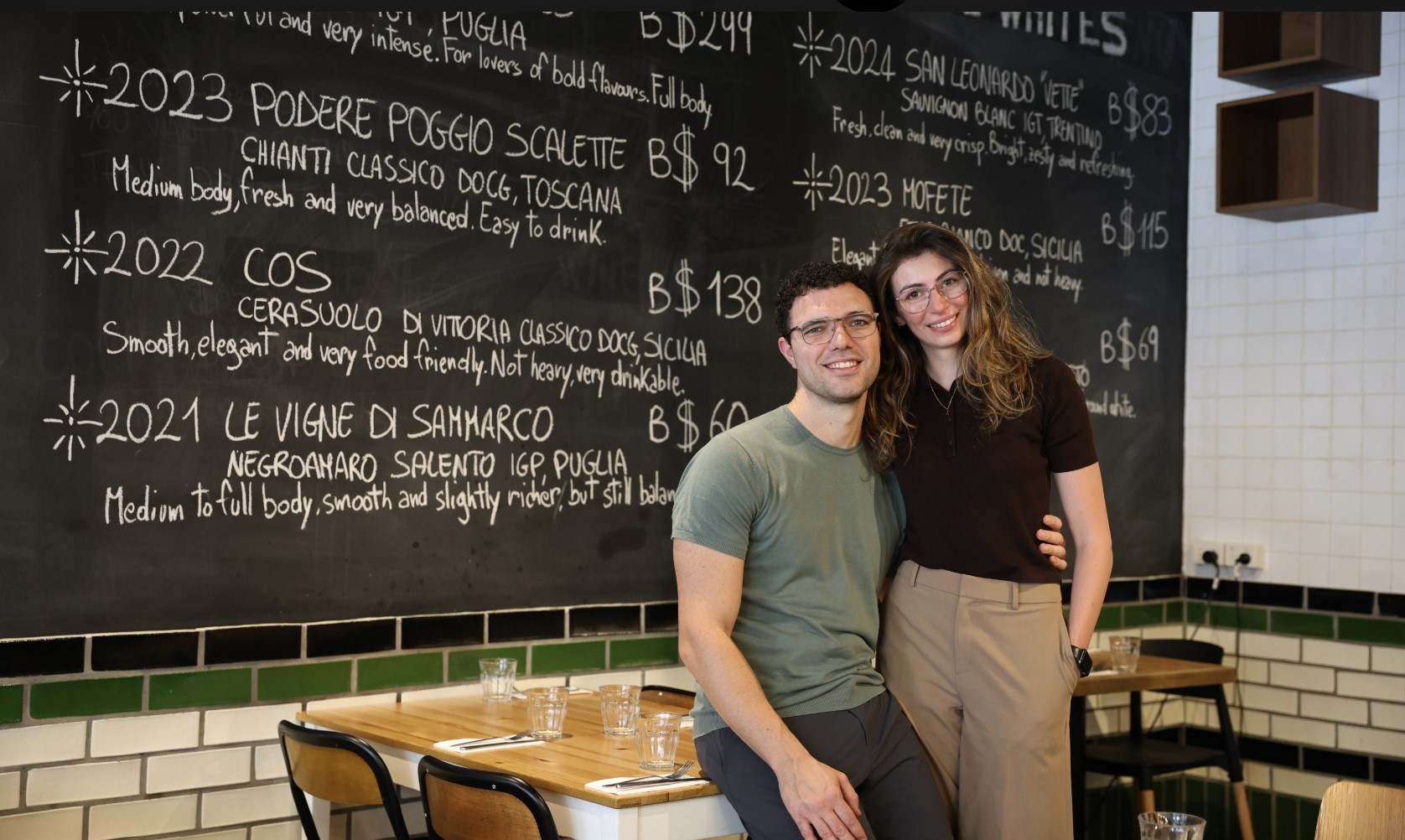
Behind that visible transformation lies work that began long before last October, when Giorgia Ragusa and Mattia Cordella officially took over.
Before Alba, there were frequent dinners at home, shared with Italian and non-Italian friends alike. Improvised tables and dishes cooked without the pressure of service, stretching late into the evening.
It was there they realised that their happiness lay in sharing food with others.
Not in “running a restaurant” in the abstract, but in creating a space where people felt comfortable and part of something. Alba came later, almost as a natural consequence.
Cordella, from Salento in Puglia, already knew the inside of the restaurant like the back of his hand after having worked there for more than four years—eventually leading the kitchen.
Before that, he was on an intense path in Italy—fine dining kitchens and training at ALMA—which had left him more frustrated than inspired.
“At a certain point I shut myself away at home,” he recalls. “I was deeply disappointed with the world of cooking.” Australia, long in the back of his mind, became a dream that finally took shape.
Ragusa is Sicilian, originally from Vittoria in the province of Ragusa. She arrived in Australia young, after living in both Southern and Northern Italy.
In Sydney she studied accounting while working in hospitality, moving through various roles before finding her place in management and administration. Today, she looks after the business side of the restaurant.
“I work behind the scenes,” she says. “Accounts, organisation, structure. If that part doesn’t hold up, nothing else works.”
When the previous owner decided to step away from Alba, the opportunity to take over came quickly, almost urgently.
“Either we took it on, or the restaurant would have completely changed direction,” they explain.
The decision was clear: to care for it themselves and take it where they had always believed it could go.
The change is not merely aesthetic. The visual identity has been carefully rethought, drawing on southern Italy—particularly Salento—without slipping into cliché or folklore.
“We were interested in a simple elegance,” says Cordella, referring to the kind you immediately recognise if you’re Italian.
The same approach guides the menu. Dishes that once had no room now take centre stage: octopus ragù, swordfish, slow-cooked pasta—plates Cordella was already cooking at home for friends, long before they appeared for customers.
“If you want to tell the story of certain places, you can’t avoid [certain dishes],” he says. “Even when they’re not the easiest choice.”
A defining example of this philosophy emerged almost by chance, through an ingredient: Sicilian sheep’s milk ricotta sourced from Palermo.
“When we tasted it,” Ragusa recalls, “for me it was immediate—I grew up with that ricotta.”
It wasn’t originally meant to go on the menu, but the product demanded a decision. Not a cannolo (too familiar and predictable), but something different.
In the end the pair went with a “Salento pavlova”, borrowing a name familiar to Australian diners while transporting them elsewhere.
“It’s not a pavlova,” Cordella clarifies. “It’s a way of guiding people towards a quality ingredient, but with originality.”
Each dish has its own name. “Recipes aren’t explained, they’re told,” Cordella says. The storytelling passes through gesture, produce and care.
Today, Cordella continues to oversee the kitchen and shape the menu’s direction. The guidelines remain his, while day-to-day cooking is entrusted to a young team given room to express themselves within clear boundaries.
“The soul has to remain,” he explains.
Ragusa and Cordella have two distinct but complementary roles, holding together vision and framework.
Alba was born this way—not from a business plan, but from a series of tables set at home and the conviction that food is meant to bring people together.