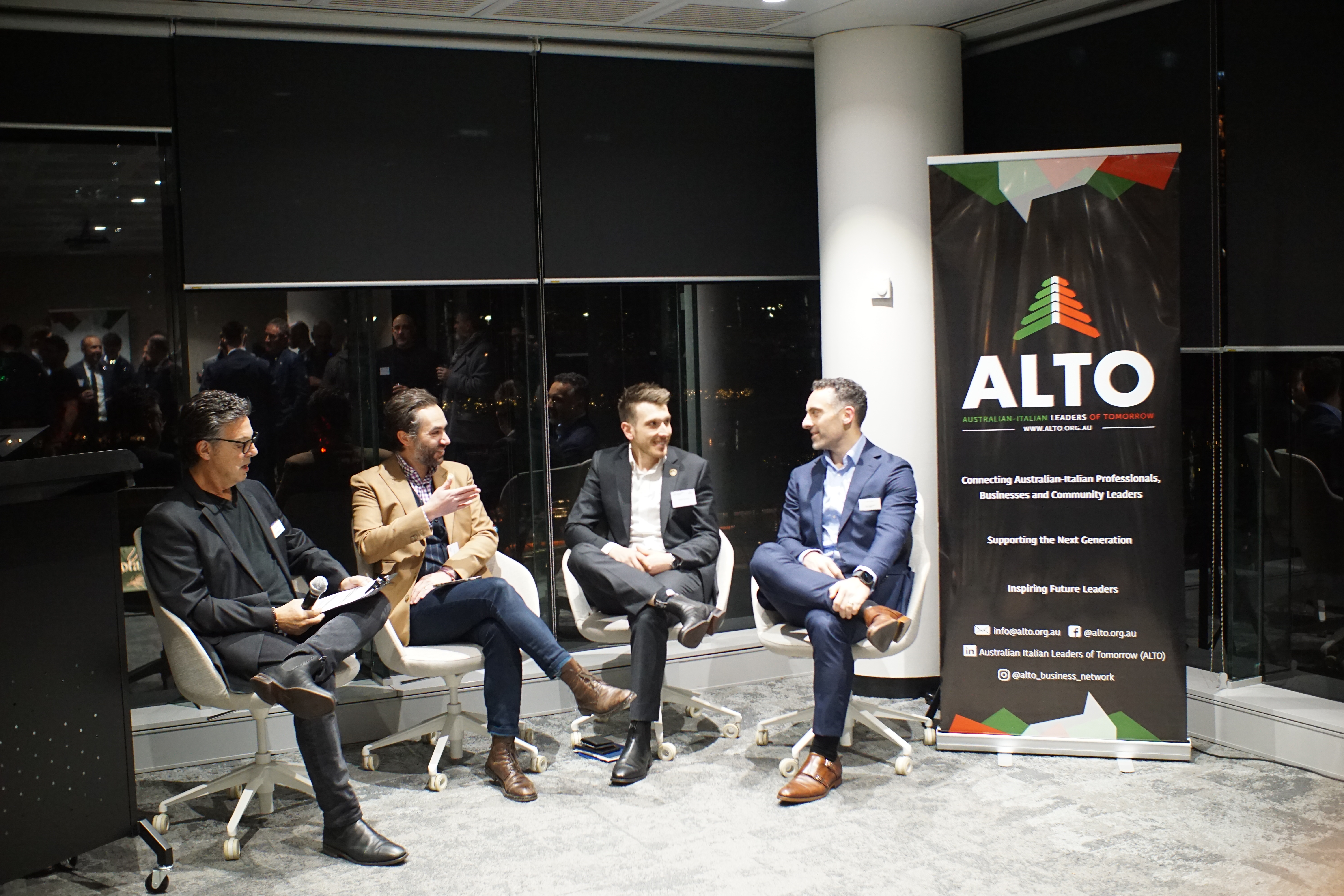
ALTO President Adrian D’Aprano welcomed the guests to ‘property night’.
“Over the past 12 years, ALTO has grown into a thriving network that more than 300 lifetime members supported by an active committee of seven dedicated individuals,” he said, “We are committed to creating valuable opportunities for collaboration and growth.
“Property night is historically one of ALTO’s most popular events, and it’s easy to see why. Tonight is a chance to learn from the experts and gain insights and connect with likeminded professionals.”
Key speakers on the night were the Employment and Industrial Relations Manager for Master Builders Victoria (MBV), Adrian Ziccone, the MBV Executive Director of People & Member Services, Giovanni Abelardo and one of the partners at Kalus Kenny Intelex, Peter Lettieri. Hosting the panel discussion was Kalus Kenny Intelex Director Henry Kalus.
“Henry is one of Melbourne’s most experienced and respected property lawyers with decades of insight into the legal and commercial dynamics that shape successful property ventures,” said D’Aprano.
“I’m neither Italian, nor am I young, but I do aspire to be both,” joked Kalus.

Guests were treated to an array of Italian delicacies
Abelardo was the first to respond to a question about which factors he feels have most contributed to Australia’s housing crisis. “I think there’s a few factors that probably brought us here,” he said, “Before Covid, fixed-price contracts were the lay of the land, and it made it a lot easier to know what things are going to cost.
“As soon as Covid came along, we had the ‘unperfect storm’ where quite a few factors affected different things, one being supply costs became increasingly high, as were shipping containers; lumber was hard to find, and that was due to the war in Ukraine which continues now.
“Along with that, the VMIA increased insurance premiums by 94-95 per cent over a two-year period. These different costs start to add up, [then] you add in that there’s no one actually available to do the work, there’s a shortage of trades.
“[In summary,] there’s no materials at a decent cost that people can pay for, there’s no workers around to actually do the work and, if they are there, they’re upping the price of everything. So, when we put it all together, people can’t afford to build houses.”
Ziccone spoke next and shared his views on Australia’s labour shortage. “Something like 100,000 people across Australia each year exit from the building and construction industry,” he revealed, “That may be because of retirement or career change, but we’re actually losing people from the industry.
“Master Builders Australia did some modelling, and to meet the demand for housing in 2030, we’re going to need at least another 150,000 people to work in the building and construction industry.”
For Ziccone, the industry’s reputation may be one of the largest obstacles to attracting new talent. “The building and construction industry, unfortunately for many, is a bit stigmatised as an industry to go into,” he said.
“We’ve got schools that really push people towards … going to university, rather than considering building and construction as a legitimate pathway, so we’ve got that sort of imagery problem.”
Lettieri spoke about legislation aimed at making building less risky in the wake of large building companies going bankrupt during builds, warning that it may exacerbate the problem of unaffordability. “The government’s really centralising their insurance scheme,” he explained, “There’s not going to be any more private domestic building insurance providers.
“On the upside, it means that even if your builder doesn’t take out insurance, you’re covered. But, in order to fund that, they are putting a financial burden on your builders…
“It’s a cost that, without a doubt, consumers are going to be wearing. [Builders] are certainly not going to be internalising these costs, they’re going to pass them on.”
To join ALTO, keep up to date with its network events and benefit from its expert speakers, click here.