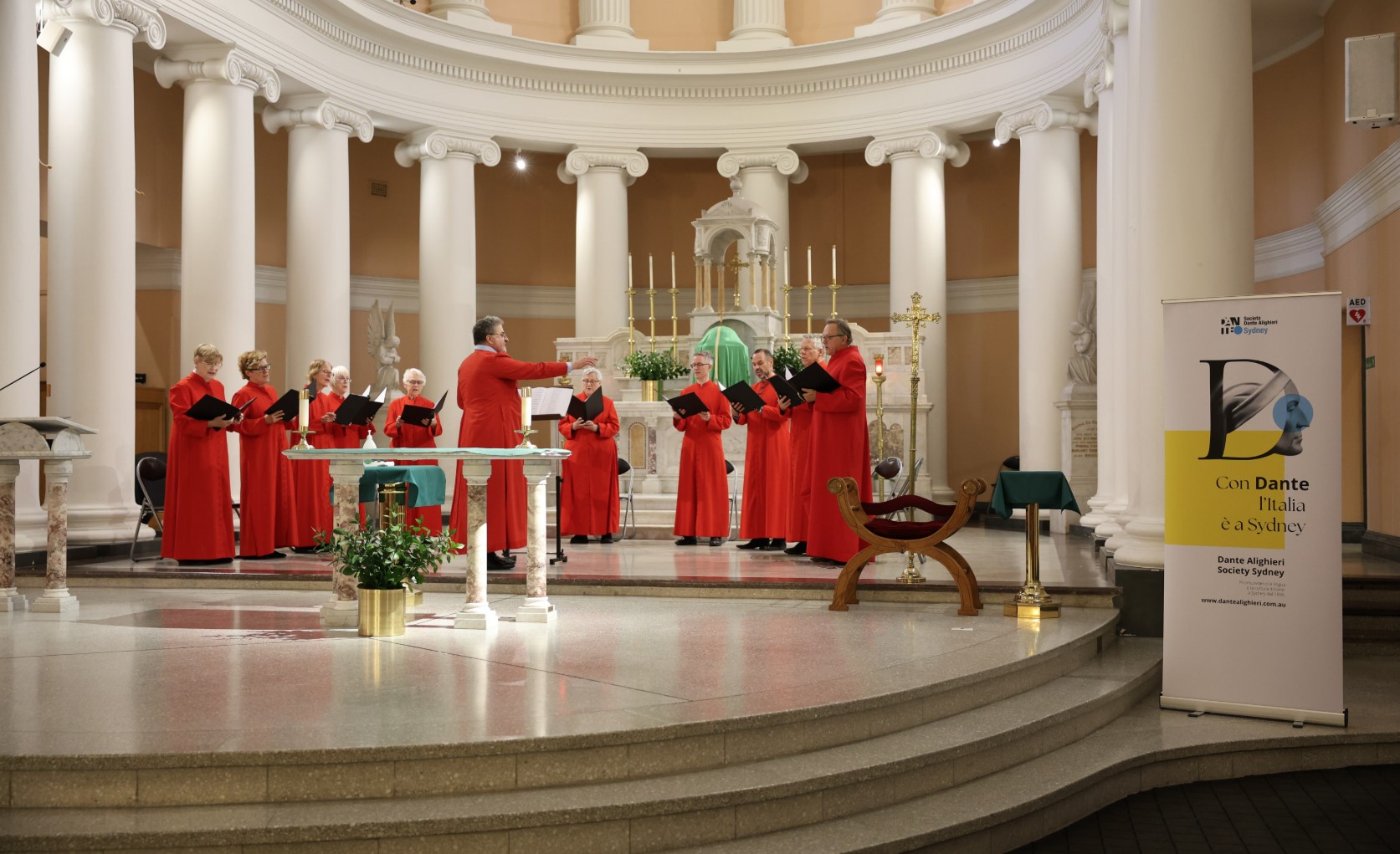
Each verse—Laudato si’, mi’ Signore—seemed to vibrate in the Gothic arches like an ancient breath, still capable today of uniting faith, poetry and humanity.
The occasion was special: the eight hundredth anniversary of the celebrated hymn by Saint Francis of Assisi and the 25th annual Week of the Italian Language in the World, dedicated to the theme Italofonia: Italian Beyond Borders.
Guiding the evening was President of the Dante Alighieri Society of Sydney, Concetta Cirigliano Perna, who welcomed guests with words of gratitude and civic spirit.
“The Canticle is not only a literary masterpiece,” she recalled, “but an invitation to rediscover the link between language, nature and peace.
“The Italian language is born here—from an act of love, reconciliation and listening to the world around us.”
With her passionate and measured tone, Perna traced a continuum between the Franciscan legacy and the cultural mission of the Dante Alighieri Society: to preserve and spread Italian as a living, inclusive language capable of uniting generations and continents.
“Every time we celebrate our language, we also celebrate our identity and the possibility for dialogue that it carries with it,” she added.
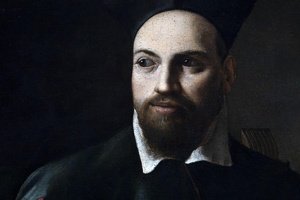
Professor Daniel Canaris of the University of Sydney offered an in-depth reflection on the literary and spiritual value of the work, explaining how Saint Francis, by choosing to write not in Latin but in Umbrian vernacular, initiated the history of the Italian language.
“The Canticle is the first act of linguistic democracy in our culture,” he explained. “It is the voice of the people becoming poetry, poetry that becomes a collective prayer.”
After this introduction, Vice President Antonella Beconi gave voice to the text of Saint Francis. Her reading restored the Canticle to its popular origin: a universal hymn of praise that does not divide but embraces, in which “the sun, the moon, the water and the fire” become brothers and sisters of humankind.
The evening concluded with a convivial aperitif, with conversation, smiles and a shared glass of wine in the parish hall, a moment that reflected the authentic spirit of Francis: the simple joy of being together.
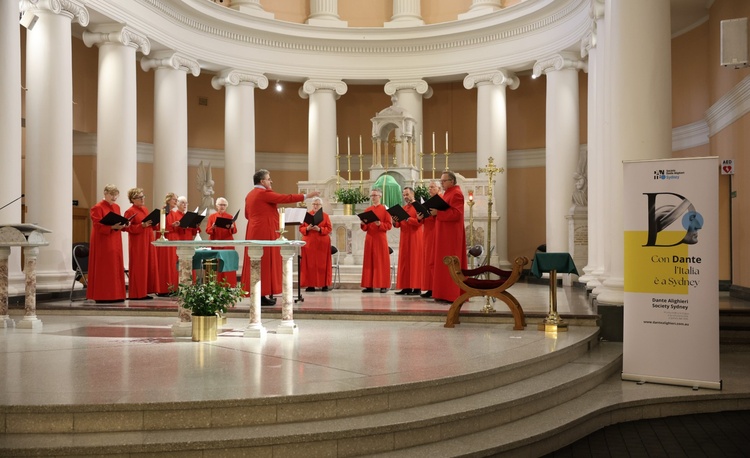
Under the arches of the church, the final notes of the Saint Francis choir gently faded, leaving in the air the feeling that those ancient words, born eight centuries ago, continue to speak to each one of us in the timeless language of gratitude.