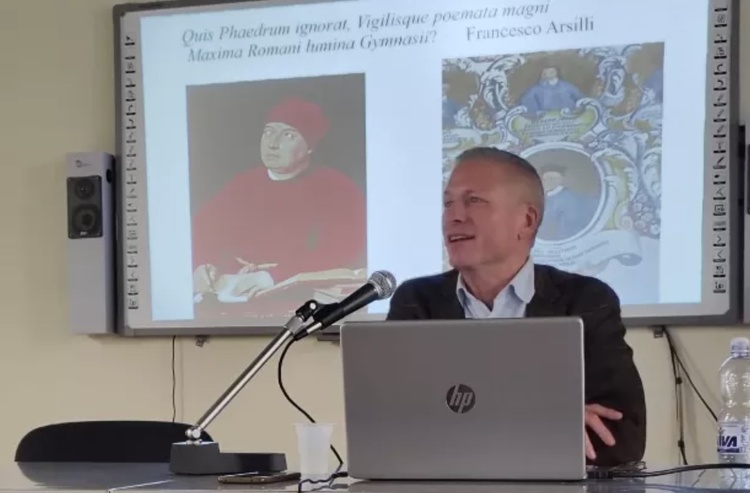
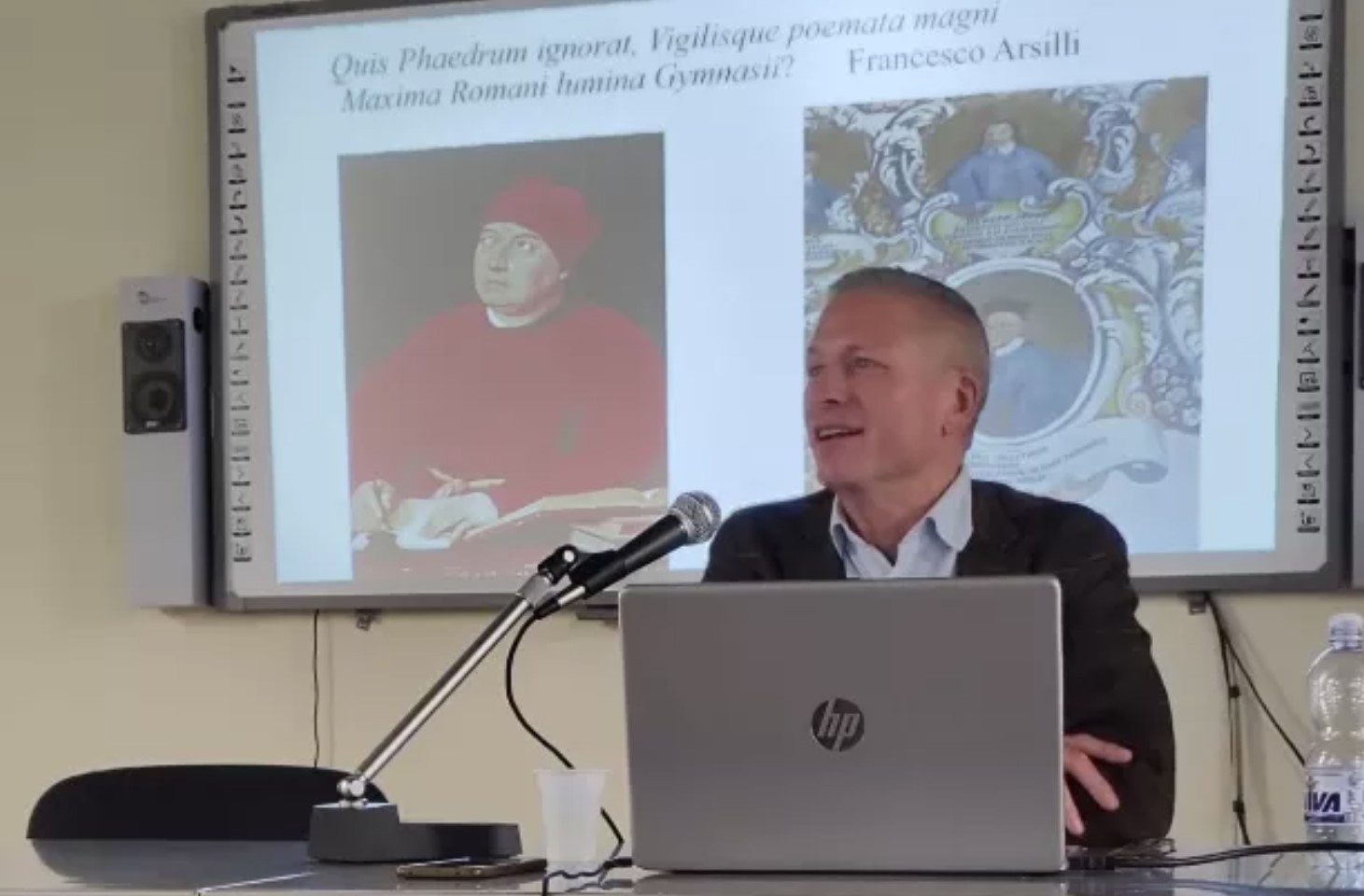
This time, our conversation took a different turn. We weren’t talking about Dante or Petrarch, nor about Lokaj’s scholarly work. Instead, the invitation was for Lokaj to tell his personal story and speak about his experience as an Australian who has chosen Italy as his new home.
Born in Melbourne, the third of four children, Lokaj has a family history deeply intertwined with the events of the 20th century. “My father was Polish,” he shares, “After the German invasion of Poland, he was forced as a teenager to move to Germany due to the Germanisation program imposed on Slavic populations.
“At seventeen, he enlisted in the American army and was sent to Italy, near Naples.” It was there that Lokaj’s father made a life-changing decision: “He heard about a ship bound for Australia and boarded it.”
In Australia, his father met Lokaj’s mother, who was of British and Irish descent, and together they built a family.
After finishing high school, the young Lokaj enrolled in Electronic Engineering, following what seemed the “right” path in Australian society at the time. “The better you were at school, the more you were pushed toward careers like medicine, engineering or law,” he explains, “Humanities weren’t even considered an option.”
But on his very first day of class, Lokaj realised he’d chosen the wrong path. After a year, he radically changed direction, enrolling in Arts and majoring in Italian Studies and Psychology. It was a decision that would mark the beginning of his deep and passionate relationship with the Italian language and culture.
The first day of his Italian literature class proved to be a turning point. “I was placed in the absolute beginners’ group,” he recalls, “I was perhaps the least inexperienced because I’d studied classical guitar and knew words like adagio, fortissimo and pianoforte ... but I had no idea what ciao meant.” When the professor handed out photocopies of Dante’s Commedia and asked him to read aloud, it was love at first sight: “That was the beginning of a love affair with Italian literature that has never ended.”
Lokaj completed his degree with a thesis on the dialect of Pisa. At that point, thanks to advice from some of his professors, he learned about scholarships offered by Italy’s Foreign Ministry for foreign students. He decided to apply, but months went by without any news. Only at the end of his studies did a call from the Italian Consulate in Canberra inform him that he’d been awarded a nine-month scholarship to study in Italy.
He could choose between La Sapienza University in Rome, the Scuola Normale Superiore in Pisa or the University for Foreigners in Perugia. He chose Perugia, aware he still needed to strengthen his language skills. “It was the best choice I could have made. I immediately felt welcomed, supported and immersed in a stimulating and open environment,” he says. But by the end of those nine months, the idea of returning to Australia had faded away; Italy had become his new home.
Lokaj found a job at a private language school that handled the paperwork for his work permit. He enrolled back at university and completed a second Arts degree, rented an apartment, bought a car, was hired as an English language lecturer and began a life fully integrated into Italian society. “Around that time, I applied for Italian citizenship, which I’ve now held for over twenty years,” he reveals.
From there, his academic career continued steadily, marked by publications, conferences and collaborations with universities in Italy and abroad. In 1998, he began a PhD at the University of Edinburgh, but never completely moved to Scotland. Instead, he kept his residence in Spoleto, where he had purchased and begun restoring a 14th-century tower, now both his home and a national monument. “For three years, I lived between Italy and Scotland,” he explains, “I was managing renovation works at home, teaching in Perugia, conducting research in Rome and once a month flying to London and then taking the train to Edinburgh. It was an intense life.” After earning his PhD, Lokaj secured a temporary lectureship in Edinburgh.
A pivotal moment in his journey was meeting the great philologist Giorgio Brugnoli in Assisi, at a conference organised by Accademia Properziana. “I presented a paper on Franciscan themes in Petrarch, which also tied into my PhD research,” Lokaj recalls, “That’s when I met Brugnoli, who became my mentor. Although I wasn’t his student at university, we developed a deep collaboration.” Thanks to the Roman philological school to which Brugnoli belonged, Lokaj gained access to high-level academic networks, scholarly journals and prestigious conferences that still play a role in his career today.
In 2012, he became the first foreign associate professor in the field of Italian Philology. In 2017, he was appointed associate professor at the Kore University of Enna, where, in 2023, he attained a full professorship in Italian Literary Philology. “I’m very satisfied with the choices I’ve made,” he says, “I’ve been able to do what I love, and I still do. But I have to be honest; without that scholarship, I don’t think I would have made it. Coming from a family with four children and only one income, I would never have had the means to attempt such an experience.”
When he’s not lecturing or attending conferences, Professor Lokaj enjoys a quiet, modest life. He loves cooking for friends, spending time at home and surrounding himself with loved ones. A simple life (on the surface), but one built on an extraordinary journey. A journey linking Melbourne to Perugia, Spoleto, Rome and Edinburgh through music, literature and an enduring passion for the Italian language. A story that, perhaps more than most, exemplifies what it truly means to be one of the new “Australians of Italy”.