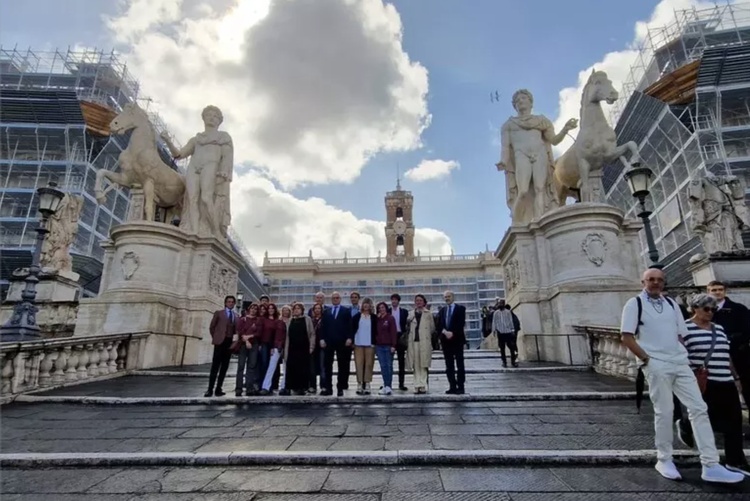

Saluting the return of the sons of Jupiter and Leda, Capitoline superintendent Claudio Parisi Presicce explained that, “One is mortal and the other human, they exchanged their nature every six months and are therefore the symbol of fraternal harmony.”
“And this Hill is the symbol of welcome,” she added.
Rome Mayor Robero Gualtieri said this message was “fully in line with the Jubilee year”.
“A demanding intervention,” continued Gualtieri, “carried out in a short time that gives us wonders and anticipates the restoration of the facades of the square.
“Now the Dioscuri will be able to welcome those who climb the cordonata (the steps up from the street near Piazza Venezia) in the best way.”
The huge statues have a fascinating history, starting from their dating which is believed to be around the middle of the second century, at the beginning of the Age of the Antonines.
They can be linked to the double succession of Hadrian and Lucius Verus to their adoptive father Antoninus Pius.
They were found between 1561 and 1565 in the area of the Circo Flaminio (today between the Theatre of Marcellus and via Arenula, not far from the Campidoglio) where the Temple of Castores stood and were already the subject of a twenty-year restoration that involved numerous sculptors.
This is also evidenced, among other things, by the materials. The statues are made of mostly precious Pentelic marble and Carrara marble.
This, the superintendent explained, made the restoration work of the two colossi even more complex, as they have been exposed to smog and bad weather. The last cleaning was in 2006.
The intervention concluded on Friday cost 270,000 euros and is part of the Caput Mundi program - the ‘jubilee’ tranche of Italy’s National Recovery and Resilience Plan.
Rome has another two iconic statues of the Dioscuri, in concrete, outside the Quirinale presidential palace. These statues have stood there since it was the home of popes during the Renaissance and are even bigger than the colossi on the Campidoglio.
ANSA