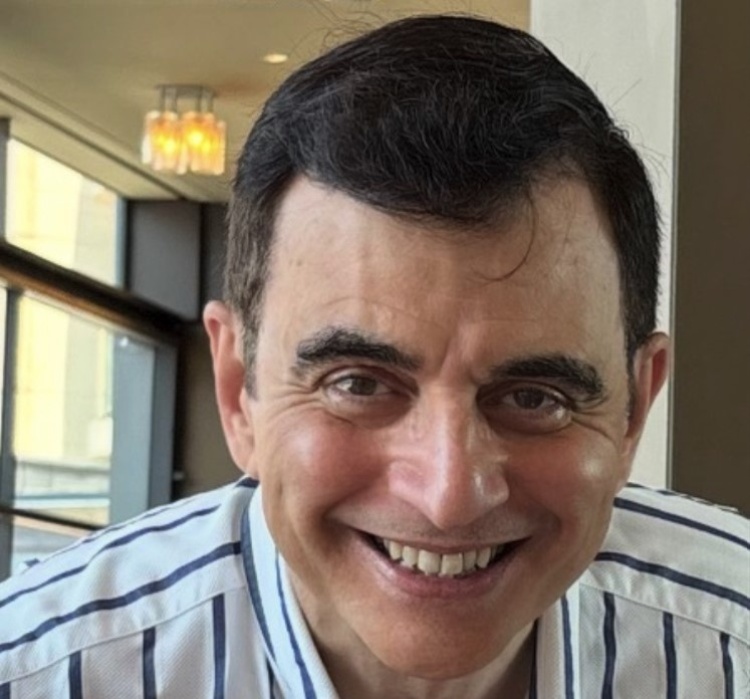
Professor Andrew Sindone chose to dedicate his career to that very frontier, where medicine once had few tools and many unanswered questions.
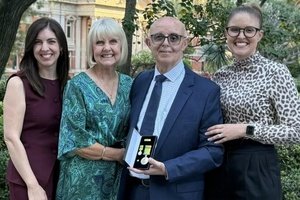
Nearly 40 years on, after a lifetime spent between hospital wards, research labs and the training of new generations of specialists, the Director of the Heart Failure Unit at Concord Hospital and Head of Cardiology at Ryde Hospital has been appointed a Member of the Order of Australia (AM) for his outstanding contribution to cardiology and cardiovascular research.
“The heart is everything,” he says. “Without it, you don’t live. When I finished medical school and had to choose a specialty, I had no doubts. I wanted to do something that genuinely changed people’s lives.”
Sindone was born in Australia, but his story reflects that of many Italian families who arrived in the post-war years. His father left Milazzo, in Sicily, at just 16, travelling alone.
“There was no work,” Sindone recalls. “The Australian government offered twenty pounds to come here.”
Like many young migrants, his father’s first stop was a boarding house in Leichhardt, followed by years of hard labour, sacrifice and determination. His mother also had Italian roots, from Stromboli in the Aeolian Islands, while his maternal grandfather arrived in Australia before World War II and was interned because of his Italian background.
Andrew grew up between Leichhardt and Gladesville, in an Australia very different from today. Even his name became an issue. “My real name is Andrea, but in the 1960s having an Italian name wasn’t always easy. So I became Andrew,” he reveals.
After completing his medical degree with first class honours and a University Medal at the University of Newcastle, Sindone trained at Royal North Shore Hospital before returning to Concord Hospital, where he built much of his career.
He later completed his cardiology training at St Vincent’s Hospital, working closely with the heart transplant unit, where many patients were suffering from severe heart failure.
It was during those years that he realised how urgently perspectives needed to change. “At a conference, someone said that if you had heart failure there wasn’t much we could do,” he recalls, “At the time, outcomes were worse than for many cancers.”
That sense of fatalism convinced him to focus on heart failure and to bring hope where little seemed to exist.
One of his most significant contributions came during his PhD. At the time, patients with heart failure were advised to only rest. No exertion, no movement—complete passivity.
“Exercise was thought to be dangerous,” Sindone explains, “We showed that, on the contrary, it can make an enormous difference.”
Together with his team, Sindone introduced structured exercise programs, demonstrating that physical activity could improve quality of life and help patients return to everyday functioning. Today, he notes, “Rehabilitation and exercise are integral parts of treatment.”
Over the years, he has also led studies on intravenous therapies to temporarily support the heart in critically ill patients awaiting transplant, helping identify which drugs were most effective.
The results of this shift are tangible. “Compared even to 2013, we can now give, on average, an extra eight and a half years of life to a patient diagnosed at 55,” he says.
For Sindone, medicine has never been his only pursuit; teaching has been central to his mission.
“I can help one patient in my clinic,” he says, “But if I teach a doctor, that doctor will help hundreds.”
Sindone has delivered more than a thousand lectures to specialists and GPs and has directly trained over 100 cardiologists in his clinic.
In 2001, with government funding, he helped introduce a dedicated heart-failure nurse in every hospital across New South Wales, reducing 30-day readmission rates from 29 per cent to 17 per cent.
Today, he advises the NSW Government and chairs committees focused on improving care and preventing unnecessary hospitalisations.
He remains particularly concerned about vulnerable groups: people with lower socio-economic status, Indigenous Australians, those who struggle to understand diagnoses and treatment plans, culturally and linguistically diverse communities, and patients living in rural and regional areas, where outcomes are often worse than in cities.
Sindone is one of the few cardiologists of Italian background in Sydney and conducts around a third of his consultations in Italian. For many elderly patients, language is not a minor detail—it fosters trust, understanding and the ability to navigate a complex health system.
His own family remains closely tied to their Italian heritage: his wife’s family is from Basilicata, and his son, now a doctor, is following in his footsteps, training to become a cardiologist.
To the Italian community, Sindone speaks plainly. “Here in Australia, many Italians tend to be more overweight than those living in Italy today,” he observes.
Changing habits are often to blame: larger portions, daily sweets and a diet that has drifted away from the Mediterranean model.
His message is one of prevention—monitoring blood pressure and cholesterol, staying active, quitting smoking and not ignoring symptoms such as shortness of breath, fatigue or swollen legs.
“If even one person decides to get checked before it’s too late, then it’s been worth it,” he says.
That same principle has guided his entire career in the public health system. “I don’t work in private practice because I believe people should be treated the same, regardless of income,” he explains.
It’s a philosophy that defines his work: healthcare as a right, not a privilege.
And perhaps that is the true measure of Andrew Sindone’s journey—a doctor who has remained close to his community and is committed to reminding us that the heart is not just an organ to be treated, but the quiet engine that keeps us alive.