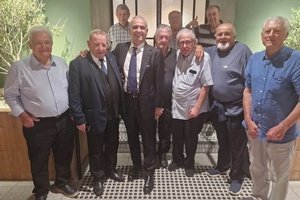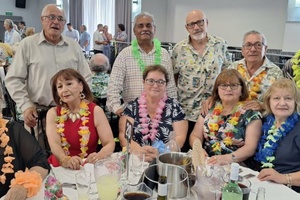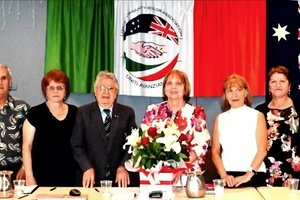
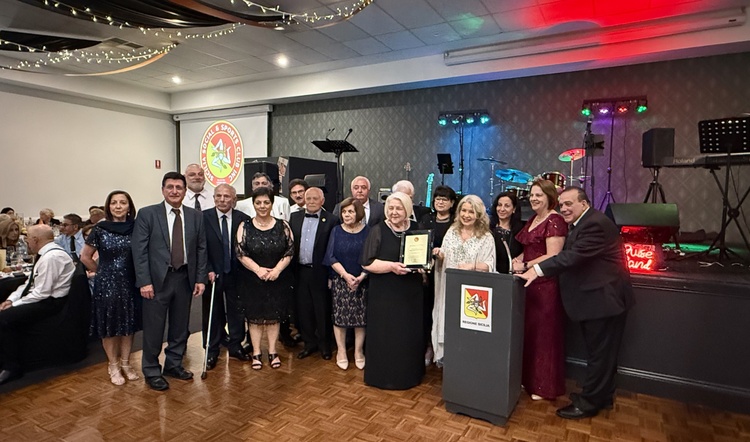
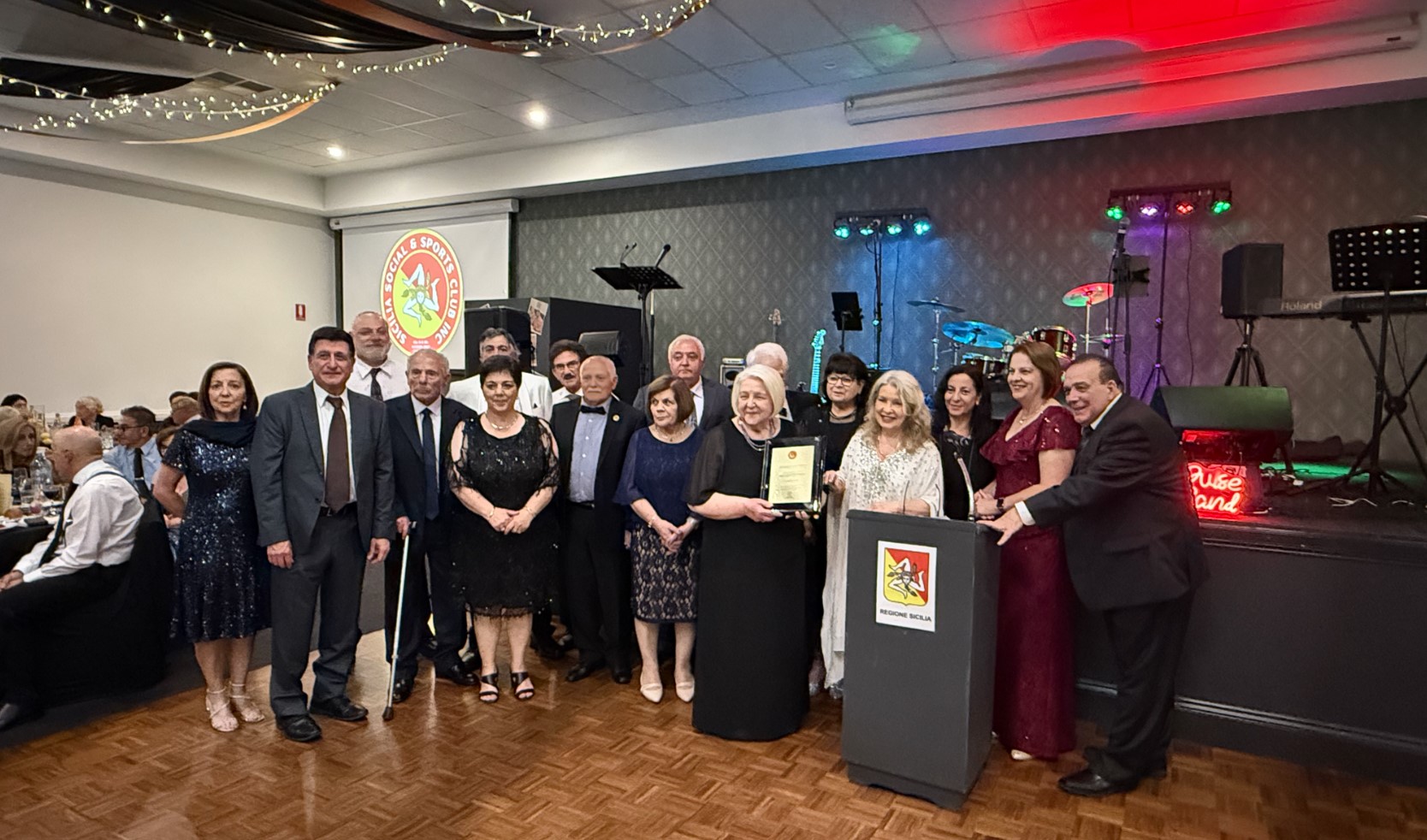
As in previous years, the event was sold out. The band Friends kept the dance floor lively, while Rose Senesi hosted the evening as MC.
In her opening address, president Rita Bianca Palumbo warmly welcomed guests, inviting them to retrace the club’s history together: “As we gather today to celebrate the 50th anniversary of our beloved club, I invite you to take a journey back in time with me. We are here primarily to honour the vision of a group of paesani who dared to dream big.”
Everything began on a hot New Year’s Day in 1973, when Gino Carubia—“a kind soul deeply in love with his Sicilian roots”—was sitting on the veranda of his home in Unley, beer in hand, letting his thoughts wander back to his homeland: its culture, its food and, above all, its family traditions.
It was then that the idea was born to create a space where Adelaide’s Sicilian community could come together and share their stories.
Realising he could not bring this project to life alone, Gino turned to his friend Frank Augello, who immediately embraced the vision with enthusiasm. Together, they involved other fellow Sicilians who shared the same dream.
At first, it was a shared passion for bocce that brought them together, but they soon recognised the need to involve families as well.
During a lively meeting, they decided to organise an event combining dancing and good food—a perfect embodiment of the Sicilian spirit of conviviality.
Despite logistical challenges—finding a venue and sourcing equipment—they managed to organise the first dinner dance towards the end of 1973. The success was such that the following year, the baton was passed to Leonardo Carubia and Biagio Barbaro.
In 1975, a meeting held at Gino’s home led to the decision to establish an official committee and club, which later became the Siculo Club.
Even with a clear plan, challenges remained: purchasing crockery and cutlery and managing logistics proved demanding. In 1978, under the leadership of Angelo Dilena, the general meeting approved a proposal to change the club’s name to Sicilia Social Club.
At the same time, Angelo enlisted lawyer Roberto Chiro to draft the constitution, a fundamental step that gave new momentum to the association.
As the group grew, the need for a suitable meeting place became evident. It was decided that each family would store part of the shared equipment at home, but costs continued to pose a challenge. To address this, in 1980 the first women’s subcommittee was formed, tasked with fundraising through fashion parades, picnics and various events.
Gino and Leonardo also sought donations, often small but invaluable. “Their determined, community-focused approach laid the foundations for lasting success,” the president recalled.
After years spent in rented premises, the committee recognised the need to purchase a property that would attract more members.
Fortune smiled when a property became available in Camden Park: thanks to collective efforts, they were able to purchase it, strengthening the club’s identity and stability.
In 1981, a folk-dance group was established, remaining active until 1995, and a youth group was also formed. At the same time, there was a growing sense that an iconic symbol of Sicilian culture was missing: the carretto.
A subcommittee sourced a cart and horse from a local farmer and began a careful restoration. With ornaments imported from Sicily and the collaboration of Alessandro Barrocchi, the cart became an authentic Sicilian carretto, now displayed at the club’s entrance.
Over the years, the Sicilia Club took part in numerous festivals and parades, including the Berri Festival, the Italian Festival, the Glenelg & Norwood Pageant Parade and the Australian Formula 1 Grand Prix.
As its reputation grew, so did the need for a larger space. The opportunity came with vacant land in Klemzig: after complex negotiations, construction began in 1990, carried out by Ralph Brianni Constructions.
The first event in the new venue was a wedding—a fitting symbol of a new beginning.
Rita Bianca Palumbo also recalled the origins of the MetroStars soccer club, which emerged from the Sicilia Club, at a time when the association expanded its identity by adding “Sports” to its name, becoming the Sicilia Social and Sports Club Inc.
In closing, the president paid tribute to “the visionary spirit of Gino and Frank”, to the ancestors who left Sicily in search of a better future, and to past and present committees who, through their dedication, have enriched not only the Sicilian community but the wider one as well.
She thanked sponsors—in particular Galipo Food Company—volunteers, families, friends, kitchen and floor staff, and all those in attendance. Special thanks were extended to Michael Liapis for the excellent dinner.
During the evening, individuals who made an outstanding contribution to the life of the club were honoured with certificates of recognition: Sebastian and Bill Galipo, Luciano De Palma, Gus Carubia, Sam Castello, Ralph Brianni, Basilia Ficcadenti, Pietrina Costanzo and Josie Ciano—“who bravely took on the task of running the kitchen despite having no experience”— treasurer and head of bar and events Marco Ciano, and finally the behind-the-scenes team: Maria, Erasmo, Grazia, Pam, Jack, Anna and Fedele.
Greetings were also delivered by the Hon. Dana Wortley and Vince Tarzia, the Italian Consul in Adelaide Ernesto Pianelli, Senator Francesco Giacobbe and Comm. Mariangela Stagnitti, who read messages of congratulations from Salvatore Augello, president of CARSE, and Giuseppe Cannata, Regional Councillor for Emigration for the Sicilian Region.
The evening concluded with music, dancing and an atmosphere of great joy.