The first race, known as the “Palio di Provenzano” occurs on July 2 in honour of the Madonna of Provenzano, a painting once owned by the Sienese Captain Provenzano Salvani, which was believed to have possessed a miraculous curative power.
The second race, named the “Palio dell’Assunta” unfolds on August 16 in celebration of the “Madonna dell'Assunta", the patroness and Advocate of Siena who protected the Sienese military against the Florentines at the epic battle of Montaperti on September 4, 1260.
The August race was only introduced in 1701, and was initially run intermittently as opposed to annually. The origins of the second race are tied to the Feast of the Assumption, and the event was most likely spontaneously introduced as an occasional celebration of this festive period.
August 16 was chosen as the date of the race, because August 14 resembles the “Corteo dei Ceri” (Procession of the Candles), while August 15 was reserved for the census.
The second race was originally run by the victorious district of the July competition, given the district could afford it, until 1802 when the event became funded and executed by the city.
Extra "Palii" have been known to occur between May and September in celebration of exceptional occasions, such as in 2000, when the city organised a race to commemorate the beginning of a new century.
“Il Palio”, as it is often referred to, has medieval origins dating back to the sixteenth century.
The city’s main piazza once showcased myriad public games, mostly combative in nature, including the “Giuoco delle Pugna” (a many-sided boxing brawl), jousting and bullfights.
In 1590, the Grand Duke of Tuscany banned bullfighting, leaving a void in the cultural fibre of the society.
It was then that the districts of Siena banded together to organise races, starting with “bufalate” (buffalo races) and “asinate” (donkey races).
Eventually horse racing was introduced and the first modern Palio took place on August 16, 1656.
The longstanding tradition is still celebrated in medieval spirits today, and an historical two-hour pageant, called the “Corteo Storico” takes place before each race.
Over 600 people dressed in medieval outfits parade the city’s streets, and the districts are proudly adorned with their colours, flags and emblems.
During the spectacle, “Alfieri” (flag wavers) take centre stage before a police squad dressed in medieval attire rides on horseback, wielding swords and demonstrating a mounted charge around the track.
The mounted police walk the first lap of the track, before breaking into a gallop for the second lap as a symbol of the anticipation and excitement in the lead-up to the main event.
The festivities bring the whole community together, as locals celebrate their origins and a pride in their district, while tourists pack into the Campo to witness the legendary ritual.
In the days before the event many other traditions unfold, such as the rehearsal dinner, the “mass” for the jockeys, and the blessing ceremony of the horse by its district.
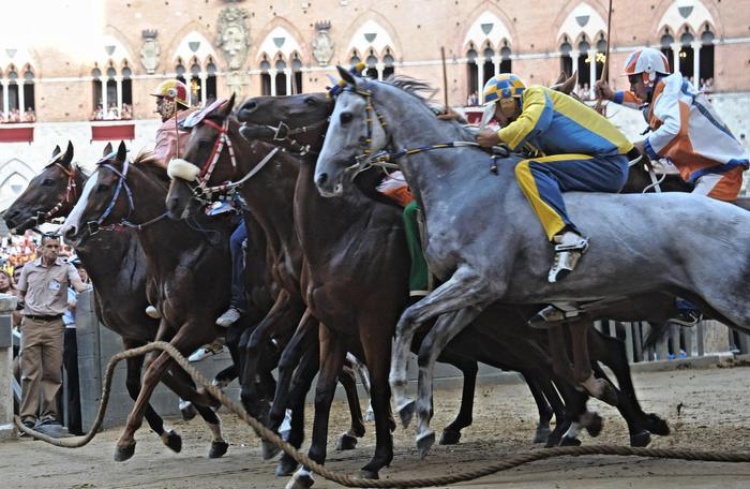
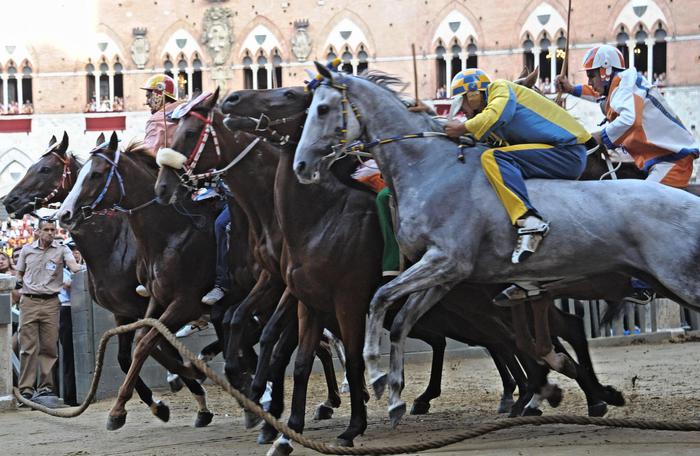
During the race, ten horses, none of them purebred, are ridden bareback by ten jockeys dressed in the colours of the represented district.
While there are seventeen “contrade”, or districts of Siena, only ten participate in the race due to the large amounts of incidents that occur and the dangerous nature of the course.
In fact, it is common for jockeys to fall from their horses along the tight corners of treacherous track, and often horses cross the finish line without their riders.
The race is won by the horses that represent the districts, not the riders, therefore a horse can win the race even if it finishes unmounted.
Both jockeys and horses have been injured and killed during the races, a controversial issue in modern times.
The 17 districts of Siena are Eagle, Snail, Wave, Panther, Forest, Tortoise, Owl, Unicorn, Shell, Tower, Ram, Caterpillar, Dragon, Giraffe, Porcupine, She-Wolf, and Goose.
The ten competitors are chosen first with precision, and then by chance. Firstly, the seven districts which missed out on the same race of the previous year are automatically entered into the race. The three extra districts are determined by a lottery.
Before the race nine of the horses, drawn from a lottery, enter the Campo and move to the starting line, while the tenth horse, called “la rincorsa”, waits outside.
When the tenth horse enters the Campo, the “mossiere” (starter), drops the rope to signify the beginning of the race.
While the race lasts barely more than a minute, the atmosphere is teeming with intensity as the competitors embark on the dangerously steep and windy course.
The winner of the race is awarded the “Palio”, a silk banner which is hand-painted by a different artist each year.
Celebrations endure for months within the victorious district.
The Palio is unique in the sense that it revolves around the pride and passion of different districts, while the objective is not to win, but to prevent other competitors from winning.
Riders push and shove one another, and use their whips not only to spur their own horses on, but to disturb their opponents and other horses. There are virtually no boundaries.
The most successful district to date is “Oca” (Goose), which has won an impressive 63 races over the years.
The most victorious jockey is Andrea Degortes, also known as “Aceto”, who took the title 14 times between 1964 and 1996, while the horses Folco and Panezio are renowned for winning eight times each.
Since its inception, only two districts have ever won both races within the same year, being “Tartuca” (Tortoise) in 1933 and “Giraffa” (Giraffe) in 1997.