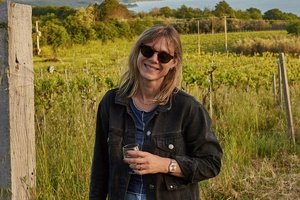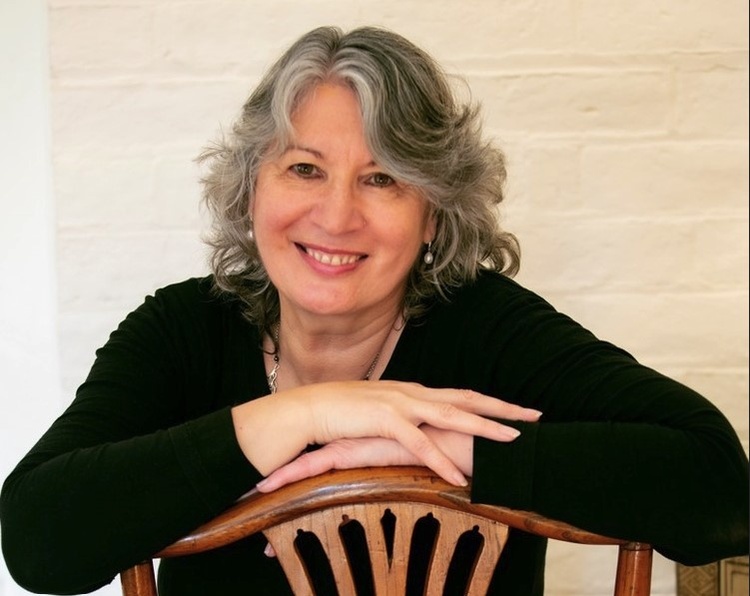
The title itself, Cleaved, is a perfect oxymoron, a word meaning both “split apart” and “joined together”. It signifies both rupture and connection, much like Cafarella’s own life. A journalist, playwright, cartoonist and well-known figure in Australian media for her sharp columns, she also carries another story behind her public persona.
Behind the printed pages stands another Jane: a woman who grew up with a leg affected by congenital lymphedema; a daughter caught in a family war between a Sicilian father and an Anglican mother; a sister separated far too soon from her other half.
The event was introduced by Paolo Baracchi, Director of Co.As.It.’s Cultural Program.
“We’re delighted to welcome Jane Cafarella to our program,” he announced, “Today’s theme, From Cultural Alienation to Connection, reflects the very heart of our mission: to reconnect with our roots, but also to generate new culture.”
Joining Cafarella on stage was Caroline Bond OAM, a consumer rights activist who led the post-presentation discussion and delved into the author’s memories and the core of her book.
The story reaches back to the 1920s, when Angelina Taranto, Cafarella’s paternal grandmother, left the island of Salina in the Aeolian archipelago for Sydney. Among the many significant episodes in this family journey, one especially captured the audience’s attention.
When young Angelina arrived in Australia, she was barely educated. One day, her father sent her to church. She followed his directions and ended up in an unfamiliar building, where a woman handed her a sacred book. She couldn’t read it or understand what was happening. The following week, she went back with her cousin, who took her somewhere else entirely, meaning she’d gone to the wrong church.
“But what did I know of different churches?” she would later say, laughing at her own ignorance and bewildered by Australia’s religious diversity.
“In Italy, there was only one religion,” said Nonna Angelina. That initial confusion would foreshadow the cultural divide that shaped the family’s future.
Cafarella was born in 1957. Premature and sickly, she was “claimed” by her mother, while her older sister Julie (“Giuliana” to their Italian dad) was emotionally bound to their father. Two parents from completely different cultures. Two daughters. Two destinies.
“I cleaved you to me,” Cafarella’s mother often said, a phrase meaning both “I held you close” and, ironically, “I cut you off”. The sisters grew apart, like rivals in a cold war.
The fracture deepened when Cafarella’s father Frank, the son of Sicilian immigrants, divorced her mother and soon after married her mother’s sister. From that point on, Cafarella’s paternal family vanished from her life. The two sisters were physically and emotionally severed.
And then there was “the big leg”, as her mother called it. It was, at the time, a mysterious condition which was eventually diagnosed as Milroy’s disease, a rare form of congenital lymphedema.
“I’ve never been normal,” says Cafarella today with a smile, but also with the self-awareness of someone who has turned her difference into a captivating story.
The pivotal moment came after the death of her mother’s second husband. Among the inherited documents, Cafarella found letters, notes and photographs, long-buried truths and long-withheld explanations. The puzzle pieces finally began to fit.
“I wanted to write a book about my father’s terrible infidelity,” the author admits. “Instead, I discovered a much larger, more complex story. Full of omissions, but also full of love.”
A visit to Melbourne’s Italian Museum in Carlton in 2016 brought another revelation: an archival interview with her grandmother Angelina, speaking fluent Italian, a language Cafarella had never heard her use.
“Learning my grandparents’ story shattered many certainties. Understanding them helped me understand myself,” she explained.
But the most moving chapter is Cafarella’s reunion with her sister Julie after twenty years of silence.
“[My sister] looked at me and said, ‘They took the wrong one. You’re just like Dad.’ And now I know it’s true. We’re complementary, but different. In many ways, she’s our mother and I’m our father.”
Cleaved becomes a map of the soul, an emotional treasure hunt, a family saga blending memoir, historical investigation and confession. There’s no bitterness, only understanding. No rage, only compassion.
“For a long time, I belonged nowhere,” says the author, “Now I do. My place is here, with all of you. With those who, like me, are Italian on the inside, even if it took me a lifetime to discover it.”
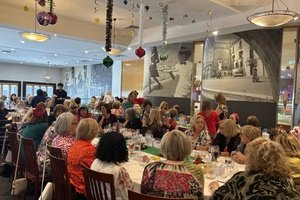
The audience at Co.As.It., students, the children of migrants, writers and educators, listened in silence. Because ultimately, Cafarella’s story is the story of many; of those who lost something along the journey, of those still seeking home in a shattered mirror.
“When we ask someone, ‘Who are you?’, we’re really asking, ‘Where do you feel at home?’” says Cafarella. With Cleaved, she shows us that the answer is never simple, but always worth seeking.