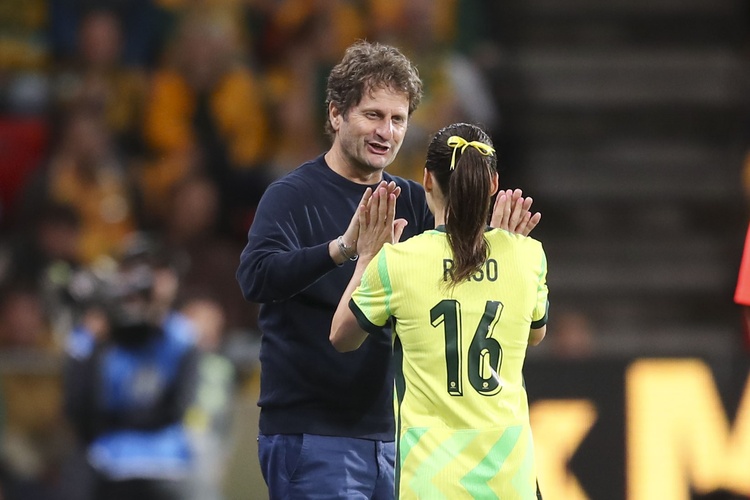

A proud Italian-Australian, Montemurro admits the weight of expectation hit him immediately. This was not a club role, where attention can be intense but contained. This was the national team: a symbol, a movement and a source of pride for an entire country.
“There was a little bit of an inferiority complex at the start,” he said when interviewed on Rete Italia.
“You realise very quickly this is the whole nation expecting something from you. But pressure is the reward for working at the top level. You have to accept it with empathy, respect and honesty.”
That pressure, Montemurro believes, is inseparable from the Matildas’ standing in the global game. Australia’s women are no longer an underdog story. They are a proven force, a team that went deep at a home World Cup and now carries the expectation of sustained success.
His task is not simply to win games, but to elevate the team’s football identity.
“I want us to bring an exciting brand of football that can stand up at world level,” he continued. “I want the players to express themselves, to be who they are. We have top players competing all over the world—they should feel free to show that.”
One of Montemurro’s first priorities was to simplify the environment around the team.
Modern elite footballers operate in a constant swirl of noise: social media, commercial commitments, agents and external expectations. While some of that is unavoidable, Montemurro believes clarity is essential.
“The biggest thing for me was to bring it back to football,” he explained. “[And to] be very clear about how we want to play, what our principles are and what our game model looks like. Once that’s clear, everything else becomes secondary.”
Those early discussions with players focused on style, structure and belief—building a shared understanding of how the Matildas can consistently compete with the best teams in the world.
Montemurro is acutely aware that the Matildas’ influence stretches far beyond results.
He sees players like Sam Kerr, Steph Catley and Ellie Carpenter as cultural leaders as much as footballers, whose impact is visible in packed stadiums and replica jerseys worn by boys and girls alike.
“But it still has to excite,” he added. “Every time people come to watch the Matildas, it should feel like an event. There should be theatre, beautiful football and a reason for fans to come back.”
Success, Montemurro acknowledges, is still the ultimate benchmark.
The World Cup run proved this group can perform under pressure, and with an Asian Cup on the horizon, belief within the squad is growing.
“The players know they can do it,” he said. “They’ve shown they can compete deep into tournaments. We’ve put in some clear ideas and language, and there’s real excitement around where we can go.”
Tournament football, he added, is about preparation as much as talent.
“We spend a lot of time on what we can control,” Montemurro revealed. “Different scenarios: extra time, going a player down, managing momentum—pressure is part of the job, but preparation gives you insurance.”
Montemurro’s global experience gives him a clear view of how the women’s game is evolving.
European leagues and competitions like the Champions League have dramatically expanded opportunities for elite players, offering more choice than ever before.
“The US [league] is still very strong, but the reality is there are now multiple pathways,” he said. “For female footballers, it’s an exciting time. There are more competitions, more high-level environments and more chances to be part of something special.”
While data and statistics are now central to elite performance, Montemurro warns they don’t tell the full story. His Matildas have adopted a simple internal principle: selflessness—something that can’t be measured.
“It’s doing something for someone else without asking for anything back,” he said. “The run that drags a defender away, the option that opens space for a better pass—those things don’t always show up in the numbers, but they win games.”
Having coached at Arsenal and Juventus, Montemurro understands the difference between club and international football.
At club level, daily contact allows issues to be resolved quickly. With a national team, communication and continuity require creativity.
“The real work isn’t game day,” he pointed out. “It’s when players are away from camp. You have to keep educating, reinforcing the language and making sure the messages continue.”
Those club experiences also shaped his philosophy. At Arsenal, he reconnected the team with its identity—proactive, expressive football. At Juventus, he absorbed a culture built on expectation and winning.
“Juventus is about values, identity and dominance,” he explained. “My role there was to take that mentality into Europe and make it sustainable.”
Under his guidance, Juventus rose into the UEFA top 10, a leap that brought credibility, talent and financial stability through Champions League qualification.
During the interview, Montemurro bristled at suggestions the Matildas are an ageing team.
“In modern football, late 20s and early 30s is often your prime,” he said. “These players are competing at the highest level in Europe. The national team should always be about selecting the best available players.”
At the same time, he is excited by the next generation already emerging.
“We’ve got an outstanding group coming through,” he revealed, naming Ellie Carpenter, Amy Sayer and Winona Heatley among those poised to shape the future.
One of his biggest achievements so far, he believes, has been mapping Australia’s full depth chart—from the senior team through to the under-20s and under-17s—to ensure continuity and resilience.
“That pathway has to stay healthy,” he stated strongly. “Bridging the gaps between age groups is the next challenge.”
Ultimately, Montemurro sees his role as bigger than silverware.
“Winning is fundamental—that’s what we’re here for,” he admitted. “But I also want to leave things better than I found them.
“[I want to create] a culture people want to be part of—a team that influences the next generation.”
For him, the vision is clear: a Matildas side that controls games, keeps the ball, competes with the world’s best and still reflects Australia’s unique sporting identity.
“We’re resilient, physical and competitive,” he said. “That should be layered on top of world-class football principles.”
If Montemurro gets it right, a nation that has already fallen in love with the Matildas will be in for a treat.