Jovanotti will perform in Brisbane on March 5 at the Queensland Performing Arts Centre and in Adelaide on March 6 as part of the WOMAD Festival, one of the world’s leading events for global music.
The musician was interviewed via video link from his home in Cortona, while Benedetta Ferrara and Marco Patavino were in the Rete Italia studios.
He mentioned that his niece had just been born and was named Adelaide—a coincidence that made him smile.
The conversation quickly turned to mindset, curiosity and music as something that’s always changing.
“I don’t know comfort zones,” he reveals casually. “It’s not that I don’t like them—I just don’t know them.”
For Jovanotti, that mindset isn’t a performance—it’s how he works. He explained that he didn’t start out as a traditional singer, but as a DJ, with “the instinct to search for things and mix them in the most natural way possible”.
“My research as an artist doesn’t come from vocal talent,” he says, “but from a way of looking at things—a point of view.”
Jovanotti describes himself as someone who moves on on once something has been explored properly.
“I see myself more as a tourist than a traveller,” he adds, “but still someone who goes around, looks and feels things on their skin.”
That same approach shaped his latest album, Niuiorcherubini, which he says came about organically.
“I went to New York to record some ideas, but it wasn’t meant to become an album,” he explains.
“I wanted to write songs. Sometimes I write in jam sessions—I surround myself with two or three musicians and, always starting from the lyrics, I adapt the words to the music happening around me.” While he was there, the project took on its own identity.
He also revealed he’d been feeling worn down by how dominant music made with software and artificial intelligence has become, and wanted to return to something more tangible, like musicians in a room, playing live.
Initially, Universal didn’t want to release the album—something he now laughs about. “I told them, ‘I’ll release it myself,’” he recalls. Only then did the label come around.
The interview also touched on the current global mood, and how that too shaped the album.
“Like many people, I was feeling discouraged and powerless,” he says, “watching this moment we’re all living through—a resurgence of war, violence tied to weapons. It scares me. It makes me feel powerless as a citizen.”
Asked what an artist can do in that kind of climate, Jovanotti said the answer was simple: go back to what he knows.
“What can I do?” he asked himself. “And I thought, ‘I’ll go back to what I love’, which is music.
“Through music I can give emotions, I can process worries and sadness and transform negative feelings into vital energy.
“My job is to build songs that give hope that make people feel alive,” he continues.
“My answer is naive, but determined: to keep believing in life. To invest in emotions, in hope—even the hope that music can play a small but decisive role in making people feel united.”
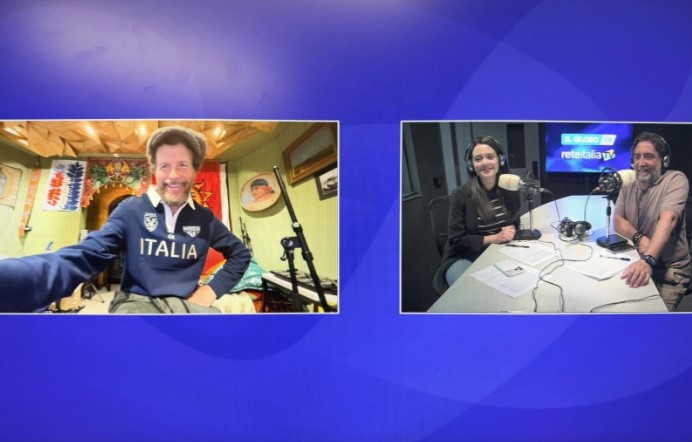
Jovanotti at his home in Cortona during the interview with Marco Patavino and Benedetta Ferrara
Whether he’s playing to a huge crowd or a small room, Jovanotti says the goal is always the same.
“For me, there’s not much difference,” he says. “I’m always looking for a connection with whoever is in front of me—in a bar, a stadium, even in a hospital corridor.”
After touring Italy with PalaJova and performing for huge crowds, he’s looking forward to the smaller scale of Australia.
“I’ve just finished a tour with more than 600,000 people,” he says of the tour that marked his return to live shows after the Jova Beach Party era.
“So, I feel relieved, curious and happy to come and play for small groups.
I don’t know how many people I’ll find in Brisbane,” he admits. “I don’t know how many at WOMAD in Adelaide already know me, but all of this is extremely stimulating—it’s like going back into a more intimate dimension.”
To explain how he sees live performance, Jovanotti shared a story about Pino Daniele.
In the last years of his life, Daniele could barely see. One night at the San Paolo stadium in Naples, Jovanotti told him, “Pino, tonight there are 50,000 people.”
Daniele replied, “Lorè, whether it’s fifty or 50,000, it makes no difference. I can’t see them.”
For Jovanotti, the point is that performance isn’t really about the size of the crowd.
“A musician plays for something immaterial,” Jovanotti says. “It can be one person or a million, but there’s no difference. Music is a prayer, in the end. And when you pray, you’re alone in front of the immense.”
He also said being part of WOMAD matters to him and linked it back to the old idea of “world music”—but added that the label doesn’t really work anymore.
“Today there is music,” he says. “The idea of an English-speaking dominance doesn’t make sense anymore. Most charts are in local languages.”
He sees that as “one of the positive sides of globalisation”.
The conversation moved naturally into books and creative influences. He referenced the writer Jorge Luis Borges, who said, “Let others boast of the pages they have written; I am proud of the pages I have read.”
Jovanotti brings the same sentiment to his own life: “I’m prouder of the music I’ve listened to than the music I’ve recorded.”
His approach is simple: listen widely, stay curious and follow what connects.
“My main instrument is my ears,” he says. “When something moves me, I feel something light up inside.”
Jovanotti will travel to Australia with a small team from Italy, and wants to involve local musicians like Mirko Guerrini, an Italian saxophonist and multi-instrumentalist who has lived in Melbourne for years.
The setlist will include his biggest hits, along with requests from fans.
“I’m asking on Instagram: send me requests,” he says. “I’ll do it like radio dedications back in the day!
“We’ll make people dance and then we’ll do slow songs—like school parties.”
There will also be room for improvisation across genres like soul, funk, Latin and cumbia.
In the end, that’s what these two Australian dates are about: turning a gig into something shared, where the music does the work.
“It’s the music that guides me,” he says. “And I like it when music moves—in bars, in cars, at parties and weddings.”