MELBOURNE – With the elections fast approaching, last Thursday we had the opportunity to conduct a remote interview with Assistant Minister for Citizenship and Multicultural Affairs, Julian Hill, from the studios of Il Globo TV.
The Albanese government, Hill assured, has always stood by Australia’s ethnic communities in support of multiculturalism which, although recently under scrutiny for various reasons, remains a cornerstone of the country and essential for maintaining a strong and cohesive society.
Emphasising that multiculturalism is harmony and that it is now at risk due to a series of attacks driven by antisemitism and Islamophobia, I asked the assistant minister for his assessment of the state of cultural relations unfolding throughout the country.
Hill responded by acknowledging that, without a doubt, social cohesion is under pressure. “The vast majority of Australians welcome and value and support our cultural diversity,” he said.”
“But it’s true that the global conflict, particularly the war in Gaza, has been weaponised in parts of Australian society.
“The government has tried to focus on supporting Australians impacted by the conflict [by] providing humanitarian assistance and working with the international community to restore peace and [work towards a] two-state solution - a secure Palestinian state living alongside a secure Israeli state.
“Unfortunately, what we’ve seen in Australia is both extremes of politics. The Greens on one hand, and Peter Dutton and the Liberals on the other, recognise this conflict [as an opportunity] to try and chase votes.
“The Attorney General, Mark Dreyfus … whose grandparents were Holocaust survivors, described the Liberal Party’s efforts to weaponise the antisemitism crisis as grotesque. And rightly.”
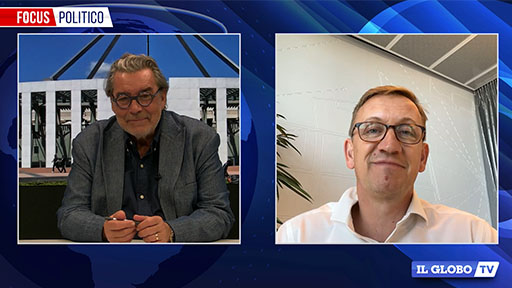
Riccardo Schirru speaking with Julian Hill MP on Il Globo TV
The Albanese government has come under fire for organising a series of citizenship ceremonies right before an election is called, but for Hill, these criticisms are “ridiculous”.
“With respect to [Mayor of Fairfield Frank Carbone] and to the Liberal Party who made some criticisms [regarding] citizenship ceremonies, the criticism is just ridiculous.
“I think we should welcome Australians who want to formalise their commitment to our country.”
Throughout the interview, I repeatedly tried – unsuccessfully - to get Hill to reveal the election date. “Here’s a hot tip,” he responded, “[The election will occur] about 30-40 days after the prime minister announces it.”
Regarding the recent mission to Washington by Treasurer Jim Chalmers, aimed at securing Australia an exemption from tariffs on aluminium and steel imports being considered by the new US administration, the representative for the Victorian seat of Bruce stressed that President Donald Trump has a different approach to global trade rules compared to his predecessor, which is a source of frustration.
“[But we] will always prosecute our national interest and we are a trading nation,” said Hill. “Over 90 per cent of our wealth comes and goes by sea.
“Australia benefits from an open and fair competitive trading system and will continue to advocate that globally in relation to our bilateral trading relationship.
“America has long enjoyed a trade surplus with Australia and we do believe that whatever changes the US makes, that should be taken into account.”
The treasurer is expected to present a budget on March 25, but everything will depend on the election date. If the prime minister decides to go to the polls in April, the budget will be scrapped. If he intends to serve out the full term until May 17, Chalmers will present it.
Sticking with the economy, Hill also sought to debunk the myth that the Coalition is superior to Labor in economic management.
“Since the government was elected [around] three years ago, debt forecasts in this country are nearly $200 billion lower than we inherited from the Liberals,” he said.
“Labor has delivered the first two surplus budgets that the country has seen for nearly 20 years. And it’s that strong budget management that has got inflation down that’s helped the Reserve Bank out in its role with monetary policy to see inflation reduced to around a third [of what] we inherited from the Liberals, and now interest rates are coming down.
“Then in terms of priorities … I’m really proud as a Labor MP at the prime minister’s announcement on the weekend of the largest single investment in Australia’s Medicare system in its entire history, to restore the promise of GP bulk billing at the heart of Medicare.”
With billions in funding allocated to Victoria and the recent announcement of additional funding for the airport rail link, I asked the assistant minister whether the elections would be won or lost in this state.
“Victoria is an important state,” he said, “and we don’t take anything for granted in my home state.
“On the airport rail link, what I would observe is that Victoria was totally and utterly screwed by the Federal Liberal Party for over a decade. We did not get our fair share of infrastructure funding.
“We got consistently overlooked by Tony Abbott by Malcolm Turnbull and Scott Morrison and even the treasurer, Josh Frydenberg.
“So I’m absolutely delighted that the prime minister has announced the infrastructure funding for the airport rail link - for a city of over 5 million people, to get off the plane and not be able to get on the train is just ridiculous.”
At the end, I made one last attempt to extract the election date, noting that Anthony Green, ABC TV’s election analyst, who announced that the 2025 election would be his last, has predicted two possible dates - April 12 or May 17.
Hill said that he was sorry to hear of Green’s decision to retire and wished him all the best. “As for the speculation regarding the election date, you know his guess is as good as any,” he said.
“But I’ll finish on this note. We should never take our democracy for granted. Most people in the world don’t enjoy the basic right that Australians enjoy.”