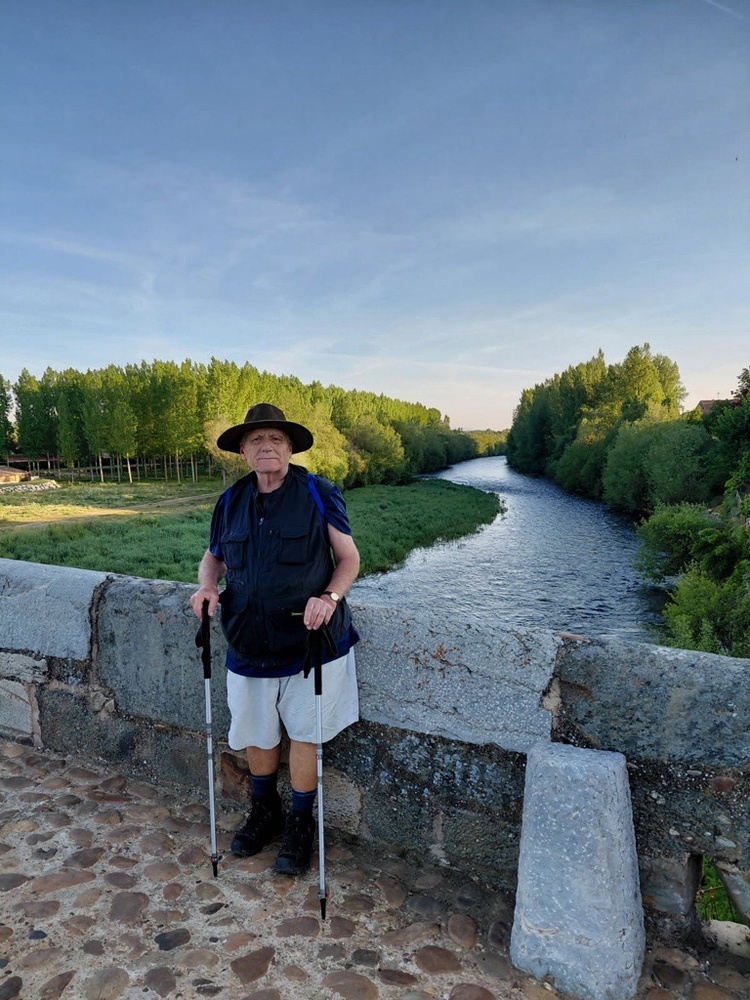

After a lifetime dedicated to others, Montrone felt a deep need to walk alone, reflect and give thanks. So, in May of this year, with nothing but a backpack and his thoughts, he set out on a 550-kilometre journey along the Camino Francés, the most famous stretch of the Camino de Santiago (also known as the way of St. James), starting in León and crossing northern Spain all the way to Santiago de Compostela.
The idea came to him almost as a whim. “At Christmas, I asked myself what I truly wanted,” he recalls. “It wasn’t something anyone else could give me. It was something only I could give myself: time.”
After sharing his plans with his wife Miranda, who was initially hesitant about such an ambitious undertaking, Montrone was introduced to Sister Veronica, a Dominican nun who had already walked the Camino several times. After confirming his physical condition and commitment, she welcomed him into the group.
From January to April, Montrone trained diligently, covering many kilometres each month in preparation. By May, he was ready. He joined a group of six pilgrims - two men and four women - and together they began their adventure. From Madrid they took a train to León, where the walk officially began.
Each day started early; they woke up at 5 a.m. and were on the trail by half past. After walking 10 kilometres, they’d stop for a light breakfast, with a modest lunch later in the day. By afternoon, they’d arrive at the next village, staying in designated hostels designed to accommodate pilgrims along the route.
The first hour of walking each morning was spent in silence, dedicated to personal reflection and prayer. Evenings were marked by the simplicity of hostel life: shared dormitories with 40 to 50 beds, communal showers and hand-washed clothes drying in the sun.
There was also time for meaningful conversations with fellow pilgrims from around the world: Italians, French, Australians, Americans and Brits. Over the course of 20 days, the group covered 550 kilometres. “The Camino put everyone on the same level,” says Montrone. “Humble, tired and vulnerable, it became a true school of humanity.
“Everyone was searching for something - forgiveness, transformation, answers. I just wanted to thank God for the life he gave me,” Montrone explains.
Even during this personal mission, he didn’t forget his community. He carried with him 432 prayer intentions entrusted to him by friends, each written on a small slip of paper, all kept in a pouch inside his backpack. He eventually left them at the sanctuary of Santa María la Real do Cebreiro, one of the Camino’s most spiritually significant stops.
Throughout the journey, Montrone supported many fellow pilgrims who struggled, helping them down from difficult trails and offering motivation. Among them was a woman named Jenny, who despite being physically prepared, encountered a deep emotional and psychological crisis along the way. To lift her spirits, Montrone shared the story of Cavalleria Rusticana, before playing the opera for her on his phone. “An hour and fifteen minutes passed without her noticing. By the time we reached the next village, she was completely recovered.”
Montrone described the Camino as a threefold test: “It challenges you physically, mentally and spiritually, all at the same time,” he says. “And you can’t lie to yourself: you either face it, or you turn back. It changed me. It made me more humble.”
He didn’t walk the Camino for a specific reason, but rather as a practicing Catholic believer who simply wanted to express gratitude. “The Camino isn’t just a path to walk,” he reflects, “It’s a journey that connects you with the deepest meaning of life.
“Because that path, in truth, runs through each one of us.”