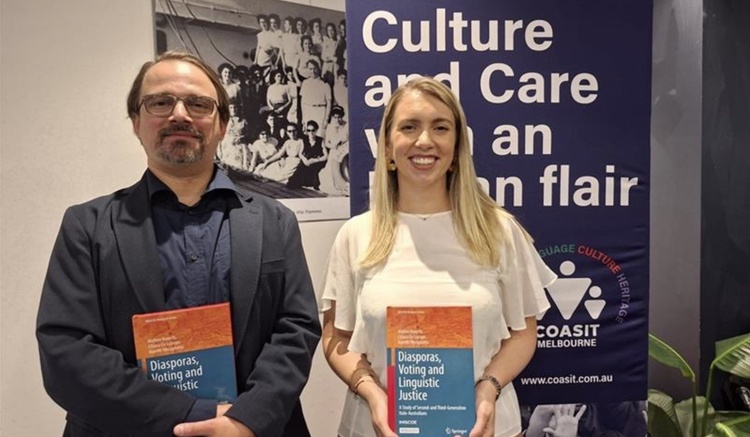
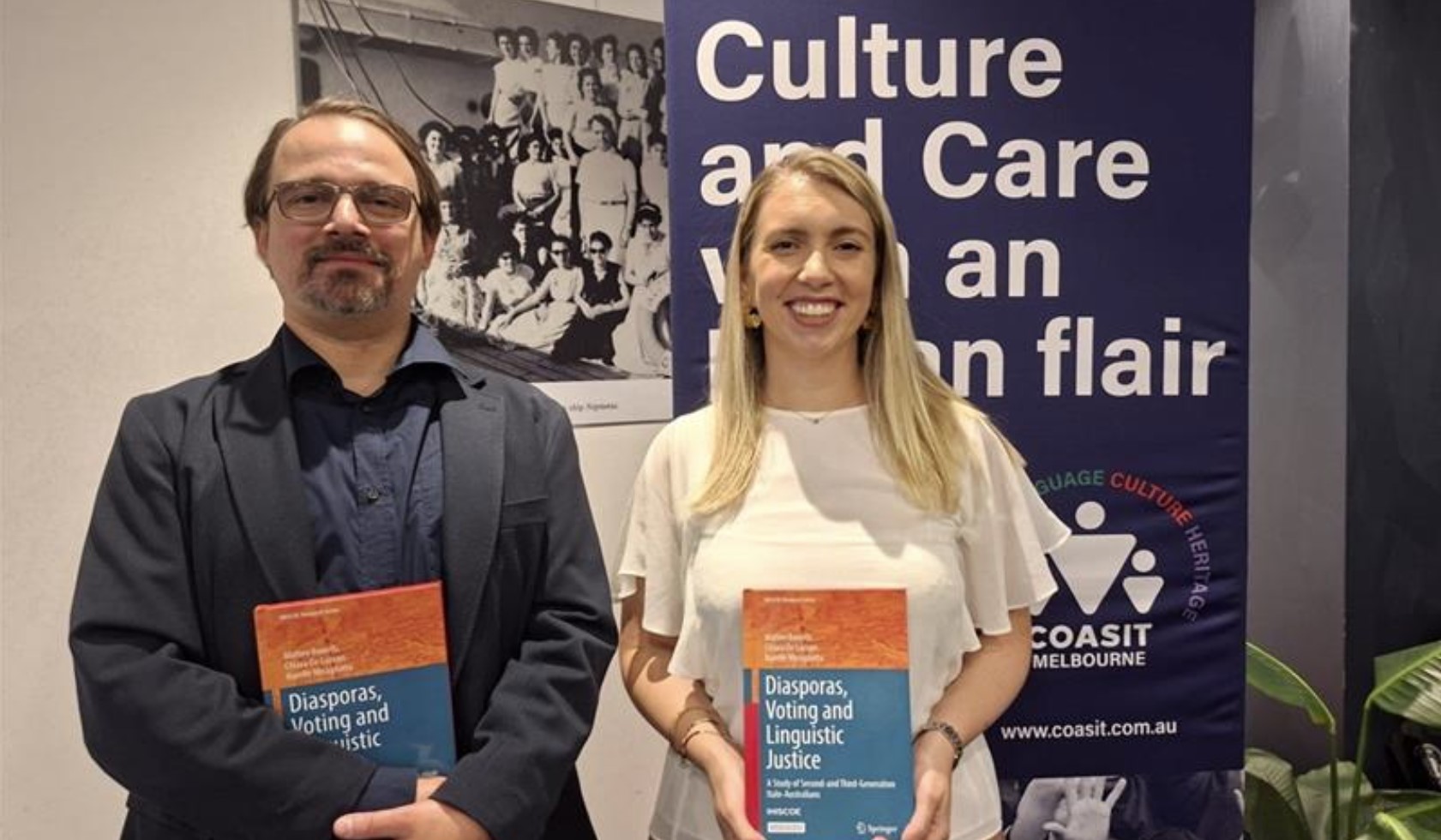
Bonotti and De Lazzari were present to discuss the book with the audience at an event supported by the valuable contribution of Com.It.Es. Melbourne, which accompanied and assisted the research together with Monash University thanks to funding from the Ministry of Foreign Affairs channelled through Com.It.Es.
De Lazzari clarified from the outset that the book represents “the final step in a broader research journey” developed over time.
“We started with a smaller study, then expanded it, eventually conducting a survey and interviews with second- and third-generation members across Australia,” she explained.
The research adopted a mixed-methods approach, combining quantitative and qualitative data collected online through questionnaires and Zoom interviews, from Melbourne to other capital cities.
“We don’t claim to hold the absolute truth, but the data gives us a clear sense of the situation, the critical issues and the real difficulties,” she noted.
The findings confirm a widely held intuition: maintaining a high level of language proficiency outside Italy is challenging, and even more so when moving from everyday speech to understanding political and bureaucratic language.
“If political language can already be difficult for someone born and raised in Italy, imagine in a diasporic context,” De Lazzari observed.
In mixed families, linguistic dynamics are even more complex: Italian, English and sometimes the language of the other parent coexist.
Often, the domestic lingua franca aligns with the host country’s language and the language of schooling, while Italian remains peripheral, reduced to intermittent exposure.
Outside Italy, this has resulted in a form of Italian marked by regional inflections and dialect traces—a linguistic export quite different from the standard Italian taught in schools, often transmitted by a generation of dialect speakers with limited formal education.
At the same time, the results must be read in light of broader trends. It is difficult to consider data on linguistic competence abroad without acknowledging parallel developments within Italy itself.
Screen-mediated communication, changes in reading and writing habits, widespread smartphone use, heavy engagement with social media, constant contact with English and a decline in intergenerational communication—as highlighted in recent surveys by the Accademia della Crusca during the Week of the Italian Language in the World—have fuelled a recurring narrative of the “impoverishment” of Italian within Italy.
This context makes more fragile the often-assumed idea that citizenship and language coincide almost automatically.
It is precisely here that the research intervenes with nuance and precision. “The main limitation of the Italian approach is assuming that if you are Italian, you know the language,” De Lazzari stressed.
This assumption becomes problematic when discussing overseas voting and informed participation.
One particular finding struck her while preparing the presentation: “Many rely on friends and relatives in Italy to guide their vote. They call a cousin and ask what’s happening and who they should vote for.”
Rather than signalling disinterest, the result reflects the difficulty of navigating parties, institutional dynamics, political discourse and information flows from afar.
The issue inevitably intersects with a broader debate that has recently sparked controversy: the relative ease with which descendants abroad obtain Italian citizenship. Recent legislative changes that were tightened last year have made the process more restrictive, reigniting questions and disputes.
At the same time, a fundamental tension persists: new arrivals in Italy struggle for recognition of citizenship while beyond its borders, the State, through municipalities, courts and consulates, grant citizenship to individuals who often do not speak Italian, have never been to Italy and may not intend to go.
It is within this gap that the book’s central question emerges: how can the State ensure not only the right to vote, but also the tools necessary to exercise it?
The authors propose measures that extend beyond the Italian case: more structured language policies for diasporas, more accessible informational tools and even the possibility of providing referendum and legislative materials in major languages.
Such proposals inevitably raise further questions: to what extent should the State provide translations, and to what extent is it the citizen’s responsibility?
De Lazzari does not sidestep the complexity but returns to the core issue: “If the right to vote exists, then we must ask what can be done to facilitate that level of engagement.”
Published in December, the book was also conceived as a way of “giving something back to the community, thanking those who took part in surveys and interviews”, many of whom the researchers only met online.
Perhaps the most effective summary comes from De Lazzari herself: “We cannot take for granted the thread that connects citizenship, linguistic understanding and political debate.”