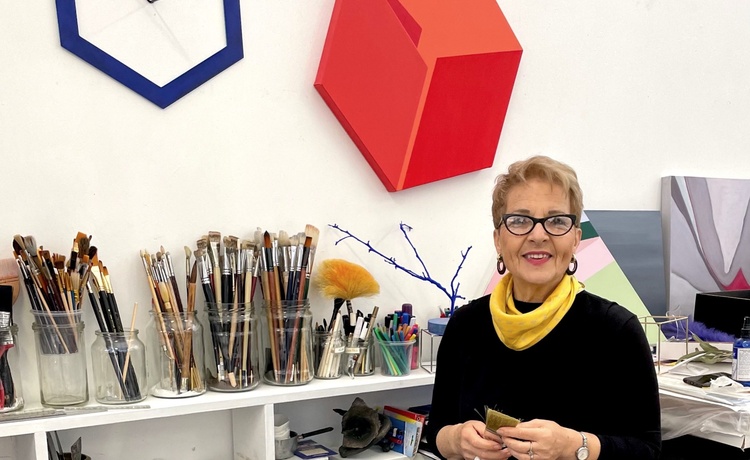

I walk through narrow corridors lined with canvases wrapped in plastic and cardboard. They silently guide me to a studio bursting with colour. The scent of well-worn brushes fills the air. Chaos hums with creativity. And there she is, her warm smile welcoming me in.
In her Northcote art studio, Liliana Barbieri greets me. With twenty-five years of artistic practice behind her, she has exhibited in galleries, museums and private collections across the globe, from Beijing to New York, London to South Korea and, of course, Italy.
She immediately gifts me delicate, hand-painted paper butterflies that flutter at the slightest breath of air. “They’re for your son, to play with,” she says with a smile.
For her, the butterfly represents the perfect balance of fragility and strength, freedom and metamorphosis. “Because butterflies, like people, can migrate beyond the borders drawn by history.”
To this day, Barbieri continues her artistic and personal journey guided by the shades of her cultural memory. Her work challenges perception and builds bridges between the tangible and intangible, “driven by the excitement of possibility, by the ideas of time, beauty and nostalgia”.
Her story begins in Ripa Teatina, a small hill town in Abruzzo where her parents, Elvira and Nicola Di Lizio, were born—two different families with the same surname. In 1954, her father left that quiet hillside village near the sea for faraway Australia, chasing the dream of a better life.
“During World War II, the frontline passed through our town and my mother’s house was turned into a German military base,” she tells me.
“It was completely destroyed. It was a very sad time. I was born later, but I always heard my mother and grandmother’s stories.
“My father, though, never wanted to talk about it—I think he saw things he wanted to forget.”
A tireless worker, her father saved enough money in ten months to bring the family over. Liliana was just three years old when she and her mother boarded the SS Sydney from Naples to Melbourne’s Station Pier.
“When we stopped in Colombo, Sri Lanka, I remember passengers being amazed to see people ‘with dark skin’, as they said,” she recalls.
“Everything felt so different, but I was a curious child and made friends easily, so I don’t recall any problems. Apparently, the crew looked after me and took me around the ship holding my hand—my poor mum was terribly seasick.”
An only child until age fifteen, when her sister was born, Barbieri always admired her parents’ determination to build a life from scratch.

Liliana Barbieri as a child with her parents outside their home in Brunswick in 1958
“My mother’s strength has always inspired me,” she says. “Three days after arriving in Melbourne, she took a tram to Flinders Lane—back then the heart of the textile trade—and found a job at the third door she knocked on.
“They handed her a sewing machine and asked her to assemble a suit. She was hired on the spot. When she came back to our boarding house in Brunswick, she was thrilled that she’d get a weekly pay packet.”
But like so many other migrants, Barbieri had to adapt quickly.
“I didn’t speak English and the children at school laughed at me,” she recalls, “That probably brought out my determination—within a short time I’d learned the language and by age six I was interpreting for the women in my family.”
But at home, Italian remained sacred. “My grandmother was a formidable woman who spoke in rhymes—her stories sounded like poems,” she says.
“My grandfather was a storyteller too. He used to tell us tales from World War I and had even worked as a field surgeon’s assistant during operations that were performed with nothing but a single shot of whisky!”
By age twelve, her family had settled in Australia. Her mother still a full-time seamstress, her father a builder. That year, they returned to Italy for six months and Barbieri rediscovered the homeland she was slowly forgetting.
Rome in particular left an indelible mark: the Forum, the Colosseum, the Vatican Museums and Michelangelo’s Sistine Chapel “stamped a permanent imprint on my mind”.
“I always loved drawing and wanted to study art after high school, but my parents didn’t see a future in easels and brushes,” she recalls.

Barbieri with her parents at a dinner dance at Mokambo in Carlton in 1956
Instead, she pursued travel and adventure, joining Alitalia as a member of ground staff. Frequent training in Rome rekindled her love of art. After marrying an Italian migrant in Australia and raising two children, she later joined Continental Airlines, but her creative hunger never faded.
At 42, after receiving a redundancy payout, she enrolled full-time at RMIT University to study Fine Art.
“My family thought I’d gone mad!” she reveals. “I had two teenage kids, a husband, a mortgage—and I decided to study art full-time. I worked evenings as a travel agent and studied from midnight to two.
“I never felt tired; I loved university life—it was full of possibility.”
She completed her undergraduate degree, master’s and then a paid PhD on Renaissance art.
“My ideas were nurtured there, and I think following my dream changed our family’s outlook for the better.”
Painting, once a weekend passion, soon became her profession. Her first project, In memoria, honoured women throughout history who were the victims of violence. Red panels with names etched in burning white: a visual outcry and a striking debut.
Her work, full of colour and emotion, has since been exhibited worldwide, including in her native Abruzzo at the Castello Ducale di Palena and the Basilica di Santa Maria di Collemaggio in L’Aquila, part of her project Via Vai – Arte in Valigia.
“It felt like I’d come full circle,” she reflects.
“When I graduated after six years, my mother said, ‘Do you realise you could have become a doctor by now?!’” she laughs.
“Ironically, both my parents were creative. My mother sewed everything by hand, perfectly—she matched colours beautifully and kept a chest full of bright fabric scraps.
“That inspired one of my shows—a wall of scissors drawn in graphite on acrylic, including my father’s wire cutters and my mother’s dressmaking shears.”
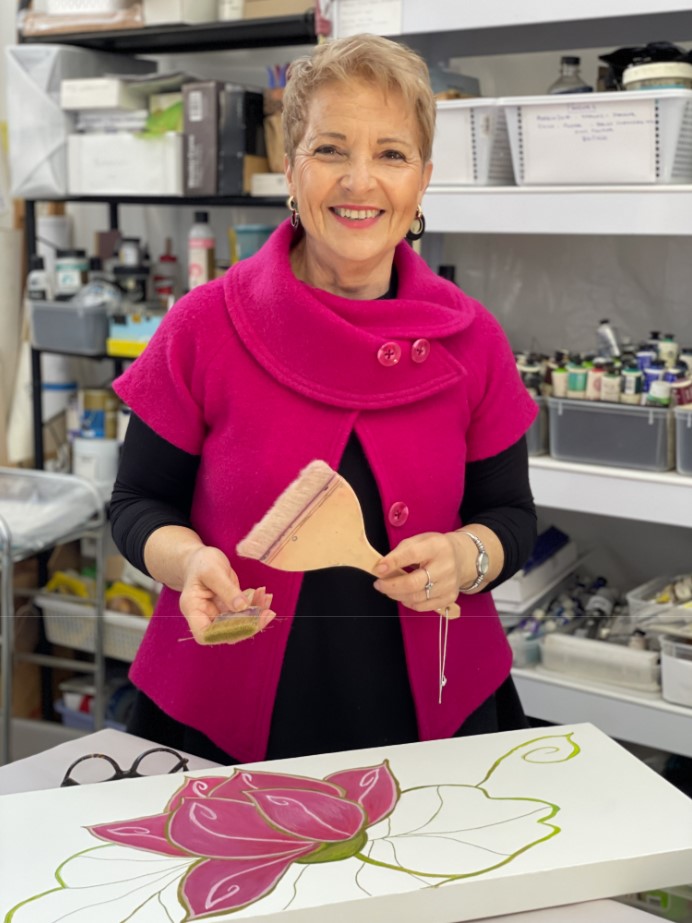
Barbieri back in her Northcote art studio
Having taught painting and art theory for many years, Barbieri still draws inspiration from the small joys of everyday life.
“Today, the gaze of my grandchildren discovering the world ignites a spark in me,” she says tenderly.
Her current series, Echoes of Time and Nature, features large-scale works on wallpaper using leaves, flowers and herbs collected from her mother’s garden—metaphors for migration and adaptation.
“It’s a reflection on culture as a living, evolving experience,” she explains. “But you must always find a space to exist without prejudice, preconception or pressure. That’s where I paint, and that’s where I truly live.”