For more than half a century, on Lygon Street in Carlton, Donati’s Fine Meats has stubbornly endured—surviving eras, trends and urban development without ever losing its identity.
It was never just a butcher shop, but rather became a local landmark, a small civic institution, a human touchstone where commerce intertwines with relationships and a simple greeting swiftly transitions into storytelling.
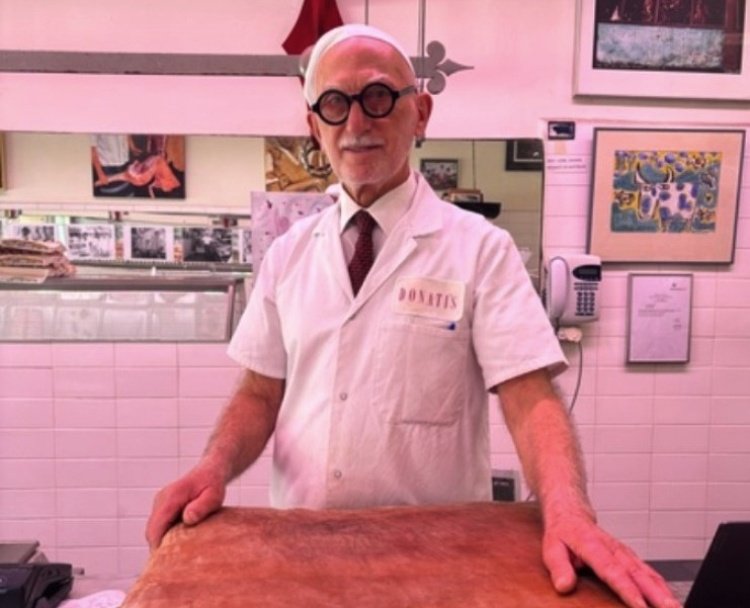
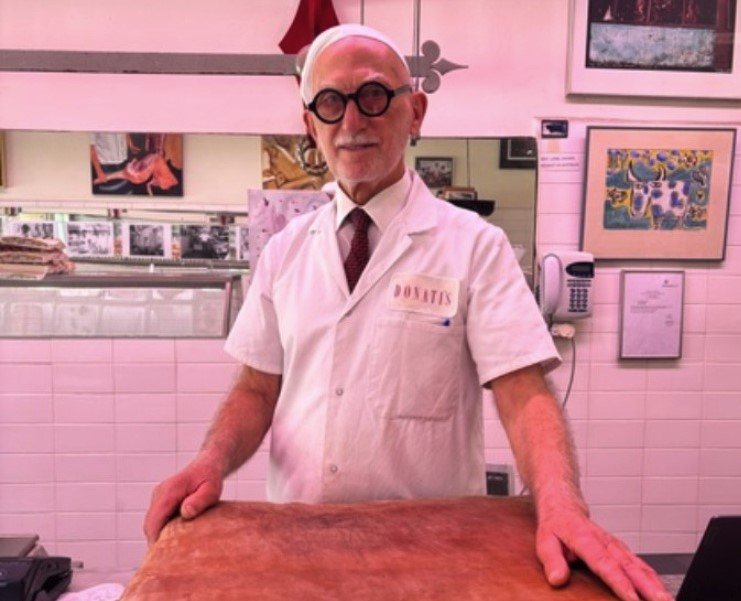
Walking into Donati’s today feels like stepping into a space suspended in time. Fresh flowers in vases, paintings of pigs and cows on the walls, a small bookshelf, classical music playing softly as work continues behind the counter. Butchers trim a fillet, tie a roast and talk about the news, food and life. Presiding over it all—shirt and tie beneath a white apron—is Leonardo Donati.
Donati stands out for the restraint of his movements, for a gentleness that is never showy and for the quiet dignity with which he has always practised his trade. With the traditional white paper cap on his head, he seems like a gentleman from another era rather than an ordinary shopkeeper—and perhaps that is exactly what makes Donati’s so exceptional.
Now, however, Donati has decided it is time to stop. Soon, for the first time in more than fifty years, he will no longer be behind that counter.
“I’m 77, and if everything goes as planned, the shop will change hands at the end of the month,” he says.
The name will remain. A deliberate choice—but Donati’s is not something that can be replicated. It is the product of a rare balance between craft, character and human connection.
“We’re sad, but at the same time very happy because he’ll have more time for his family,” says James Spinks, head chef and co-owner of Japanese restaurant Ima, which has sourced from Donati’s since opening.
“It’s an institution in Carlton, and he helped us enormously from the very beginning. We still place our orders directly with him.”
The story of this place began long before the Donati name. The shop has existed since the early 1800s and became an Italian butcher in 1954 with the Bertocchi family. It was only in 1972 that it took its current name, when a young Friulian from Codroipo—about 20 kilometres from Udine—decided to go out on his own. Leonardo Donati was just 23, with an apprenticeship under the previous owners behind him and no idea that this path would become his life.
“I opened thinking about meat,” he recalls, “but then this place became my everything.”
His clientele has always been broad and cross-sectional: long-time locals, restaurateurs, the curious. Among them, Donati also found love—marrying Vivienne, an Australian and one of his customers. From that moment on, the butcher shop definitively stopped being just a job.
The secret to such rare longevity lies not only in the quality of the product, but also in relationships. “You have to like dealing with people,” Donati says. “Building relationships is essential.” A simple idea, but one that made all the difference over the years—especially as everything around him changed.
When he started, there were nine butcher shops in three blocks of Lygon Street. Today, only his remains. Shopping centres, new consumer habits, a slow but inexorable transformation—changes that were often so gradual they went almost unnoticed.
Among his dearest memories, one stands out: Christmas Eve, 1984. Donati is in the shop, as always, overwhelmed with work. His wife, heavily pregnant, calls: she’s about to give birth.
“Try to wait a little—I need to sort things out here and then I’ll come,” he tells her. Marcello was born at six in the morning, after waiting three hours. “Punctual,” as Leonardo likes to say.
Since then, for Marcello Donati, birthdays have coincided with the busiest days of the year, among hams and porchette for Christmas lunch. For 25 years he has worked alongside his father, despite being an architect and having his own plans for the future.
The decision to sell comes down to age, Donati explains, as well as a desire to slow down. “I feel well, but it’s the right time,” he said, “And my son would like to do something else.”
The hardest part was making the decision: “Once that was done, everything seemed easier.”
Asked what message he would like to leave his customers, his voice falters: “A heartfelt thank you.”
Donati imagines the future filled with books, travel and time with his eight grandchildren. For decades, the routine was always the same: up at five and a full day behind the counter.
On January 30, Donati’s will close, before reopening under new ownership. While the name will remain on the window, what truly made that place unique was the people.