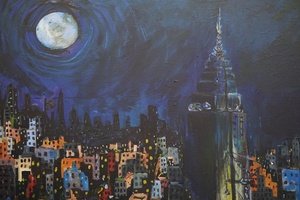

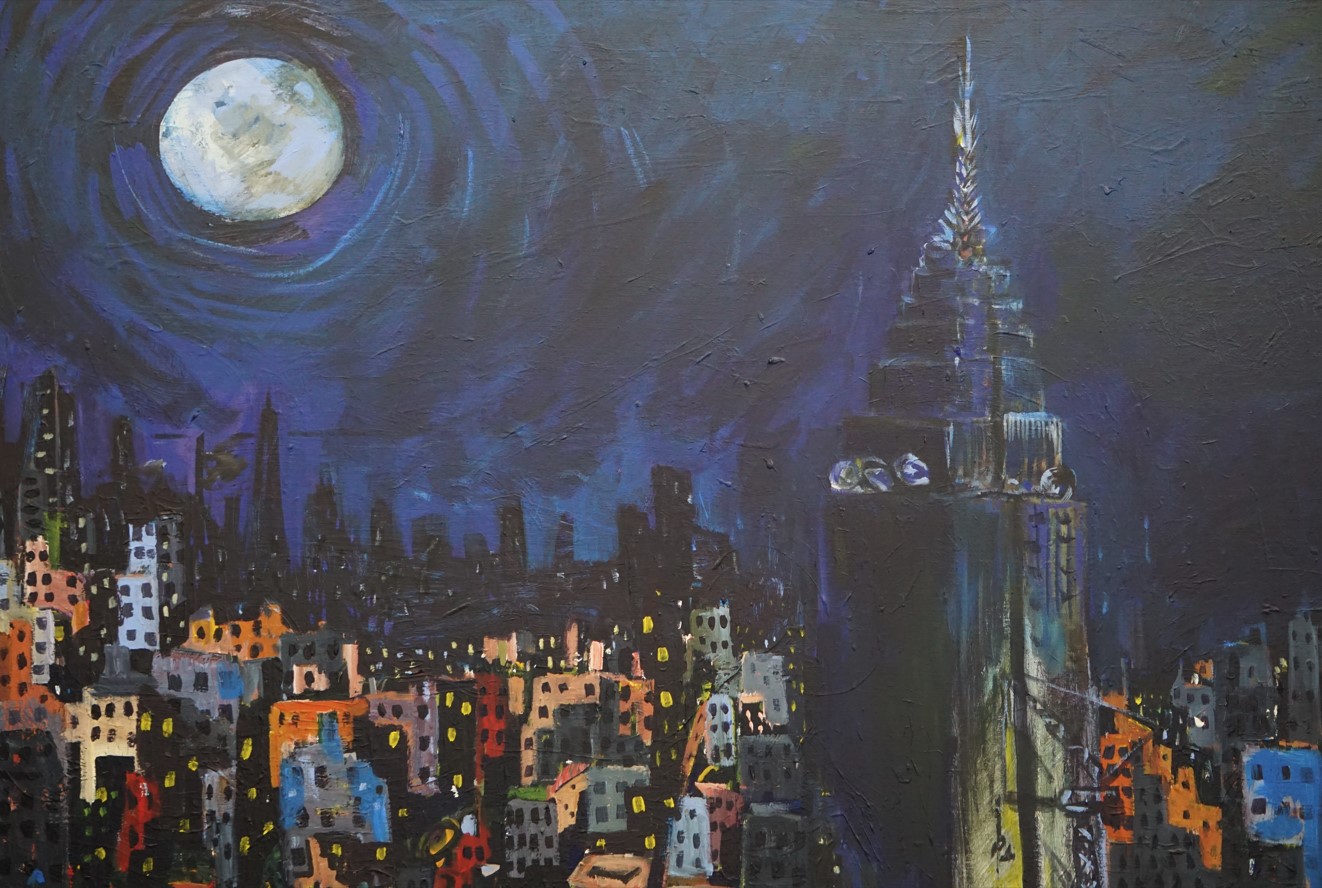
Luccio, having frequented Manhattan for decades on creative expeditions, has always been in love with its limitlessness.
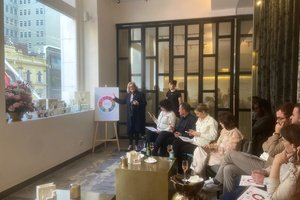
“I think the beautiful thing about New York as an artist is that every time you go there, it changes,” he explained at the exhibition’s opening.
“And I’ve changed a lot too … so that means that it’s never the same city.
“I remember the first time I went, I just sort of thought, ‘Wow.’ I was so overwhelmed with the stimulus, I didn’t know if I could do it.
“I spent two weeks just drawing, just trying to get close to it and trying to connect to it, because there’s just so much that you can be inspired by.
“It’s endless, no matter what subject you’re interested in. That’s why I keep going back. I think I’ll go back every year for the rest of my life.”
Manhattan gives visitors an insight into the different faces of the island. On one wall, Luccio shows us its gritty, wild and artistic side—most associated with neighbourhoods like the East Village and Lower East Side, while across from it sit myriad pieces capturing its grandeur and gravity—dark and imposing pictures of Grand Central Station, the Flatiron Building and Empire State Building.

Flatiron Building by Marco Luccio
What separates this collection from its predecessors, however, is that a sizeable portion of it has been influenced not by the wonder Luccio usually feels for New York—but by an intimidating and downright frightening experience.
In the midst of a creative fervor, Luccio was sketching outside and lost track of time before finding himself alone in Harlem in the early hours of the morning, where he says he was followed by a car for around five minutes. But the artist feels the result was worth the small scare.
“It’s funny because this trip I felt more confident in New York than ever before,” he said. “I was probably a bit too confident—it was the first time I went there just feeling like I belonged.
“Maybe these paintings, which are full of all sorts of energy, couldn’t have happened if that didn’t happen. So out of that negative experience, something very positive came out of it for me.
“But I didn’t know that it would develop,” he added, before revealing an eery detail.
“I had been working on some of these for years, and then all of a sudden, in a frenzy … I started painting and it was 2 a.m.
“The incident happened at 2 a.m., so it was interesting that these were finished at [the same time].”
While his relationship with the city has taken a slight hit, this one negative experience isn’t enough to keep Luccio away from the Big Apple.
“Maybe it’s changed the idea that I might move there,” he admitted, “but I’ll still always go, because that experience has made these [pieces].
“It captures a bit of the menace, a bit of the love—it has everything in them.”
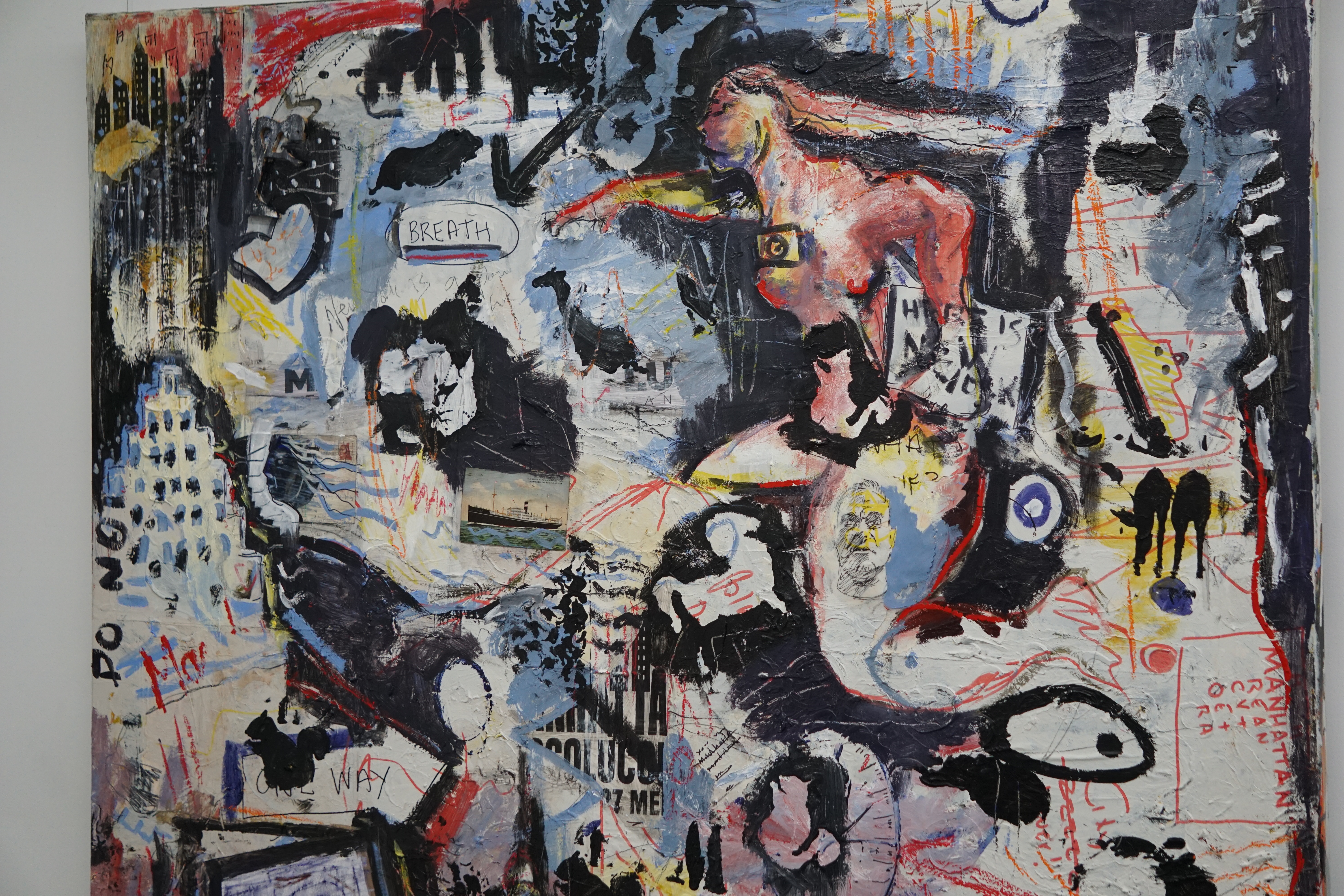
Marco Luccio capturing the “a bit of the menace, a bit of the love” of New York City
Luccio also revealed that it’s important for an artist to create distance from their subject—in his case, New York City—so a piece of them enters the work and they avoid the pitfall of creating something too literal.
“If you’re there painting the sky and trying to make it right, you won’t do an extra mark at the bottom if it’s not there,” he said.
“But if you walk away from it at a certain point, then it becomes more like an imagined New York, maybe New York as a mythical place and maybe the New York that you feel in your body and in your bones—not just the New York that you see literally in a postcard or in a photo.
“Maybe it becomes more about how the place feels … [and] how you felt at the time.”
Having created works all over the world, Luccio offered the audience an amusing insight into the ways different people connect with artists.
“In New York they join in, in Paris, they’ll leave you alone,” he began, “and in Italy, if you’re in the Uffizi … drawing the portrait of Medici, you’ll get an Italian come up and say, ‘Tut, you’ve made the nose too long.’”
Finally, the artist offered some advice regarding how creatives can avoid losing touch with themselves when making art.
“I’m always interested in process, and for me, that process is the truth,” he said.
“[You’re in trouble] once you get caught up with thinking about it too much in the sense of ‘What will people think? Is this body of work different enough?’
“That’s why I take copper plates on site, drag them across Phillip Island or paint on top of a rooftop, because then I can engage in the process—I can feel my breath, it’s freezing cold and I’m drawing…
“[There were times when] I couldn’t move my fingers, but that means you’re doing something that is pure, I tap into that,” he continued.
“And if we can all tap into that, then what you produce, hopefully, is a product of that purity and that integrity.
“I reckon that if you do that, you’re probably closer to not being cliché—but we can all fall into that,” he admitted.
“But … you’ve always got to have your own voice in your head anyway—you can’t have the outside people.”
The Manhattan exhibition is at @14 gallery in Collingwood until December 15.