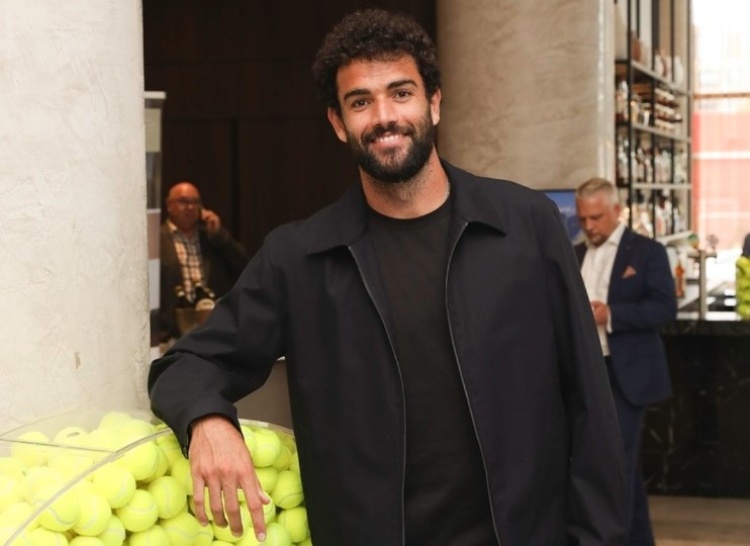
Just hours before his scheduled debut against Australia’s Alex de Minaur, it was impossible to foresee that Berrettini would be forced to withdraw because of an injury to his oblique abdominal muscles.
It was a tough blow for the Italian—and former world No. 6—who had spent four weeks in intensive training to be fully prepared for the courts of Melbourne Park.
This would have been his seventh Australian Open, a tournament he holds particularly dear thanks to the positive energy the city gives him, as well as the fact it was his first Grand Slam—both as a junior and as a professional.
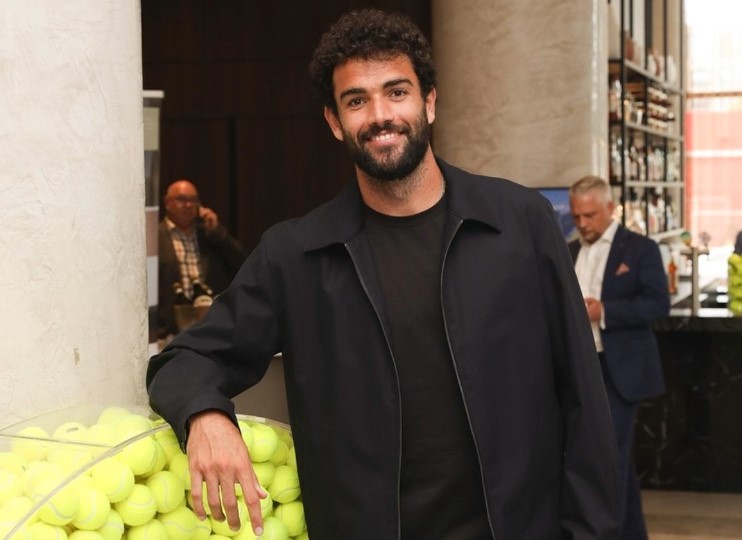
“I have wonderful memories,” he shares during an interview at the Oakwood Premier Melbourne Hotel, on the occasion of an event attended by other major names in tennis including Belinda Bencic, Learner Tien, Clara Tauson, Karolína Plíšková, Hady Habib and Dayana Yastremska. “In every match there was a special energy.”
Berrettini’s career has been a long one. He was just four years old when he first picked up a racquet, and a few years later he was training with Raoul Pietrangeli in Rome. The rest is history, with his entry into the professional circuit coming in 2013 at just 17 years of age.
There have been many emotional highlights along the way, including back-to-back Davis Cup victories in 2024 and 2025. “But the Wimbledon final was definitely the highest point—and also the most overwhelming,” he recalls with a smile, referring to the historic 2021 final against then world No. 1 Novak Djokovic.
Berrettini lost that match in four sets, but it went down in history for the exceptionally high level of tennis on display from both players. That result allowed him to climb to sixth place in the ATP rankings the following year.
Being a professional tennis player undoubtedly comes with many privileges, but also many sacrifices, with constant travel, gruelling training schedules and strict discipline required to deliver top-level performances, both physically and mentally.
So how does one prepare for the pressure of a tournament like the Australian Open? “Matches are won one at a time, match by match, point by point,” Berrettini explains.
While it can’t exactly be trained, emotional control becomes crucial on court and is considered one of the most challenging aspects of tennis.
When Berrettini makes a mistake, his approach is “to try not to think too much about what just happened, but to set my mind on the future—to what can happen and what I want to happen”.
“Being too attached to what just happened results in a smaller chance of winning the next point, which is the most important thing,” he explains.
“Stay focused on what you want to do, how you want to play, while also recognising mistakes and trying not to repeat them.”
Open and generous by nature, Berrettini says he is a great animal lover and admits that, had he not pursued a sporting career, he would happily have chosen a job “connected to the animal world—though probably not a veterinarian, because I don’t like seeing them suffer”.
Then, recalling a recent visit to an aircraft cockpit, he adds: “It reminded me that as a child I dreamed of being a pilot.”
For now, fans can only look forward to seeing him back on court when he’s ready—once the disappointment of not being able to cheer him on here in Melbourne has faded.