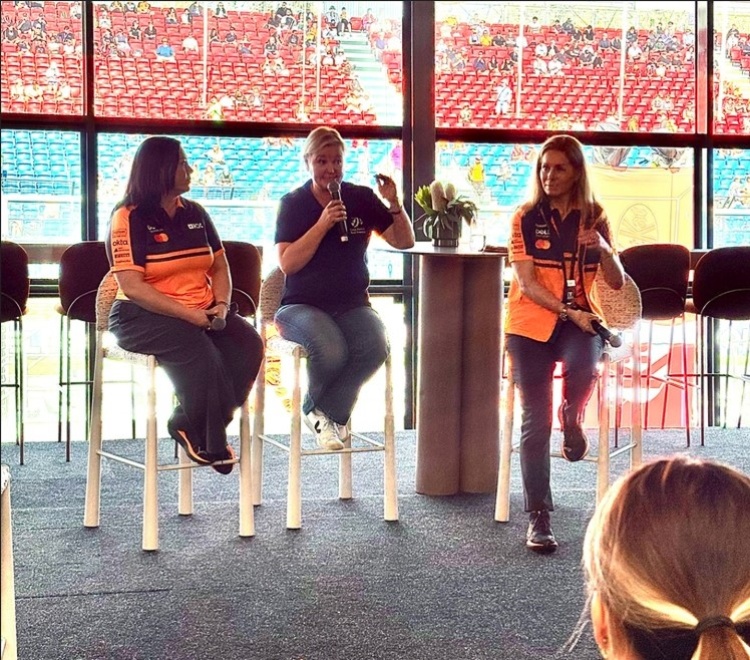
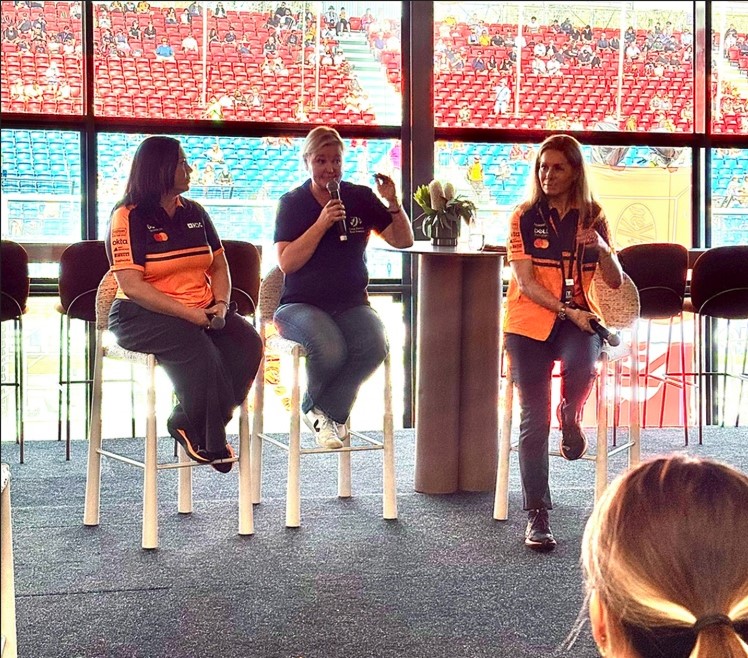
From a suite overlooking the pit building, directly above the race operations area, the British team presented one of the more unusual initiatives to emerge from Formula 1 in recent years: a collaboration between a race car team and marine scientists to accelerate reef restoration.
Opening the discussion was Louise McEwen, Chief Marketing Officer of McLaren Racing, who welcomed guests by highlighting the team’s strong form on track.
For McLaren, the return to Melbourne followed a significant season. “It’s fantastic to be back here as double world champions,” she said, “It’s the first time since 1998.”
But the focus of the conversation went well beyond racing results.
“At McLaren, being pioneers is part of our DNA,” she explained. “In the 1980s, we were the first to introduce the carbon-fibre monocoque.
“That technology has since spread and has saved many lives. We realised early on that the way Formula 1 thinks can extend beyond the track and contribute to society.”
That vision led to the partnership with the Great Barrier Reef Foundation. Kim Wilson, McLaren Racing’s Director of Sustainability, explained how the collaboration began.
“A few years ago, one of our team members was watching a documentary about the Great Barrier Reef Foundation. The next day he came into the office and said, ‘Kim, you need to talk to these people,’” she recalled.
The idea was simple: apply the engineering mindset and high-performance approach of Formula 1 to coral restoration.
“He had noticed the incredible scientific work being done, but also that many of the processes were extremely manual and time-consuming,” Wilson continued.
“So, we thought we could contribute with what we do best.”
The scale of the challenge is enormous. Coral reefs cover just 1 per cent of the ocean floor but support around a quarter of all marine life. Anna Marsden, Managing Director of the Great Barrier Reef Foundation, highlighted the urgency of the situation.
“These ecosystems are extraordinary, and very fragile,” she said. “With global warming and marine heatwaves, we are losing more coral every year.”
Natural coral reproduction occurs during the brief spawning season, when millions of tiny coral larvae are released into the water. But it is no longer enough to compensate for the losses.
“For the first time in history, coral reefs need human help,” Marsden said.
The biggest obstacle is scale. Traditional restoration methods involve growing small coral fragments and then replanting them manually—a process that takes about 90 seconds per unit.
That pace is far too slow for an ecosystem as vast as the Great Barrier Reef, which spans an area comparable to 70 million football fields.
This is where McLaren’s engineering expertise comes in.
Working with the foundation, the team developed Machine One, a semi-automated system capable of assembling coral seeding devices in around ten seconds.
The machine, nicknamed OSCAR (Operational System for Coral Assembly and Restoration), could produce up to 100,000 units per week, dramatically increasing the scale of restoration efforts.
“In racing, small improvements drive performance,” Wilson explained. “We’re applying the same philosophy to coral restoration.”
The next stage will involve field testing in Townsville at the National Sea Simulator, one of the world’s most advanced marine research facilities.
There, the system will be tested using coral produced during the most recent spawning season before being deployed in the most damaged sections of the reef.
It is an unusual collaboration between two seemingly distant worlds—Formula 1 engineering and marine biology—but one with a clear purpose.
“For corals, it’s not game over. It’s game on,” McEwen concluded.