Whether it is the Australian Open, an AFL match or a major international event, the city transforms almost effortlessly.
Streets fill with different accents, team caps and colourful jerseys. On trams across the CBD, animated conversations revolve around predictions and memories of great races, while side streets carry a sense of anticipation—as if Melbourne has suddenly returned to the centre of the world stage.
The Formula 1 Grand Prix is no exception. In fact, it may be the event that most dramatically changes the atmosphere of the city.
Part of the magic lies in the setting. The Albert Park circuit winds between the silver surface of the lake and the city skyline, providing a striking backdrop for the opening race of the 2026 season.
This year’s start to the championship has attracted particular attention. New regulations have reshaped the cars and left the competitive balance uncertain. With 24 races on the calendar and teams still trying to understand their true pace, Melbourne once again serves as the first real test of the season.
Walking through the circuit’s avenues and along the famous Walk of Fame, another change is noticeable: the crowd is getting younger.
Compared with the past, there are far more teenagers and young fans—a trend many attribute to the documentary series Drive to Survive, which has introduced a new generation to Formula 1.
Cheers erupt as drivers pass by, phones rise to capture every moment, and the atmosphere sometimes feels closer to a music festival than a race weekend.
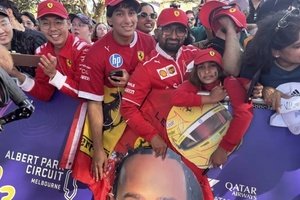
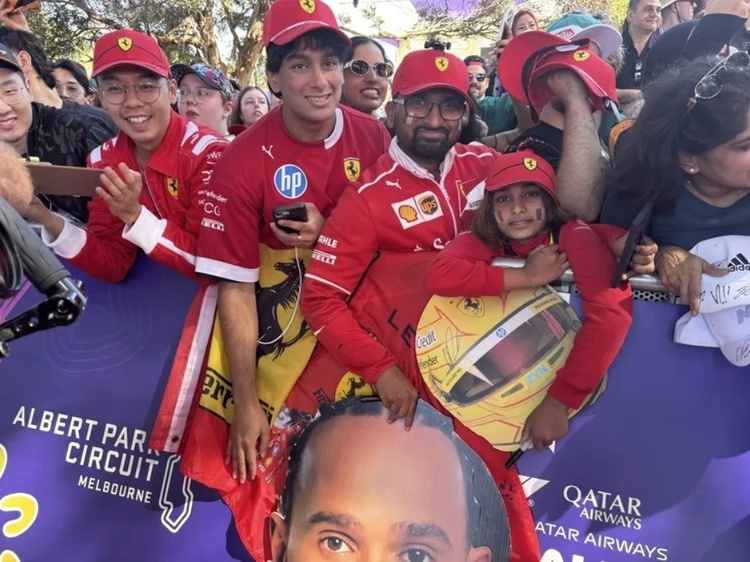
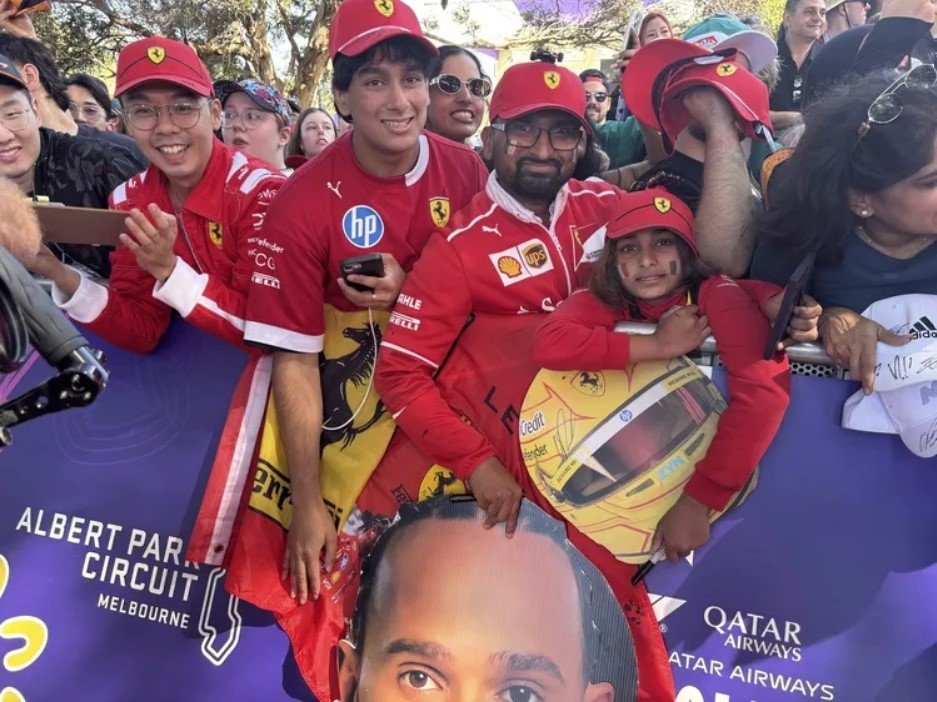
The colour that dominates the crowd is unmistakable: Ferrari red. Shirts, caps and flags from the Scuderia are everywhere. Even on the other side of the world, the team from Maranello continues to inspire remarkable loyalty.
That passion becomes particularly clear during the third practice session, when a loud gasp spreads through the crowd after a crash involving young Italian driver Kimi Antonelli from Bologna.
Despite racing for Mercedes, the Italian immediately draws the attention and concern of the fans. For a moment, in front of the big screens, silence falls.
Among the circuit stands are also stories that highlight the long connection between Italy and Melbourne.
Frank Gugliandolo was born in Messina and has lived in Australia for more than half a century. He works at a stall selling Italian products.
“I’ve been here fifty-five years,” he says. “In August, I’ll go back to Sicily. In the meantime, we bring fine wines, chocolates and of course San Pellegrino water. With this heat, that’s what sells the most.”
His favourite team is no surprise: Ferrari.
Not far away, Mohamed Niaz watches the track with his family. Even the youngest members are wearing the unmistakable red caps.
“We’ve supported Ferrari for twenty-five years,” he explains proudly. “Ferrari is passion. Wherever we go, we find supporters and incredible enthusiasm. We really hope to win this year.”
Much of that hope centres on Lewis Hamilton, who joined Ferrari last season in pursuit of his eighth world title.
Alongside the Ferrari faithful, however, there is also strong local support. Melbourne-born McLaren driver Oscar Piastri represents Australian pride on the grid.
Matthew Anderson, who grew up in Brighton not far from Piastri, says that is exactly why he began following him.
“It’s great to see an Australian back on the grid,” he says.
His partner Tay Blaney, however, remains loyal to Ferrari. The friendly rivalry has family roots: Tay grew up supporting the Scuderia thanks to her father, who followed the team during the Michael Schumacher era.
Unfortunately for McLaren fans, though, disappointment arrived early. During the formation lap, Piastri lost control of the car and compromised his race.
Meanwhile, a few kilometres away from the circuit, Melbourne’s Italian heart was beating strongly.
In Carlton, the Ferrari Club of Melbourne turned Lygon street into an open-air party. Outside the iconic Cafe Cavallino, Ferraris parked in a row attracted cameras and curious onlookers, while fans followed the race on big screens, which was closed off for the occasion.
The music, initially loud and festive, fades as the race intensifies.
“Everyone is listening to the commentary in complete silence,” says Lisa Francese-Martinez, who runs the venue with her brother James.
As the energy of the race spreads through the street, the Grand Prix becomes more than a sporting event—it becomes a shared celebration.
“Our hearts beat red all year round,” Lisa adds. “Whatever happens, when Formula 1 comes here it feels like our family is out there on the track.”