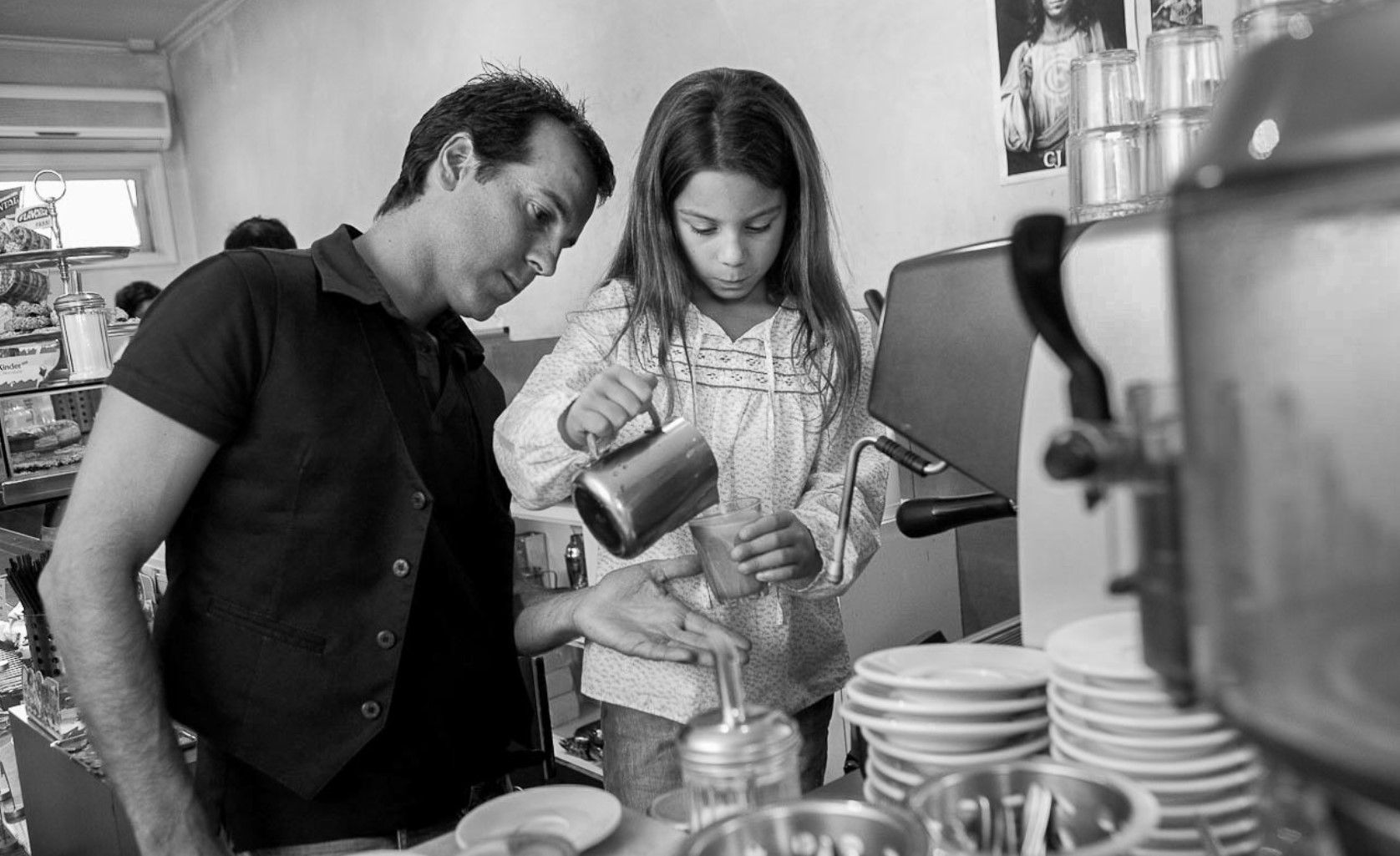
Melbourne is a city whose arteries flow not with blood, but with coffee. It’s considered the coffee capital of the world, where drinkers have very specific tastes and expectations.
Cafés seem to sprout like mushrooms after the rain, frequented by regulars who go there for much more than just a beverage. But it wasn’t always this way. Like many contemporary habits, Melbourne’s coffee culture began with the postwar waves of migration.
This fascinating phenomenon has long captured the interest of writer Sandra Makris, who in 2010 wrote the book Journeys of Melbourne’s Coffee Pioneers: Trailblazing Passions.
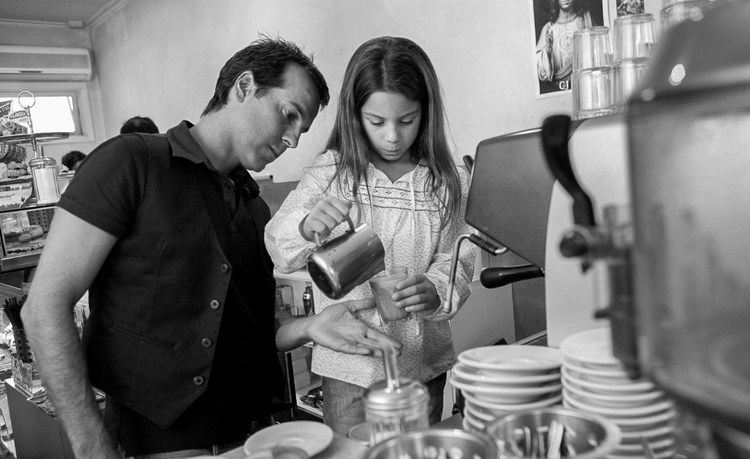
For that ambitious project, Makris worked with renowned Italo-Australian photographer Peter Casamento.
“About fifteen years ago, we started approaching people sitting in cafés, or the owners themselves,” Makris recalled. “That’s how I discovered extraordinary stories of migrants, hardships and entrepreneurial success.
“I thought they deserved a book of their own.
“A follow-up book about coffee culture was supposed to come next. Unfortunately, my life took another direction — my mother needed my support.
“So, the 25,000 photos Peter had taken were left there, gathering dust. But he never stopped saying, ‘Sandra, we have to do something. These photos are beautiful; we have to share them with everyone.’”
By chance, Casamento was recently selected as one of the few photographers in Victoria to host an exhibition in Melbourne as part of Sydney’s Head On Festival.
Makris and Casamento have now decided to display fifty of those long-forgotten photographs at Coffee Machine Technologies on Lygon Street in a free exhibition titled Melbourne Through the Coffee Cup, opening November 9 and running throughout the month.
The exhibition will be divided into sections, each representing the different settings in which people enjoy their coffee, like while studying, during work meetings or while writing a book.
“I still remember a woman who wrote an entire book in the café she frequented. Later, she held her book launch there,” Makris said.
During Sunday’s opening, there will also be a ticketed screening of Lygon Street: Si Parla Italiano at Cinema Nova. The choice wasn’t a random one, as part of that documentary was based on Makris’ book.
“My biggest regret is that neither the printer nor my graphic designer told me they were closing their businesses,” she shared.
“They never even asked if I wanted the files, the photos, the interview masters. So now I can’t reprint the book. Whoever owns a copy has a rare collector’s item.”
Among the guests at the opening will be Angelo Pricolo, son of Francesco Pricolo, one of Carlton’s café pioneers of the 1960s.
“We have a photo of Francesco standing beside his trusty meat slicer. He took it home when he retired. It shows just how much love and dedication these people put into their work,” Casamento said.
Even the image chosen for the exhibition’s promotional postcard has a story. “It shows two French sisters,” Makris explained. “We met them at 11 a.m. and they were already on their third coffee.
“They told us they wanted to taste all of Melbourne’s coffee before going back to Paris.”
The back of the postcard, coloured like the crema of a coffee, recalls the same tone Makris chose for her book fifteen years ago.
“I remember bringing coffee beans to the printer because we wanted to get the colour just right,” she revealed.
If Makris has always been the caffeine behind the project, Casamento has been the one to capture the soul of an entire city in a cup.
“When we say, ‘Let’s go out for a coffee,’ it’s about more than the drink itself,” he explained.
“At Sandra’s book launch, it suddenly became clear to me … it’s about community: the pride of families gathering to be part of something — the ritual of laughter and connection.
“Coffee is the glue that holds us together.”