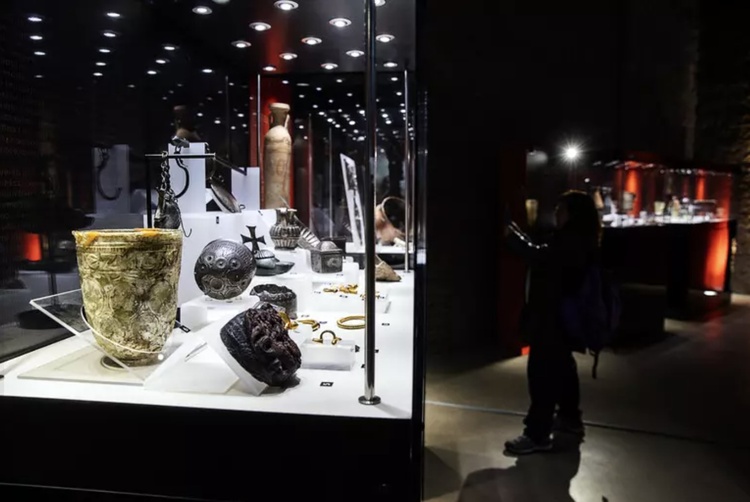
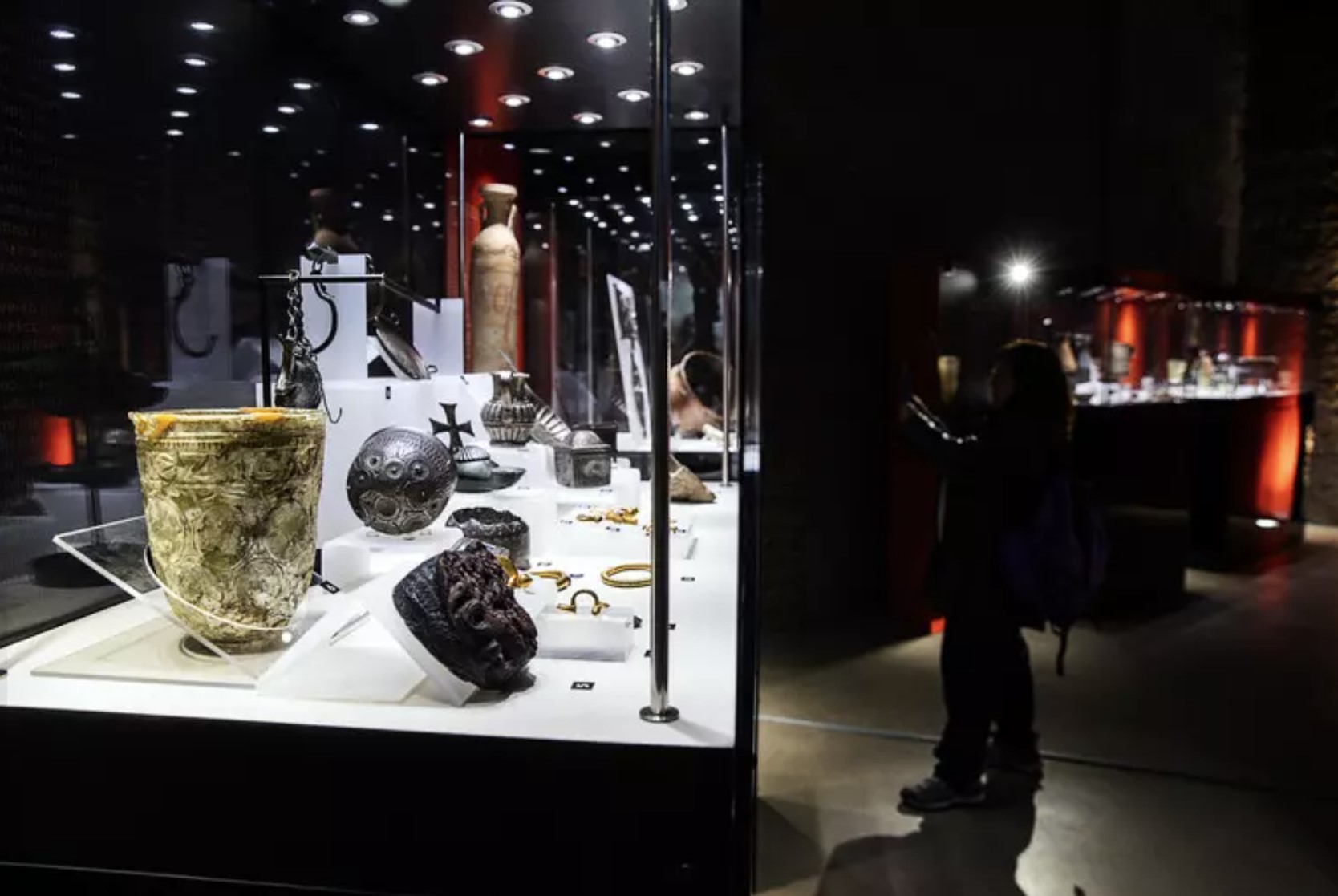
The new exhibition, titled New Recoveries, features remarkable artifacts including delicate faces of Etruscan female figures, preserved for centuries on alabaster cinerary urns.
It also showcases items from what authorities have dubbed the “London and New York Treasury,” amassed over years by a well-known British antiquities dealer who later fled abroad.
Among the highlights are parade helmets and bronze breastplates, still resonant with echoes of ancient battles, identified through photographic records in the Carabinieri’s database.
Another standout piece is the Potnia Theron, the goddess who tames wild beasts, depicted on an antefix that once adorned the Hellenistic sanctuary of Ardea, south of Rome. This artifact made its way, via the black market, to the Israel Museum in Jerusalem before being recovered.
These are just a few of the wonders now on display at the Museum of Saved Art, which has reopened to the public with a completely renewed exhibition path. In total, the collection includes more than 100 works dating from the 9th century BC to the 3rd century AD, all recovered from the illicit art market or repatriated from the USA and various European countries between 2022 and 2025 by the Carabinieri Command for the Protection of Cultural Heritage.
“These treasures had been silenced by international criminal networks,” said the museum’s interim director, Edith Gabrielli, “but now they tell powerful stories of investigations, seizures, arrests and international cooperation.”
“The recovery of a work,” Gabrielli explained, “does not end merely with its return. It is complete only when its meaning is restored.”
The museum previously hosted the 2021 exhibition of the Group of Orpheus and the Sirens, which was returned from the Getty Museum in Malibu and subsequently transferred to the Archaeological Museum of Taranto.
“The Museum of Saved Art also holds symbolic value,” added Luigi La Rocca, Head of the Department for the Protection of Cultural Heritage. “It makes tangible the restitution to the community of cultural goods that would otherwise have served the interests of only a few.”
The new exhibition will run with free admission until August 31. After that, it will be included in the regular ticket price for the National Roman Museum. Ultimately, the recovered works will be allocated to public museums in their regions of origin, where known or presumed.
“This museum stands as an outpost of legality, especially for young people,” said Alfonsina Russo, Head of the Department for the Promotion of Cultural Heritage. “These are works rescued from oblivion. Here, their voices can be heard again.”
Among the most intriguing pieces are the richly decorated cinerary urns from the 3rd century BC, linked to illegal excavations in Città della Pieve in Umbria. Another highlight is a bronze statue of a mature togatus, recovered in Belgium during Operation Fenice. Russo noted, “It comes from Perugia and is stylistically close to the famed ancient Roman bronzes of the Sanctuary of San Casciano dei Bagni in Tuscany. It probably belonged to another sacred area, still unknown to us.”
“In fifty-five years of work, the Carabinieri art recovery unit (CCTPC) has recovered three million works of art,” said General Francesco Gargaro. “Yet our database still lists 1.3 million pieces to be found; work we now pursue with the help of artificial intelligence.”
Also on display are five marble theatre masks from the 1st century AD, recently returned by an American collector. “They arrived in Italy just two days ago, among the 114 works recovered from the USA,” Russo added.
Thanks to international agreements, over 600 artworks were repatriated from the United States between late 2023 and early 2024 alone.
ANSA