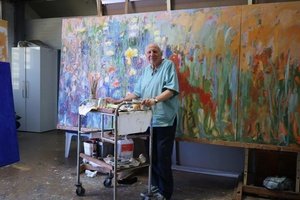
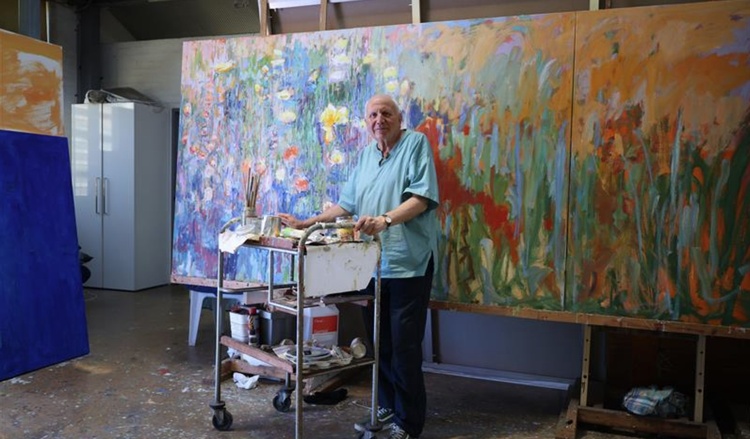
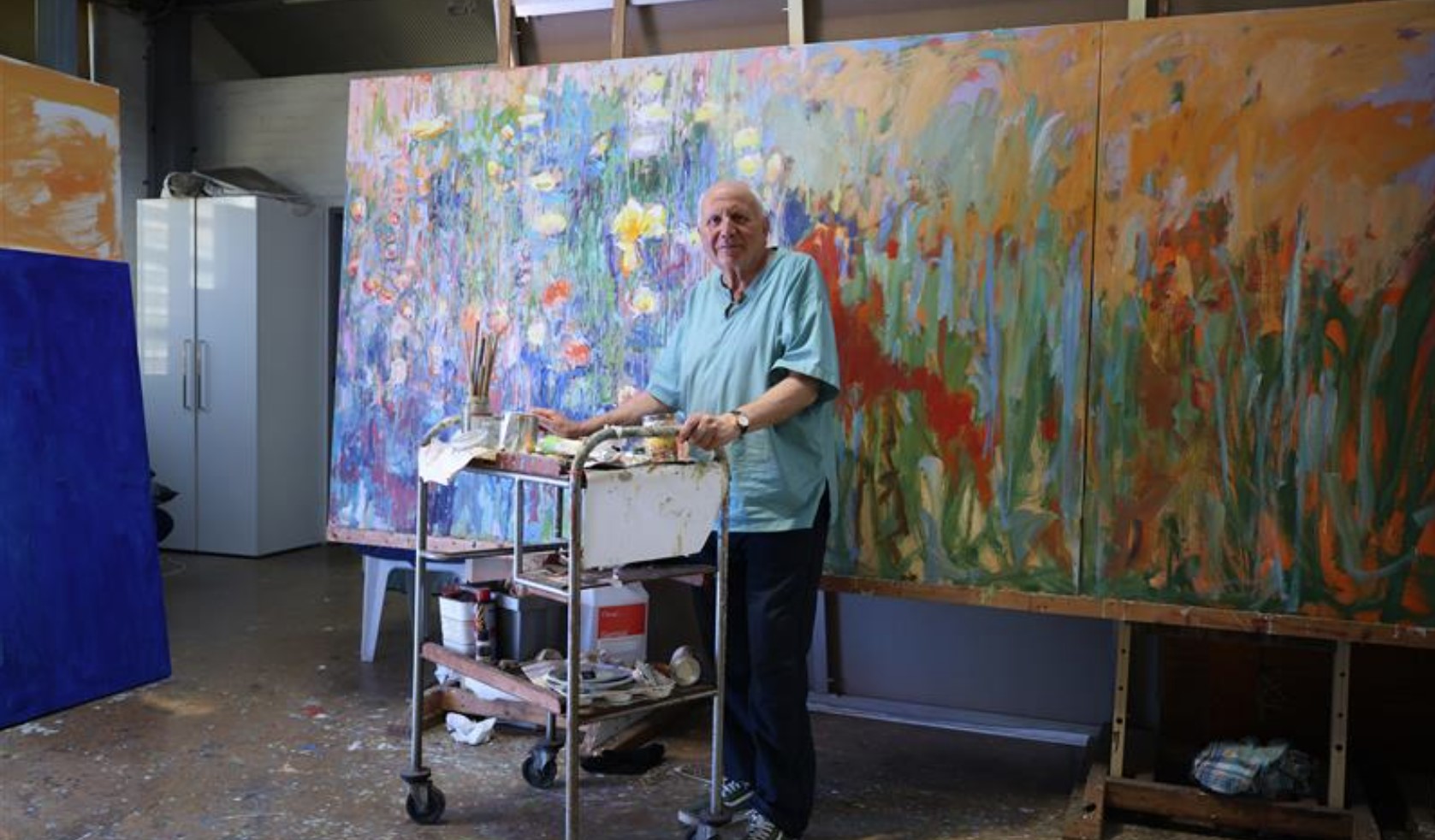
When Zofrea opens the door to his studio—together with his wife Stephanie—it feels like stepping into a complete circle, where the place of his early life meets the place of his maturity.
The studio sits north of Sydney, in the same house where he grew up after arriving in Australia as a child.
Inside, part of his Day Cycle dominates the space. Large panels stretch across the studio, marked by vertical flows of colour that echo the rhythms of nature.
It is only a fragment of a much larger work, which will eventually extend to around 122 metres. The effect is striking, not for its scale alone, but for the way it dissolves the boundary between inside and outside.
Nature does not appear represented—it feels present.
“I am searching for the absolute beauty of creation,” he says. “My art is my life. I live for painting. I am in love with painting. It’s a full commitment.
“You dream about art, you wake up thinking about it, you read poetry, you keep looking at books.”
Born in 1946 in Borgia, Calabria, Zofrea moved to Australia at the age of nine. The youngest of nine children, he grew up in a world shaped by the cycles of the land—wheat, vineyards and seasons.
His father read the stars to predict the weather, while his mother baked bread several times a week. Nature was not scenery, but structure. Alongside this ran the rhythm of religious life—feast days, saints and rituals that connected everyday life to something beyond it.
In Sydney, he studied at the Julian Ashton School, where he met his mentor Henry Justelius, a defining figure in his development.
At 15, he left school to help support his family, but continued painting. By 20 he had already held a successful exhibition, selling every work.
Despite this, family pressure pushed him to take on other jobs. In the early 1970s he made a decisive choice: painting would become his only work.
For many years, the human figure was central to his practice—portraits, commissions and, above all, his extensive collection inspired by the Psalms, with 100 of the 150 works completed.
In these paintings, he explored the relationship between fragility and transcendence. The series also reflects a period marked by serious illness and personal loss, including the death of his mother. Painting became not only expression, but a way of working through grief.
Around the age of 60 came a turning point. “I could no longer paint the human figure. I couldn’t go further,” he says.
Nature, once a background element, became the subject. And with it, the Australian light—something he felt he truly saw only after decades in the country. He describes it as “an epiphany”.
This shift gave rise to the Day Cycle, an expansive project that follows the movement of light from dawn to night. The scale is not about ambition, but necessity. His approach echoes that of a farmer: steady, continuous, leaving no part untouched.
As he approaches 80, his work continues to expand rather than narrow.
In recent years, music has become central to his practice. Not as accompaniment, but as structure. Debussy, Messiaen, Liszt and Schoenberg inform his work. He speaks of a blending of the senses, where sound becomes colour and rhythm shapes the surface of the painting. The canvases resemble open scores, with colour marking time.
This direction was evident in his recent exhibition Seven Days of Summer (October 7–25, 2025), where Australian summer light was his muse. In works such as Night Garden (after Debussy), he uses lapis lazuli—a deep blue pigment that captures and reflects light—creating an effect that feels almost musical.
Poetry, then music, and now painting as a point of convergence. His work moves towards a total form, where word, sound and image are part of the same language.
“Nature is God,” he says—not as doctrine, but as a belief that the divine exists within reality itself.
His vision of nature is spiritual, but not tied to a single tradition. Drawing on poetry, mysticism and European philosophy, his work seeks a language that connects the visible and the invisible.
He speaks with calm clarity, without any trace of the stereotypical troubled artist.
“To paint, you need a clear mind,” he explains. For him, creativity is not chaos, but focus.
His works are held in major public collections across Australia, and in 2014 he was awarded the Medal of the Order of Australia for his contribution to the arts.
His life reflects the same discipline. With Stephanie, he shares not only a home but the long, steady rhythm of artistic work—a partnership that provides stability for such a demanding practice.
In 2026, his 80th birthday will be marked by cultural initiatives involving both Italian and Australian institutions.
Asked what he hopes people will remember, he does not mention awards or achievements.
“Look at that painting and see me. See my spirit. When I die, I won’t die—I’ll be there,” he says.