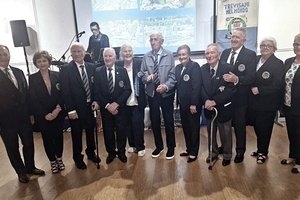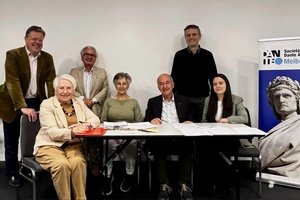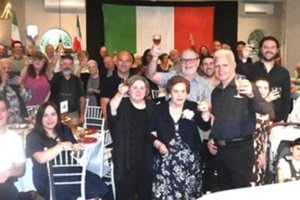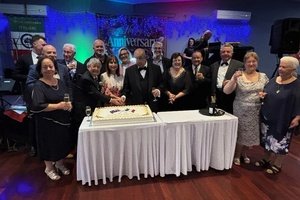
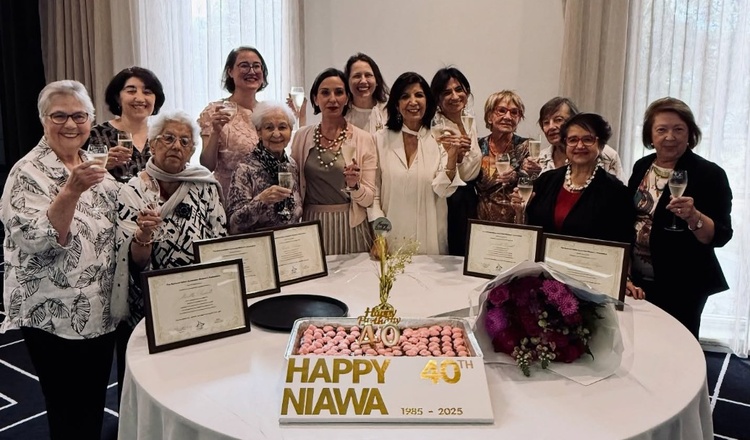
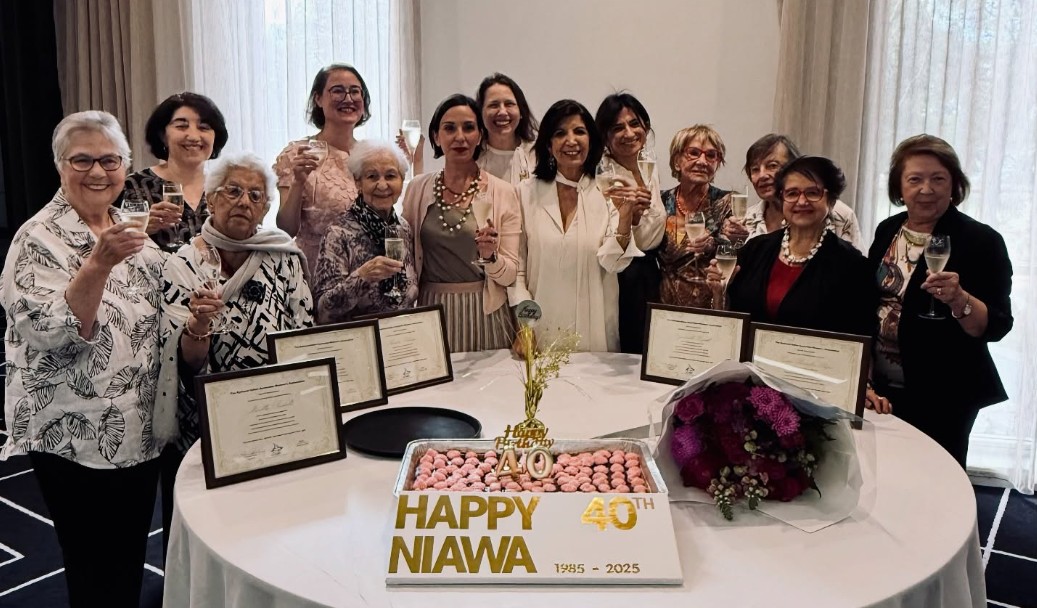
The event began with a video retracing the association’s first three decades, from its founding in 1985 to the present day.
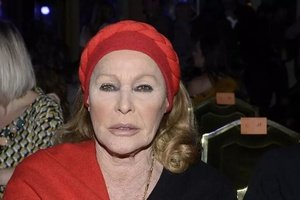
It all began in January 1985, when a group of Italian women gathered at the New South Wales Parliament to establish what would become a landmark organisation. “That conference was organised like a military operation. Each of us had a specific role and we worked in perfect harmony,” recalled Franca Arena, founder and first president of NIAWA, in her autobiography Franca, My Story.
“Over seven hundred women attended, many arriving by bus or train from distant towns such as Lismore and Griffith.
“I remember that before the conference, the president of a men’s Italian association asked me how many women I expected. To sound modest, I said about four hundred. He laughed and said I was dreaming.
“He had even forbidden his wife and daughter from attending, calling me a ‘dangerous feminist’.”
Despite the enthusiasm, it wasn’t easy to involve all women. Many were still tied to traditional, patriarchal family structures. As journalist Livia Bosi later observed, “Women were often uncomfortable when encouraged to step outside familiar boundaries.”
That lingering patriarchal shadow – what Virginia Woolf called ‘the angel in the house’ – still haunted many Italian migrant women in Australia. Raised to be discreet and self-sacrificing, they carried within them that idealised image of purity and devotion that Woolf had urged women to “kill” to gain freedom and a voice.
NIAWA was born from this need: to help women recognise that ghost and free themselves from it, turning silence into speech and submission into awareness.
Though unable to attend the anniversary event, Franca Arena sent a message of congratulations:
“In forty years of struggle, we have achieved many, many goals. The situation of women in our society has greatly improved – in part, thanks to us. Especially for our daughters, there is now a better future. We came from a misogynistic community, but much has changed because of our battles, our work and our determination to build a fairer world for all women.”
Pina Lombardo, who as a young woman had participated in the very first conference as a member of the Youth Committee, took the stage to offer her testimony.
“That meeting laid the foundations for an association destined to become a point of reference for Italian Australian women, giving voice to those who had never had one,” she reminded everyone.
NIAWA emerged in a climate of renewal encouraged by the Ethnic Affairs Commission, founded by Paolo Totaro, and supported by media such as La Fiamma and SBS, which amplified women’s voices.
The event even received a message from Italy, sent by the prime minister at the time of NIAWA’s founding, Bettino Craxi, who praised the civic and cultural contribution of Italian women in Australia.
“Today, after 40 years, we come together as a tribute to all those who made this journey possible – the founders, activists, volunteers, professionals, mothers, daughters and all of you who continue to support us,” current NIAWA president Concetta Cirigliano Perna said, before giving a special mention to Luisa Perugini.
A pioneer of SBS, journalist Perugini spoke at the original 1985 conference with a memorable address titled ‘I’m a Bundle of Nerves’. Then a health consultant for migrant women, she described their reality with unflinching clarity: hostility, racism, prejudice, domestic violence and workplace abuse – often numbed with alcohol or medication. Yet she also emphasised a collective awakening among women through dialogue and trust.
“It’s extraordinary how once a relationship of trust is established, our women – who appear timid and unsure – reveal immense inner strength and resources they never knew they had,” she remarked at the time.
Perugini was greeted by thunderous applause at the recent celebration.
“Under Franca Arena’s inspired leadership, NIAWA was born with a dream – to give Italian Australian women a voice, to create a space where they could meet, support each other and promote culture, education, solidarity and civic participation,” she said.
“Forty years later, looking around this room, I see that dream not only realised, but flourishing.”
Before their emigration, the feminist movement in Italy was still in its infancy. Women worked in the shadows – dignified, but largely unacknowledged. In Australia, October 1985 marked a turning point as over 800 women gathered at Sydney Town Hall to assert their collective strength.
“We exist. We are part of this society,” Arena declared at the time. “We have endured humiliation and sacrifice, yet we have helped build a healthy, just community. We are proud of our Italy and equally proud of our new homeland.”
Arena’s pioneering work is also featured in the documentary Signorinella: Little Miss, celebrating the Italian women who transformed Australia – from Carla Zampatti to Tina Arena – as icons of creativity, resilience and leadership.
Over the years, NIAWA has left a deep and lasting mark on Italian Australian women’s lives. Founded in a time dominated by male associations, it gave women a political voice and platform, addressing domestic violence, discrimination and family rights.
It built a nationwide network of solidarity, helping migrant women escape isolation and take part in public life. Through literary competitions and publications like Forza e Coraggio and Cinderellas No More, NIAWA has promoted cultural identity and self-expression, turning migrant memory into collective heritage.
Working with SBS and La Fiamma, it strengthened intercultural dialogue and nurtured a new generation of leaders, teachers, journalists, entrepreneurs and activists – proving that being a woman, Italian and successful in Australia was not only possible, but vital.
Among its champions were journalist Enoe Di Stefano, who curated a women’s column for La Fiamma for many years, and Fiorenza Jones of Brisbane, who brought NIAWA to Queensland.
The association has also published four landmark books chronicling Italian migration: Forza e Coraggio (1989), Growing Up in Australia (1993), Buon Appetito (1995) and Cinderellas No More (1995). Together, these works trace a collective journey – from silence to voice, from invisibility to recognition.
At the anniversary conference, excerpts from these books were read by Nadia Fronteddu and Manuela Rispoli, followed by commentary from Professor Alice Loda, an expert in Italian linguistics and migrant literature.
Loda highlighted the symbolic power of these writings. “Migrant women’s writing is an act of resistance and rebirth – a way to reclaim selfhood, denounce silence and turn pain into shared voice,” she explained.
“It’s a form of symbolic motherhood that binds women together in care and solidarity.”
The readings were enriched by the evocative voice of Lisa Genovese, accompanied on accordion by Jedda Kassis, adding emotion and rhythm to an evening steeped in history and gratitude.
Today, Concetta Cirigliano Perna and the current NIAWA committee – Stefania Vetrano, Rosilia Palmas, Gina Papa, Marina Zochil (granddaughter of Giulia Bonacina), Dona DiGiacomo, Lisa Genovese, Manuela Rispoli, Nadia Fronteddu and Joyce Dimascio – carry forward Arena’s vision with passion, adapting the association’s spirit to the challenges of the present.
As in 1985, Arena’s words still resonate today: “We are sisters. We are Italian. We are Australian. Today we celebrate our achievements. Let us ensure that future generations remember the sacrifices of those who came before.”
It is a call to continue the work begun forty years ago by a group of courageous women who dared to speak when silence was expected – women who chose to be seen, to lead and to build.
Today, NIAWA remains a living space where Italian Australian women – mothers, daughters, professionals and artists – keep transforming memory and solidarity into action.