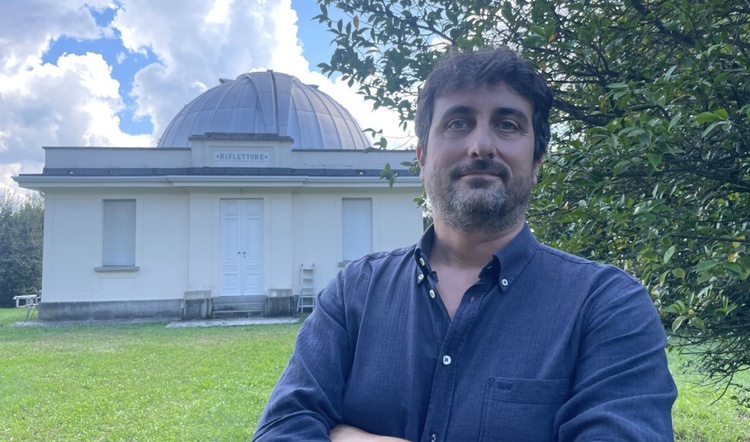
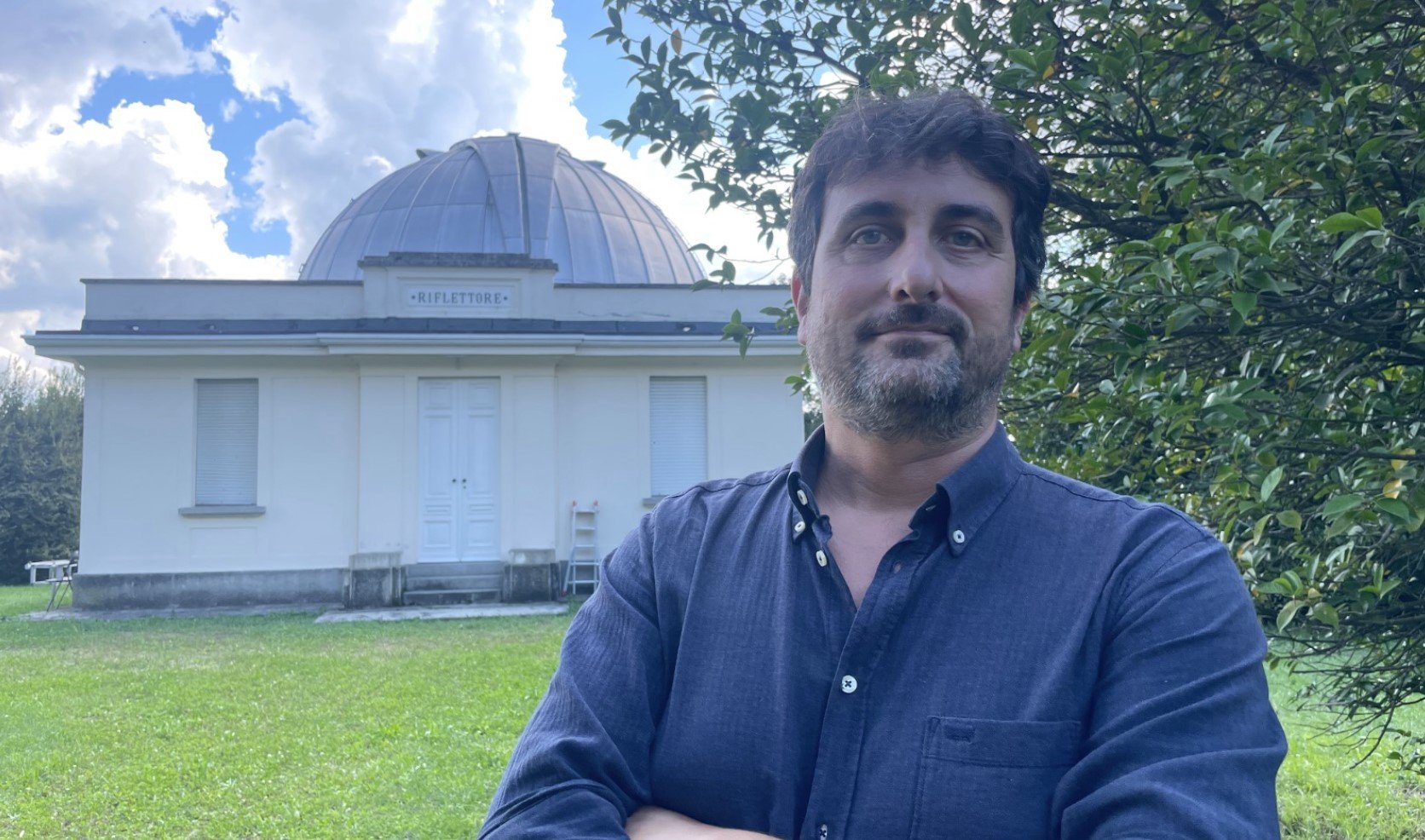
The record of these fascinating phenomena is the result of more than 20 years of work by astrophysicist Paolo D’Avanzo, who recently visited the studios of Rete Italia.
Arriving in Melbourne directly from the Atacama Desert, the senior researcher at the Brera Astronomical Observatory is currently testing a cutting-edge spectrograph in Chile—an instrument designed to observe gamma light.
At the heart of his research, D’Avanzo focuses on Gamma Ray Bursts and X-ray binary systems, where interacting stars generate some of the most powerful and intriguing events in the cosmos.
These are extremely high-energy phenomena which, despite their intensity, are invisible to the naked eye. “When we look at the sky with our eyes or with a traditional telescope, we only see visible light,” the researcher explains.
“But if we used a telescope sensitive to gamma rays, we would be able to observe extraordinarily powerful events.”
Fortunately, such explosions have not occurred in our galaxy. “If they did,” says D’Avanzo, “it would be a serious problem for us—we could literally be wiped out.”
Statistically, however, these events occur roughly once every billion years in each galaxy, so for now we can rest easy.
“These extremely bright flashes,” he continues, “suddenly light up about once a day somewhere in the distant universe, and they provide us with invaluable information.”
But what produces all this energy? “The explosion of massive stars, or the merger of compact stars.”
As D’Avanzo explains, when this happens, the light released is so intense that it can be observed from the edge of the universe. And because the farther we look, the further back in time we see, these bursts act like cosmic beacons, illuminating the early universe and helping us understand what was happening in those distant epochs.
The first observation of such a collision dates back to 2017, detected by the Italian interferometer Virgo, located within a major astrophysical observatory near Pisa.
For the journal Science, it was the most important discovery of the year. “As John Belushi says in The Blues Brothers, ‘We saw the light’,” D’Avanzo jokes.
That historic moment also marked “the beginning of multi-messenger astrophysics”, a field that has transformed our understanding of the universe. “For the first time, we observed both a disturbance in space-time and the emission of gamma light, opening a new era in science,” he adds.
Four centuries ago, Galileo Galilei challenged the limits of human senses with his telescope, ushering in a new chapter in astronomy. Today, the work of D’Avanzo and his colleagues continues that tradition, pushing observation to new levels thanks to advanced technologies that allow us to study not only visible light, but also immensely powerful energy explosions in deep space.
This new way of seeing the cosmos enables us to explore the most remote regions of the universe and gain a more complete understanding of what happens out there—in the search for answers about its origin and evolution, and about ourselves.
“These discoveries help us understand where all the matter we are made of comes from,” the researcher explains, “which is—let’s not forget—of cosmic origin.”
All of this is made possible by extremely powerful telescopes. “The idea is that radiation arrives at a very shallow angle and bounces off,” D’Avanzo says.
“It’s like throwing a stone into a lake: if you throw it straight down, it sinks, but if you skim it across the surface, even though it’s heavy, it will bounce. That’s exactly what we do.”
Finally, D’Avanzo touches on an intriguing possibility: “Some mass extinctions may have been caused by high-energy waves that altered Earth’s environment. By studying rocks, there are signs that could support this theory—but since it’s not my field, I don’t want to draw definitive conclusions.”