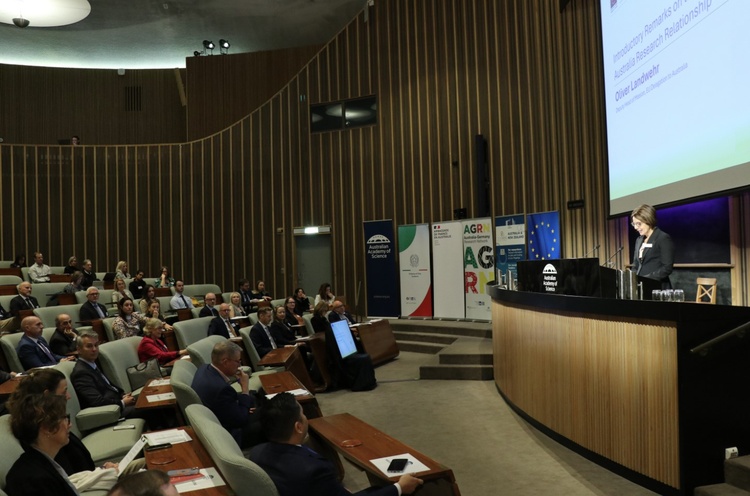
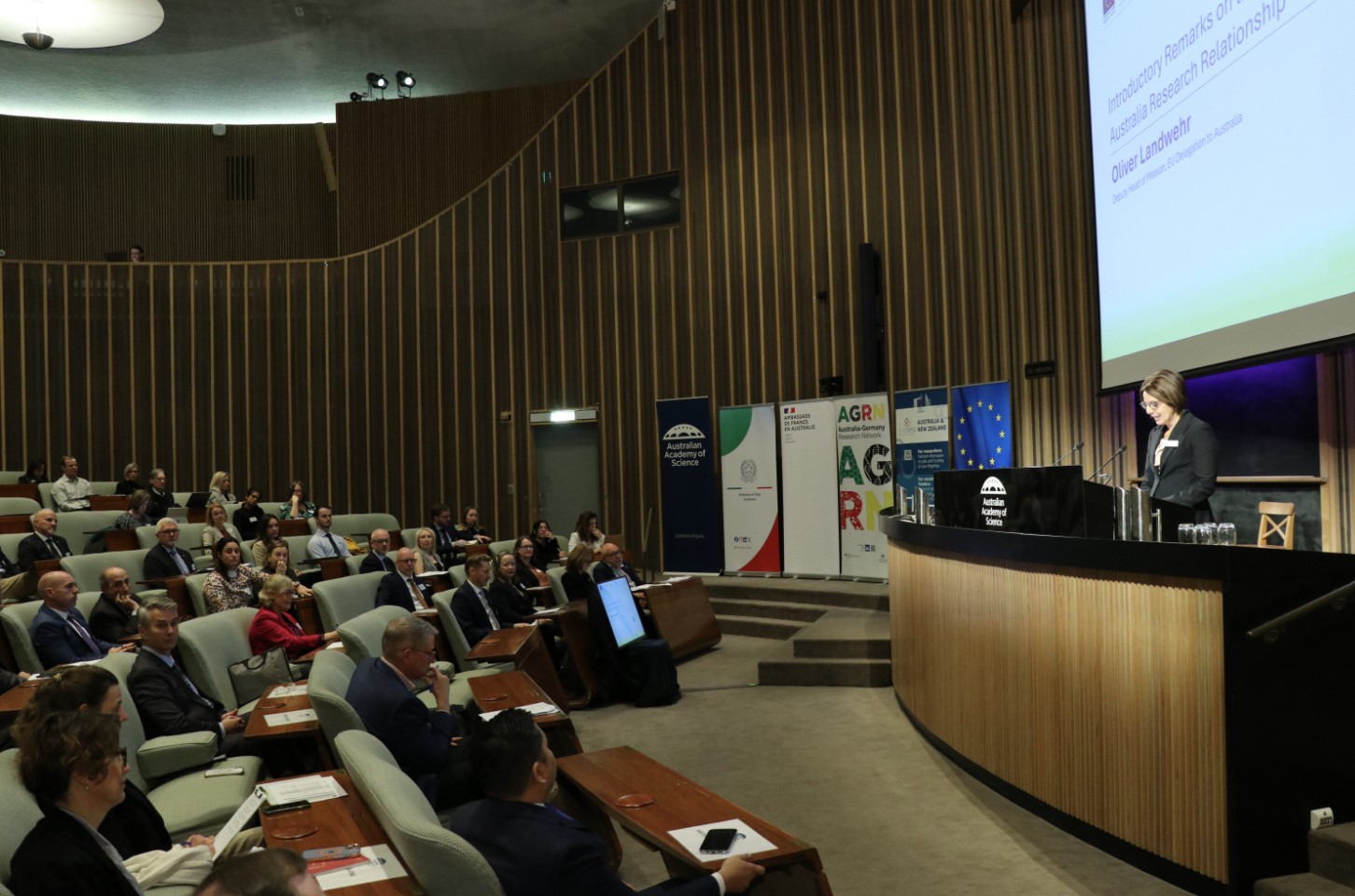
The gathering brought together institutional representatives, academics and researchers from both the scientific and industrial sectors to explore the future of collaboration between Australia and the European Union in the field of science.
Organised by the EU Delegation to Australia with support from the Embassies of Germany, France and Italy, as well as the Australian Academy of Science, the event had a national scope and drew an exceptional turnout of stakeholders from across the country. The shared objective was to reflect, exchange ideas and envision a more structured and dynamic partnership with Europe.
The day featured two key sessions. The first panel, moderated by Anna-Maria Arabia, Chief Executive of the Australian Academy of Science, brought together voices from Australian government bodies, universities and scientific institutions. The second session focused on firsthand experiences with Horizon Europe, the EU’s flagship research and innovation program, which, with a budget of over €95 billion, is the world’s most ambitious initiative of its kind.
Marco Lazzarino, Science Attaché at the Embassy of Italy in Canberra and a key contributor to the event, described the dialogue as “very positive and full of optimism, thanks to a highly receptive environment”.
A seasoned observer of trans-hemispheric scientific relations, Lazzarino noted that the event clearly highlighted a strong demand for engagement with Europe, not only from the academic sphere but also from the industrial and technological sectors. “There is significant momentum and strong interest from the research and tech development communities,” he said.
For many, Horizon Europe represents a gateway to a more open global ecosystem, one where ideas cross borders and expertise converges. Australia, meanwhile, remains somewhat on the sidelines, participating in the program only through selective co-funding mechanisms. Beneath this administrative distance lies a real risk: the loss of talent. “The inability to fully join European projects is pushing companies to relocate abroad. Isolation won’t retain talent,” Lazzarino added, pointing out that what is readily accessible elsewhere is often out of reach in Australia.
“Building bridges, not walls” was a message echoed by Signe Ratso, Deputy Director-General and Chief Negotiator for the European Commission’s association with Horizon Europe, during her speech. Her words, along with those of other prominent participants, including Professor Elisabetta Barberio, Director of the ARC Centre of Excellence for Dark Matter Particle Physics at the University of Melbourne, resonated with the attentive audience who recognised that this conversation goes beyond science and touches on the very future of society.
With participants travelling from across the country, the event gave a real sense that change is underway; because where ideas flow, opportunities follow.