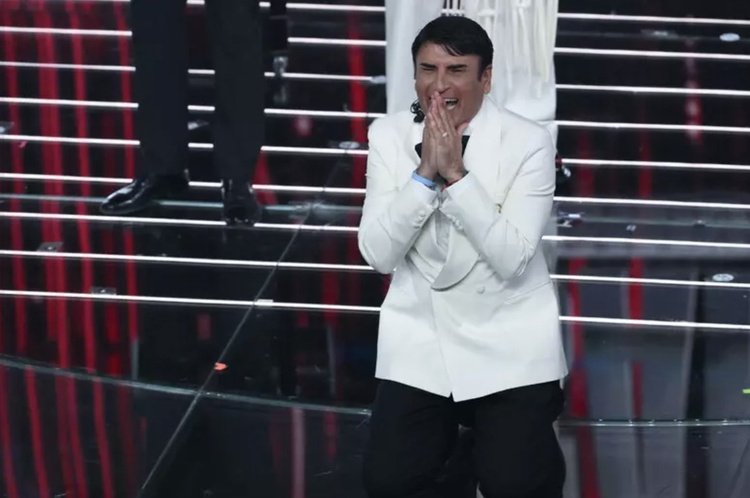
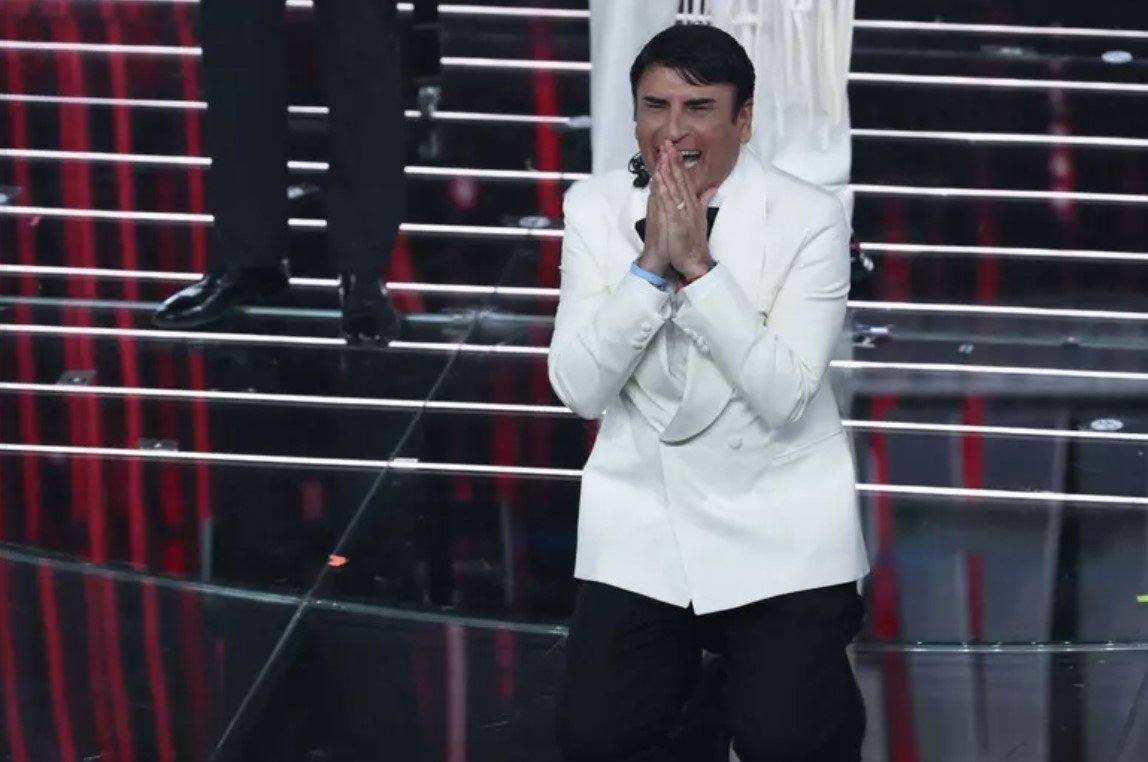
He quickly got back up, however, and sang Per sempre sì once more with indescribable energy—a song that became an instant earworm from the very first listen.
His return to Sanremo after 17 years was meant to be a celebration marking 50 years in a career full of success, but also many setbacks, armed with just one weapon: his voice, which he calls “the most delicate of instruments”.
The performance turned into a coronation—one he immediately dedicated to family who supported him throughout and to his beloved Naples.
Sal did not spare his voice during the Sanremo week, juggling interviews, fan encounters and even a major event in front of the Co-Cathedral of San Siro that brought parts of the city to a standstill, where he officiated a vow between two lovers.
He also led the lively and numerous group of young Campanian artists at the festival—from Lda to Aka 7Even, Samurai Jay to Luchè. They all speak highly of him: “He’s like an uncle,” they say.
At the press conference, the emotion was still palpable. “I still feel on my skin this incredible emotion and affection that everyone has shown me,” he said.
“This is the victory of a people, the victory of everyone who has persevered in following a dream. I’ve been doing this job since I was seven years old and I’ve carried on with determination through falls and steep climbs.
“It hasn’t been easy, but this is a victory for all those, like me, who come from humble beginnings.”
For that reason, he also shared the win with Geolier, “who comes from the people, from the same background as me”.
The song speaks of a lifelong promise of love, but with honesty: “Because love is not love for life if it hasn’t faced the steepest climb.”
“In love, as in music, you don’t run away at the first storm,” he explained. “You open an umbrella—and if it breaks, you open another.”
While he says the song is not autobiographical, it is impossible not to ask about Paola Pugliese, his wife who has stood by him for a lifetime.
“She has been an essential life companion. It’s thanks to her that I survived in the wolves’ den,” he said.
“We’ve known each other since 1984. Our first kiss was in Posillipo, and we’ve come all the way to here. We don’t need many words anymore—we look at each other and that’s enough. We’re in sync.”
The singer is now set to represent Italy at Eurovision. “It feels like something so big to take on, such a beautiful commitment and a source of pride—bringing Italian music beyond our borders. Per sempre sì—I’ve said it from the start,” he said.
Someone suggested he could officiate another vow on that stage. “Great idea,” he replied.
It is worth noting that Sal Da Vinci—an artist with over 450 million views and interactions, thanks in part to the viral success of Rossetto e caffè—dedicated his Sanremo appearance from the very first night to the late lyricist Stefano D’Agostino, who passed away just days earlier.
“If you’ll allow me, Carlo,” he said, “I’d like to dedicate this Sanremo to someone who passed away a few days ago and who gave words to my melody.”
Meanwhile, social media has been flooded with reels, congratulations and messages of affection—from Naples mayor Gaetano Manfredi to regional president Roberto Fico.
Carlo Verdone, who starred alongside him in the 1985 cult film Troppo Forte, wrote: “Dear Sal Da Vinci, my congratulations and a heartfelt hug. Today, you are the one who’s ‘Troppo Forte’.”
Singer Tommaso Paradiso, who is set to marry in spring, was filmed dancing to Per sempre sì with his partner, while Mahmood and Alessandro Del Piero have also been humming the tune online.
And perhaps the most touching thank you of all came from Naples’ Santobono Children’s Hospital, which thanked him for symbolically bringing its young patients onto the Ariston stage with the light blue bracelet he wore.
ANSA