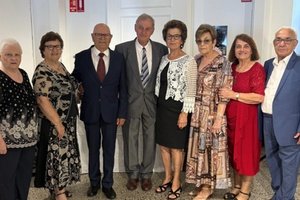


This is the question on everybody’s lips when they first meet power-couple Dominic and Marie Romeo.
It seems as though the destiny of these two passionate renovators was written in the stars long before it was realised.
While Dominic’s parents migrated to Australia from Calabria in the sunny south of Italy during the 1950s, Marie’s parents left Abruzzo and made the voyage down under during the same decade.
Soon after settling into Melbourne life, Dominic’s father established a bakery in the emerging suburb of St Albans and the family moved to what was then a whole lot of open space and paddocks.
On the other hand, Marie spent her early years in North Melbourne before moving out to the budding community of East Keilor.
Both Marie and Dominic grew up surrounded by a strong Italian culture, as many of their extended family had also embarked on a new life in Melbourne, and relatives were coming and going all the time.
While neither of them were brought up in historical homes, Dominic believes that their Italian heritage played a large part in sparking a mutual interest in these buildings.
As a child, Marie would visit display homes and then “stage” her own bedroom, combining the tips she had learned along the way with an undoubtedly natural flair for interior design.
During her gap year in Florence, Marie also spent time with her auntie in Abruzzo, where she was exposed to the beauty of Italian textiles.
As for Dominic, it all began during his time at boarding school, as he couldn’t help but come to appreciate the heritage buildings surrounding him on a daily basis.
But it was again with a visit to the Belpaese that a true passion was ignited.
“Visiting my grandmother in the southern Italian villages and my father and mother’s townships, I got to see a lot of stone cottages and houses, and just the simplicity and beauty of the architecture there certainly had an influence,” Dominic said.
Fast forward a few decades and after an extended stint in the tourism and hospitality industries, Dominic is a former Deputy Chairman and Board member of the National Trust of Australia (Vic), and currently holds a position as a heritage property sales specialist for Unique Estates.
Dominic also runs his own business on the side called Stalking Cat, which showcases a unique collection of Australian antiques.
As for Marie, days spent decorating her bedroom have paid off, and she is now an established interior designer with her own business, Bellholme, which deals with both modern and historical buildings across Victoria.
As if Dominic and Marie’s lives weren’t busy enough, the duo have also managed to write The Constant Renovators, a book showcasing each major project they have undertaken, outlining the renovation process and the history behind the buildings.
The book was yet another success for the couple, and Dominic recently attended the Bendigo Writers Festival as a guest speaker, talking about what it takes to renovate any building, great or small.
“Even though we tackle large homes, I say to people that our book is relevant whether you’re doing a brick veneer house, a cottage or a grand home,” Dominic said.
But the most exciting chunk of this duo’s life falls soon after they married and had their two sons, Gregory and Joel.
The couple began their renovation career with some quaint cottages and smaller projects, but it was in early 1995 that they took a giant leap into the world of heritage buildings, taking over a 34-room historical mansion in the township of Elmore.
Situated on the Campaspe River and surrounded by natural wonder, Burnewang became the site of many typical Italian family festivities.
“All of our relatives wished we never sold Burnewang. I think it’s because it was a stunning setting by the river and we had a lot of great times there just fishing and swimming,” Dominic said.
While the restoration of Burnewang was a long and laborious journey, it only furthered Dominic and Marie’s passion for reviving important historical buildings and bringing them back to their former glory.
“Every property we tackle is in a poor state, and I guess what attracts and excites us is the fact that every single thing needs to be done, from all of the gardens to the exterior and the interior,” Dominic said.
“We can walk onto a property that’s totally dilapidated and really see the end product right there in front of us and know that we’ve saved important Australian heritage.”
And so Dominic, Marie and their two boys moved from one fascinating historical building to the next, and over almost three decades they would come to restore six significant properties, from Burnewang, to Rupertswood in Sunbury, Timsbury, Benue Lodge and Karori in Mount Macedon, and Yalla-Y-Poora in Tatyoon.
And as for Dominic and Marie’s now adult sons?
Dominic explains that as teenagers, they would often get fed up with moving from a complete and beautiful home to another rundown project, asking “Why don’t we just buy a normal house like normal people?!”
“We used to tell them that once they were older they would appreciate what we’re doing, and now one’s 25 and the other is 23 and they do understand and appreciate it,” Dominic chuckled.
Working on and living in these stunning heritage homes, it’s only natural that Dominic and Marie were intrigued to delve into the history of each one.
“We’re very true to the way we restore and we’re sympathetic to the restoration but we also restore the social history of the houses as well; we find that that’s highly important and it gives soul back to the house,” Dominic said.
Dominic and Marie were pleasantly surprised to find that traces of Italian influence could be found in many of the buildings that they restored.
While working on Karori in Mount Macedon, the couple discovered that the architect was an Italian by the name of Luigi Boldini who had previously established himself as a notable architect in New Zealand before moving to Australia to design the stunning summer residence of Charles William Chapman in 1888.
“It was exciting to learn about the Italian history, but then we went back and researched the architect’s life in Italy and that was even more fascinating,” Dominic said.
“It’s a real buzz just finding out which town he came from and what he did in Italy, then tracing his history back to Australia.”
Investigative skills seems to be a prerequisite when it comes to restoring heritage homes, and aside from digging into the social history of the buildings, Dominic and Marie also spent much of their time unearthing the personality and functionality of each home.
Before commencing work on Burnewang, the couple and their team literally peeled back the layers of the home’s history by scraping the paint on the walls down to expose their original colours.
“There were these beautiful grand rooms with stained glass windows, and often the colours in each room matched the colours depicted in the stained glass,” Dominic said.
“There’s always evidence if you look hard enough, but you don’t just go in there and pick up a paint brush and start work; you’ve really got to stand back and do your detective work.”
For over 25 years Dominic and Marie have invested their time in breathing life back into homes, and although they both now have full-time careers, their passion for renovation hasn’t dwindled.
“We still do restoring basically full-time, but I rely on my tradesmen and even though we’re still quite active we’ve taken on more of a management role,” Dominic said.
The couple and their loyal crew are currently working on an ongoing project involving the private restoration of a family’s bluestone home in the Western District.
They’re also half way through tackling a brick veneer house - a first for them - using their experience to remodel an “unexciting” home hidden behind a blanket of blackberry bushes, into a masterpiece of aesthetic excellence.
Reading The Constant Renovators, Dominic and Marie’s passion to return beautiful buildings to their original state leaps right off each page.
Time can be merciless, but it’s thanks to this couple’s commitment and dedication that some of Victoria’s most historically significant buildings have been saved from a sad and lonely existence, and are arguably more vibrant than ever even several generations after their genesis.