Like them or not, bees are essential to our planet: they pollinate more than 80 per cent of flowering plants—keeping oxygen, food sources and biodiversity alive.
Organised in perfectly functioning societies and capable of communicating through vibrations and the famous “dance” that guides an entire colony to food sources kilometres away, bees are a world of their own—complex, fascinating and deeply interconnected.
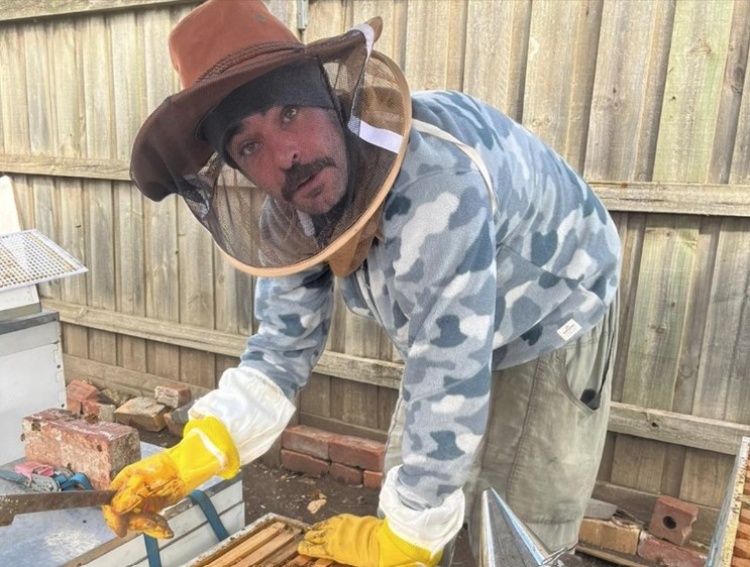
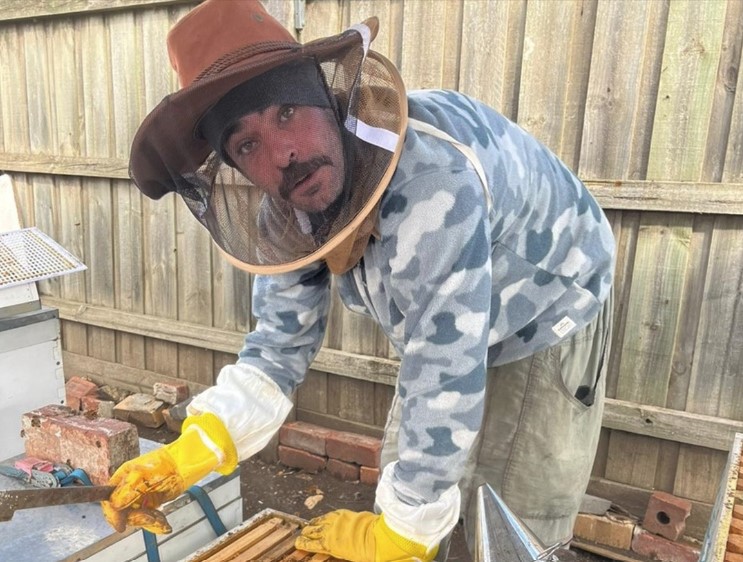
This micro-universe has, for Sebastiano Giarratana, become a true calling.
Originally from Giarratana, in the province of Ragusa, Giarratana has lived in Melbourne for almost seven years. His story with bees began in Sicily as a teenager.
“I was 19 when I found a wild colony on an almond tree,” he recalls, “I managed to get it into a box, and that’s how it all started.”
“At first it was nothing but fear—then it became a personal challenge.”
“The more they stung me, the more I understood them.”
When he arrived in Australia, Giarratana spent his first year between Queensland and travelling around the country. Then, once in Melbourne, he rented a house in Brunswick with a backyard big enough to host his first two Australian bee colonies.
“After a week I’d already brought the bees home,” he shares enthusiastically. From there, things grew quickly—not only in honey production but also in experiments with propolis, wax, natural creams and pollen.
“Honey is a natural medicine in every sense; recent research confirms it,” Giarratana notes.
Working with bees, however, requires balance. “You can’t show fear, because they pick up every vibration,” he explains.
“They don’t want to hurt us—they sting only in defence, and stinging means death for them.”
Calm, therefore, is essential.
“When I step into my apiary, I’m always relaxed. That’s what stops them from reacting to me,” he reveals.
And for those who are afraid, Giarratana gives one simple piece of advice: no sudden movements.
“Let them work. If they don’t feel threatened, they won’t do anything to you.”
But Giarratana’s dream goes far beyond traditional beekeeping. It’s called apitherapy—an ancient practice that uses honey, propolis, bee venom and hive aromas to support wellbeing, breathing and relaxation.
In Europe, a similar concept already exists: wooden cabin-style chalets where visitors sleep beside the hives, inhaling the essential oils naturally released by the colony, without any direct contact with the bees.
It may sound unsettling to some, but the concept has scientific foundations. “A lot of people have a relationship with bees built on misconceptions,” Giarratana says, adding that he wants to bring this experience to Australia.
“My dream is to create an Airbnb where people can sleep with the bees,” he explains. Not with the bees, of course, but in a protected space with glass and safety screens, designed so guests can hear the buzzing and breathe in the subtle aromas of pollen and wax.
“The wellbeing they release—the scents, the natural essences—is good for the lungs, the skin, for breathing in general. Even those with allergies, with the right precautions and medical advice, can benefit.”
The aim is to launch the project as early as next Australian spring—a pioneering idea that could make Victoria an unexpected destination for wellness tourism.
In the meantime, Giarratana continues working with his bees, producing rich, fragrant honey and nurturing a dream: bringing a piece of Sicily to Australia and turning the hum of the hive into a lullaby for visitors immersed in nature.
“Sleeping with bees: for some, it might sound like a nightmare; for others, a dream. But for everyone, it will be an unforgettable experience,” he says.