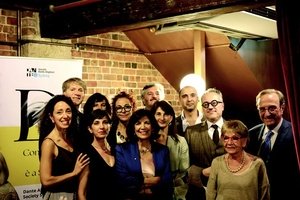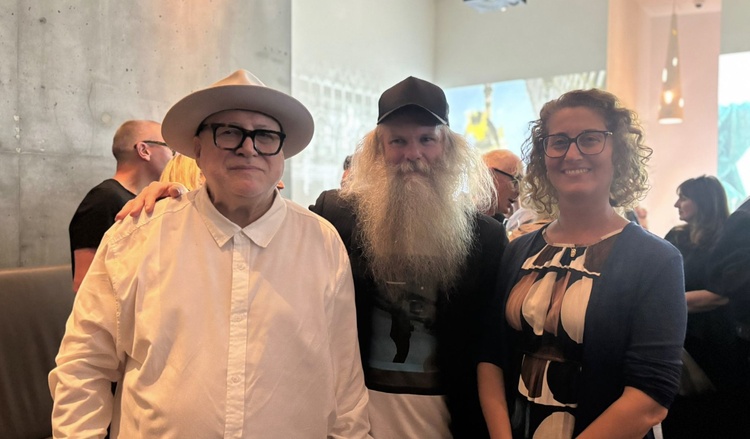
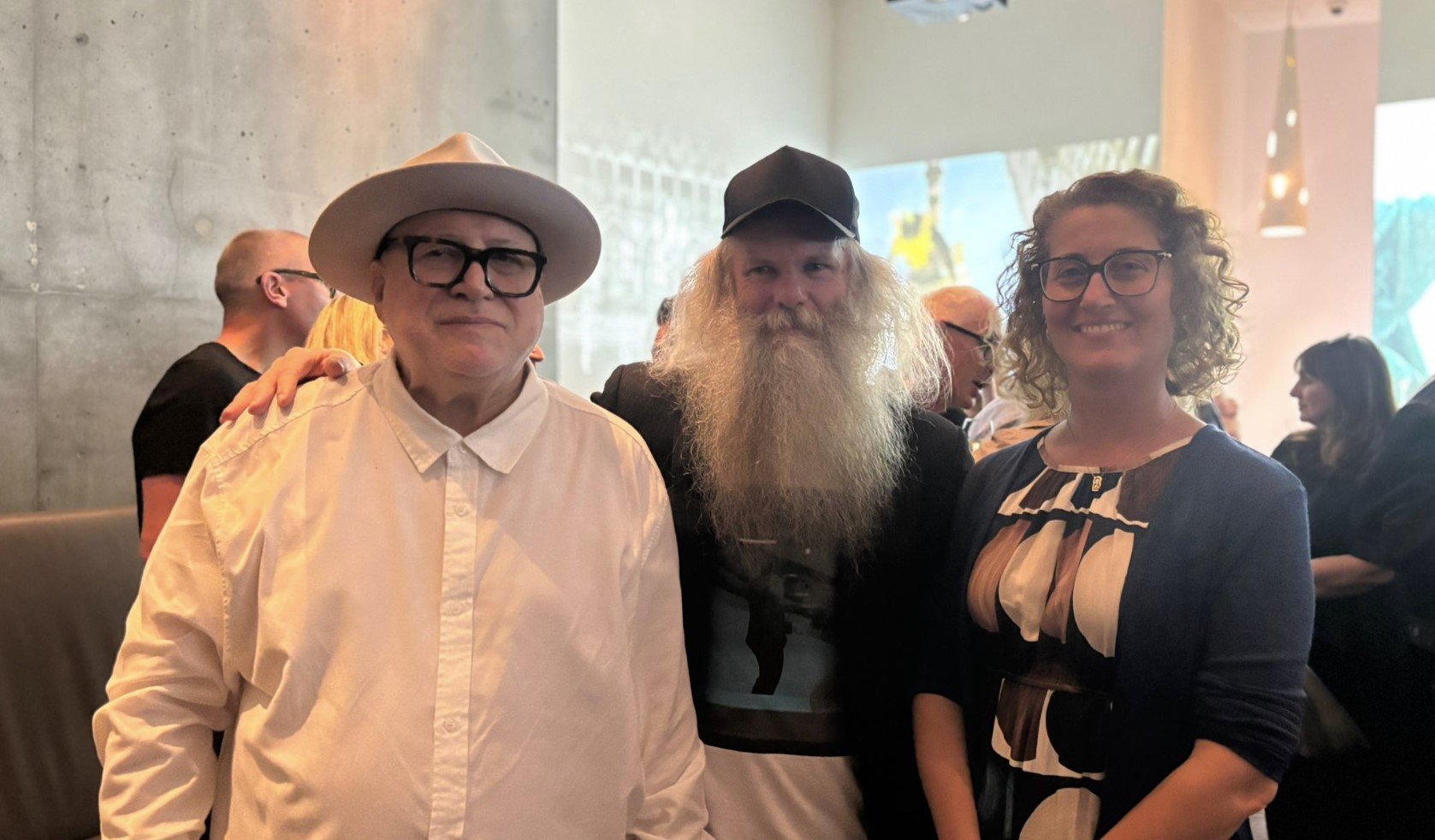
The immersive video installation was unveiled last Tuesday, February 17, with an elegant private opening at Di Stasio Città.
During the evening, art and haute cuisine found a rare, almost natural balance for a refined niche audience.
The ultra-contemporary restaurant space, bathed in soft light, became the backdrop for dynamic panels, anamorphic projections and an enveloping soundtrack.
It’s no coincidence that Di Stasio, a refined interpreter of Italian cuisine and long-time patron of the arts, chose Città to host the inaugural project of the Spazio Di Stasio platform: a model of independent patronage, removed from traditional gallery or museum frameworks, built instead on a shared vision between commissioner and artist. Its guiding principle: “Culture, Not Fear.”
Gladwell, born in 1972, is among the most recognised names in contemporary Australian art. His practice, largely centred on video performance, explores the relationship between body and landscape, gesture and architecture, moving fluidly between natural environments and urban spaces.
After his early work with the collective Imperial Slacks and his first solo project at Artspace Visual Arts Centre in 2000, his ascent was rapid: Yokohama, Busan and Sydney before representing Australia at the 53rd Venice Biennale in 2009—less than a decade after his first public gallery exhibition.
Spazio Tarocchi emerged from extended fieldwork in Venice, Milan, Rome and Naples. The work merges performance and moving image, reflecting on the symbolic language of the Tarot and the historical tension between astrology and astronomy.
Above all, it is a physical investigation: the artist’s body in direct confrontation with space—bridges, lampposts, civic architecture. The bridge, significantly, recurs as a motif, symbolising passage and suspension, but also dialogue between cultures and roles.
During the vernissage, Gladwell recounted one of the Venetian episodes that shaped the project’s genesis.
“It’s very early in the morning and I’m in Piazza San Marco,” he shared, “I see it empty, silent. One of the most crowded squares in the world is completely deserted—it’s just me and David Clarke.
“I decide to climb a 150-year-old wrought-iron lamppost. It’s essential for me not to leave traces, not to cause damage, not to disturb the city.”
There is no self-indulgence in risk, but rather an almost ethical attention to the gesture. “Spazio Tarocchi is interested in the physics of the jump and its meaning,” Gladwell explained in an interview with Vault magazine.
“It can use AI to enhance the images, but it does not simulate risk.”
The performances, sometimes unauthorised, have included encounters with Italian authorities—described as cordial and primarily concerned with safety.
His relationship with Di Stasio proved pivotal. “It wasn’t a transaction, but a dialogue,” Gladwell emphasised. Long lunches, rigorous exchanges, a shared vision intertwining art, architecture and conviviality.
Over more than four decades, Di Stasio has shaped a distinctive cultural presence in Melbourne, blending hospitality and aesthetic research into a single experience. Here, art is an integral part of the environment.
Also speaking at the opening was the Italian Consul for Victoria and Tasmania, Chiara Mauri, who described the project as “an invitation to all our senses to slow down”.
Mauri reminded guests that culture is not an abstract entity but a concrete instrument of dialogue and mutual understanding.
The message was reinforced by situating the work within a living, everyday space, where audiences encounter art without formal mediation.
The installation, with projections running for one hour and nine minutes, is supported by the technical work of Declan McMonagle, cinematography of David Clark, Judd Overton and Roberto Pio Di Monte. It was produced by Mallory Wall and Alana Kushnir.
A collective project integrated into the architecture of Città like a digital fresco, set to evolve further with a future XR component.
Art and cuisine, vision and matter, silence and sound: at Di Stasio Città, the boundaries between languages dissolve.
“I want the work to build itself before the viewer’s eyes,” Gladwell concluded.
“By slowing the images, you suspend the tyranny of gravity and can observe the grammar of the gesture. That’s where this work finds its meaning.”