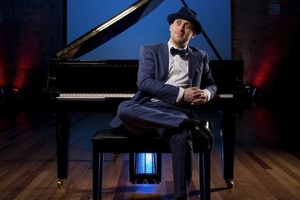
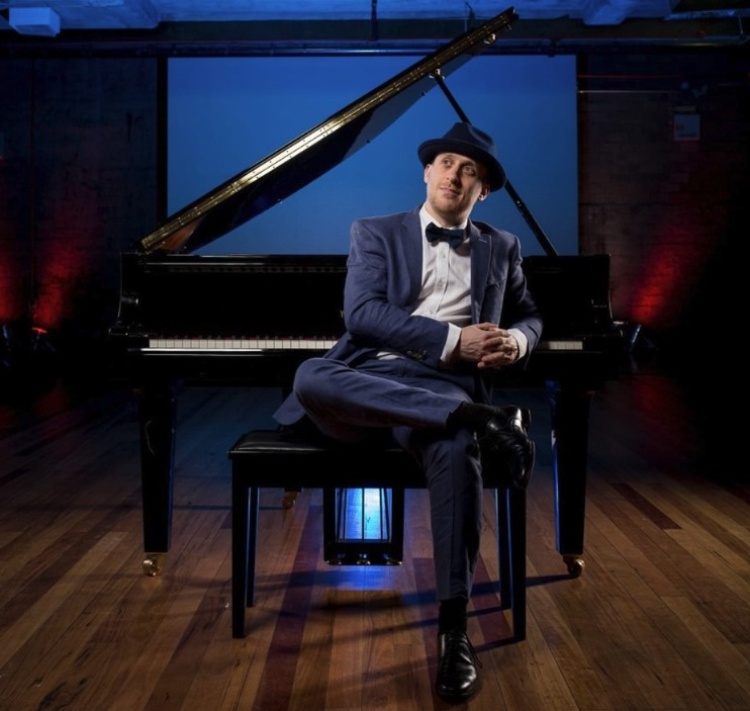
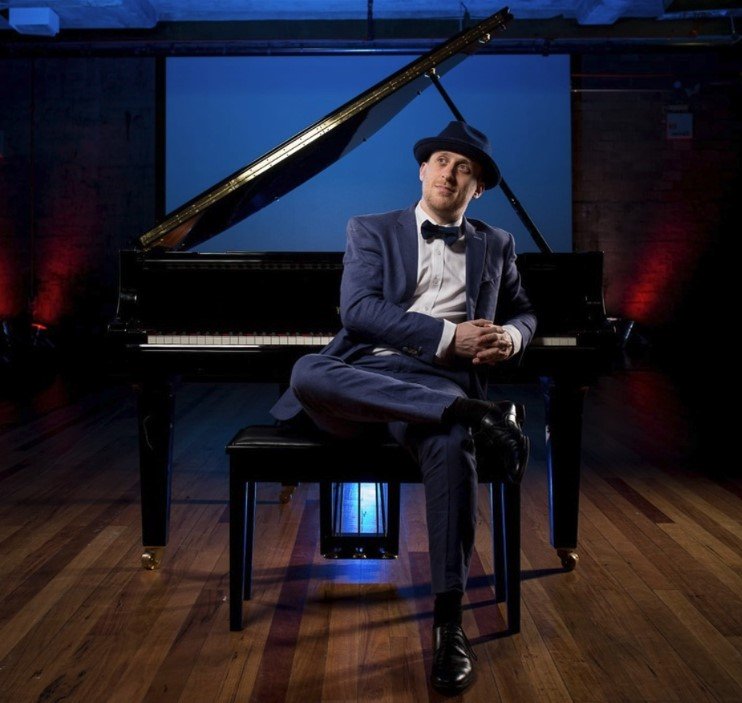
“I don’t have a clear recollection of my life before the piano,” he says. “My existence has only ever made sense through music. It’s never been work; it’s part of my identity.”
Tedeschi has performed on prestigious stages since childhood—playing Mozart at the Sydney Opera House at just nine years old. Nowadays, he prefers more intimate venues over the formality of grand concert halls.
His recent performance at the Camelot Lounge in Marrickville, an informal and intimate space, reflects this desire for closeness. “It’s one of my favourite places in the world,” he says.
“At a time when we all feel separated, it reminds musicians and audiences that we can exist together. Art doesn’t need distance or hierarchy: it can be intimacy, comfort, community.”
Looking back on that childhood concert at the Opera House, Tedeschi recalls no fear or anxiety. “I wasn’t nervous. I had no expectations to meet,” he recalls.
That absence of pressure now feels like a piece of irretrievable innocence.
“When I play Mozart now, I try to rediscover that kind of purity, but it’s impossible,” he says, “As adults, we know too much; we have lived too much.”
Over time, he admits, the weight of knowledge has made itself felt. “Playing today is harder—not just technically,” he explains, “I know the tradition, the greatness of the repertoire, and I feel an enormous responsibility.
“The music is always better than the way we can perform it. It’s humbling.”
This is a realisation shared by many artists. “An artist is always dissatisfied, because what they produce never matches the ideal they have in mind,” he shares.
Tedeschi’s relationship with memory, art and belonging is deeply rooted in his family history. On his father’s side, his family is Italian Jewish, originally from Turin. His grandfather was considered Italian until the introduction of the Fascist racial laws, which abruptly expelled him from the country.
Forced to leave, he arrived in Australia, where he was perceived as “too Italian”, suspected of fascist sympathies and interned in a camp.
“He was ‘too Italian’ for Australia and ‘too Jewish’ for Italy,” Tedeschi summarises. A state of suspended identity that profoundly shaped the family.
From his mother’s side comes a story of Polish Jews, raised in marginalisation, poverty and exclusion. “They were the same kind of Ashkenazi Jews from Central and Eastern Europe, but with completely different backgrounds,” he explains.
“Italian Jews were integrated into European culture; Polish Jews were outsiders.” This difference created tensions within the family, but also an early awareness of the complexity of identity.
Two years ago, when Tedeschi visited Turin for the first time, he felt something unexpected. “It was very strange. As soon as I arrived, I felt it was in my blood,” he says.
He visited the synagogue and the school his grandfather had attended—the same school as Primo Levi—and experienced a visceral connection to a city he had never known, yet had always carried within him.
The Italy that shaped Tedeschi is not one of stereotypes. It’s an Italy filtered through nostalgia, literature and loss. His grandfather, forced to abandon his studies, never overcame the trauma of not completing his final year of school—the year devoted to Dante.
“It was an obsession. For his entire life he felt he had lost something irrecoverable,” Tedeschi shares.
As a child, Tedeschi would listen to his grandfather reading Dante aloud on the sofa: “I think I grew up at a particular moment, when the old world was ending and I was still able to catch a fragment of it.”
Later, in his twenties, this inheritance transformed into an unexpected fascination with Italian gialli (horror films). “I don’t know exactly why, but in those films I found the Italy my grandfather had left: the tension between history and modernity, between order and transgression,” he recalls.
Alongside music, Tedeschi has long pursued writing. He published Fugitive, a work that weaves together family memory, trauma and European Jewish history, inspired by Sergei Prokofiev’s Visions fugitives.
“[With music], there’s no distance between sign and meaning,” he says, “It goes straight into the nervous system.
“Writing, on the other hand, is more cruel.” Writing requires time but offers no guarantees.
“You can work on a text for a year without knowing whether it works. It’s more sadistic than music.”
Tedeschi is currently working on a new book devoted to Friedrich Nietzsche, set in Turin, the city where the philosopher spent his final months before his mental breakdown.
“It’s not a traditional novel. It’s a psychological accumulation, a reflection on modern decay through a mind that merges with the city,” Tedeschi explains.
Turin continues to return to Tedeschi as an obsession and symbolic place. “It’s like a ghost inside me. I don’t really know it, and perhaps that’s why I feel the need to keep returning,” he muses.
Reflecting on what Italy has given him, Tedeschi says: “I am deeply grateful to Italy. It has given me an entire psychic landscape from which to draw artistically.”
Not a simple or reconciled homeland, but a complex inner territory shaped by memory, fracture and beauty.
Perhaps it is precisely there, in that unstable space between belonging and loss, that his art finds its most authentic voice.