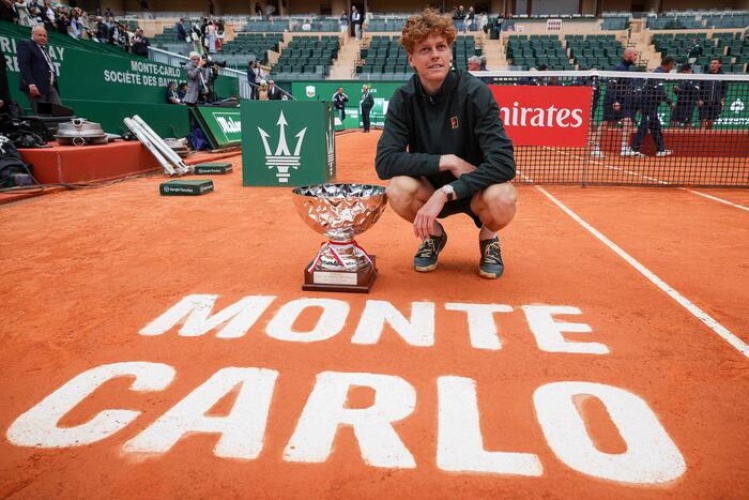
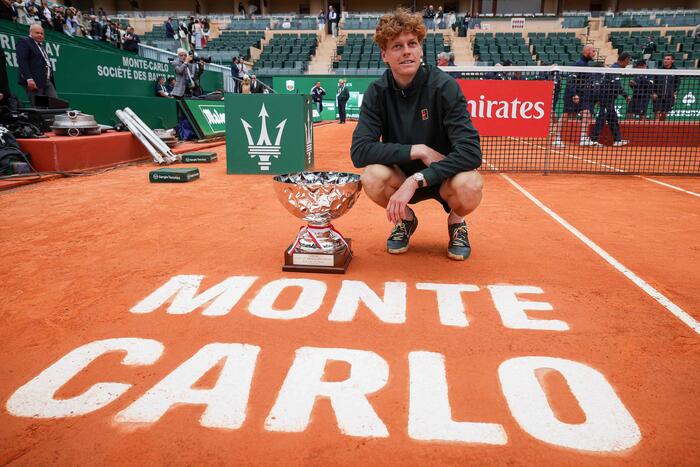
“It’s been an incredible week. I’ve played some great matches and I’m very happy. I tried to raise my level match after match and I managed to do it.” Jannik Sinner is back to his very best: on the clay courts of Monte Carlo, the Italian star claimed it all—his first title at the Principality Masters and, by defeating Carlos Alcaraz, the top spot in the rankings.
“Winning here means a lot to me, it’s a dream, just like in Italy,” he said, delighted with the milestone achieved on a surface that had not traditionally been his strongest. A journey built day by day.
“Every morning I wake up and try to improve as a player. Here we worked match by match, trying to understand the best approach against each opponent. We changed small details, and that’s what makes the difference.”
Sinner also admitted to a pleasant surprise: “Yes, I’m very positively surprised. I still need a bit of time to realise what has happened.”
The final against Alcaraz was finely balanced, also affected by the weather.
“It was a strange match, there was a lot of wind and the ball wasn’t bouncing much. I served well in the key moments, especially in the tie-break where I was very precise. The second set was more up and down for both of us—we were a bit tired, but that’s normal at the end of a tournament.”
On his rivalry with the Spaniard, he added: “He will keep improving and I need to be ready. We are very close, but the most important things are titles and Grand Slams.”
Sinner then reflected on his recent run and what lies ahead. “Winning Indian Wells and Miami wasn’t easy. Coming here and preparing the tournament day by day was crucial. I faced different players, constantly testing myself. I’ve understood many things about my game.”
And again: “Being number one is great, but what matters is working the right way. Now I’ll take a few days off, then we’ll think about the next tournaments.”
Alongside him, his team shared the satisfaction. Coach Simone Vagnozzi highlighted the value of the work done: “We’re really happy. Winning a major title on clay was one of our goals and there’s no better way to start.” Adapting to the conditions proved decisive:
“It wasn’t easy with the wind, but he played a very solid match, especially from a tactical point of view.”
The coach went into detail about the transition from hard courts to clay: “We started on Tuesday after two days off, working immediately on movement and sliding, which is the biggest difference. Then we added more spin, opened up the angles, introduced drop shots and variations. Everything improved day by day and it showed in the match.”
A process also fuelled by confidence: “The work done after Doha and the results in California gave him great belief. For top players, confidence is crucial.”
On the other side of the net, Alcaraz acknowledged his opponent’s merits: “I had many opportunities that I didn’t take. In the first-set tie-break I didn’t play well, while he was incredible when it mattered. I’m not surprised - his level on this surface is improving year after year. He’s reaching a level that makes him dangerous for everyone. He has the game to win anywhere.”
On the technical side of the final, he added: “He won mainly from the baseline, he was better in the rallies. And in the key moments he served very well—in the tie-break he barely missed a first serve.”
Finally, looking ahead to the clay season: “The goal is to play the full schedule, but it will depend on my body. I want to listen to it and arrive in the best possible condition in Paris.”