

These advantages include a plentiful diversity of foods, celebrations, music, literature, artistic forms, trade and, of course, languages to learn – and maintain.
In fact, the 2021 Census notes that there are over 400 languages other than English spoken at home. This includes 167 Aboriginal and Torres Strait Islander languages.
Whilst languages are a focus of mainstream school curriculum, there are other programs which continue to serve the community well. The support for languages learning is based on the recognition of the many benefits it provides the learner – and, in doing so, society more broadly.
Benefits include improvement of brain and memory function, the development of critical thinking skills, understanding of and appreciation of other cultures and ways of doing things, enhancing career opportunities, and opening the doors to travel and business. Some research indicates bilingualism and polyglotism even staves off dementia. In fact, many migrants have drawn on their language and cultural capital to start and enhance small to medium sized international businesses. Good for migrants and their children – good for trade.
Whilst mainstream schools offer an array of languages, these do not necessarily reflect the bountiful number of (non-Aboriginal) community languages alive in many households, for instance, Ukrainian, Macedonian, Polish, Hindi, Burmese – and Italian.
Alongside mainstream schooling, there is another sector which ensures community languages thrive and the linguistic and cultural capital of migrant children do not perish. Of course, the program is also open to those who are interested in learning the language, and what better way than to be surrounded by representatives of the culture to accelerate meaningful learning?
Latest figures by the overarching body, Community Languages Australia, indicate that this year there are over 105,500 students learning over 250 languages other than English. The community languages programs are delivered after school on weekdays or on weekends by almost 8000 teachers each week.
Languages represented include Italian, Japanese, Oromo, Dari, Arabic, Vietnamese, Mandarin, Swedish, German, Tigrigna and many more. Each of these represents a community which has settled in Australia.
If you ask the students why they are learning the language, their responses will range from wanting to be able to speak and play with cousins when they return to their family’s country, or their motivation is based on curiosity to know the language, also having a sense of the importance of maintaining the language to engage with nonni (grandparents), family, and others in their circle of friends in Australia. Some mention they want to be able to understand the music or, for those who are older, their purpose for learning is often based on career and travel aspirations.
The sector is led by highly dedicated members of the community themselves. For smaller community groups, teaching may occur in the back of a community hall. For other more established communities, these programs may be delivered in schools through a rental agreement. Generally, they are staffed by volunteer or paid teachers, depending on the means of the community and school.
Community Languages Australia, along with the community language entity in each State and Territory, provides quality assurance through a rigorous accreditation process. Further, it ensures teachers and staff continuously upgrade their knowledge and skills through professional development.
This year teachers and educational leaders from around Australia gathered for the annual National Community Language (NCL) Conference in September.
The Conference was held in Adelaide this year under the auspices of Community Languages Schools, South Australia. It provided a plethora of insightful and expert presentations.
Speakers included Professor Joe Lo Bianco who presented on a fascinating and timely theme: the future of community languages. He invited us to consider the influence of AI and other technologies on how we think, learn and teach. Noel Mifsud presented on languages and their direct relationship to opening doors to global citizenship. Prof Angela Scarino and Dr. Michelle Kohler presented research findings on the student experience of community languages. Heba El-Hakim presented on the Quality Assurance Framework that underpins the work of the sector. Admittedly, I also presented. My own piece was on the interrelationship between language and identity. And a second presentation on strategic approaches to educational leadership.
Mr. Brett Shuttleworth, Executive Director of Community Languages Schools South Australia (CLSSA) and his team of assistants ensured the three days of meetings, and the conference programs were both enriching and thought-provoking, empowering educationalists to continue to advance their practices. Mr. Binh Nguyen, Chair of Community Languages South Australia was pleased that the feedback from the many participants was that the conference was practical, engaging and visionary.
Mr. Stefan Romaniw, Executive Director of Community Languages Australia was pleased with the opportunity for the sector to come together to be enriched by the vibrant discussion and develop further skills and knowledge.
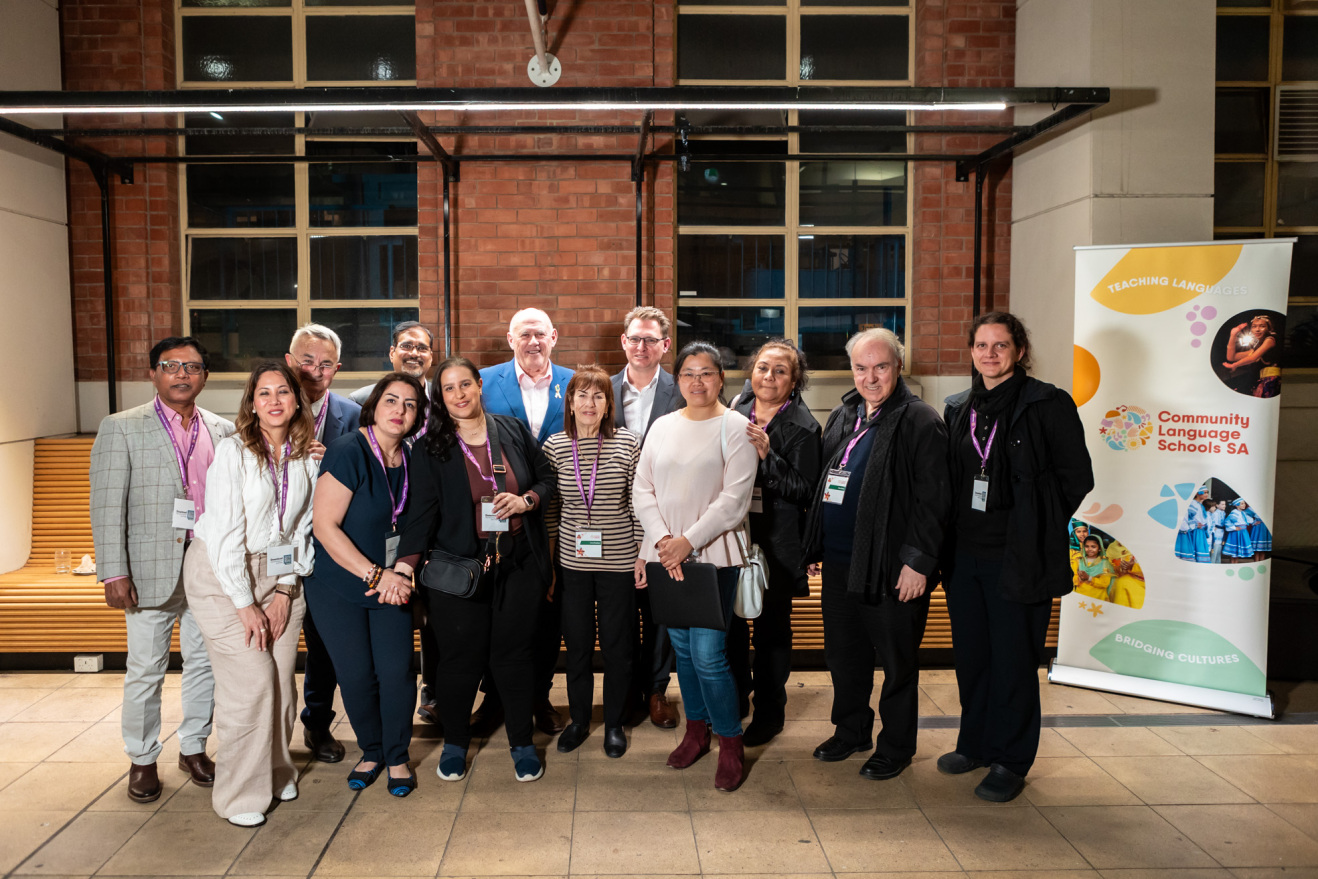
Executive officers and representatives of Community Languages Australia from each Australian State and Territory together with Mr. Stefan Romaniw AM (centre) at the National Languages Conference in Adelaide
On August 28, 2023, the Hon Andrew Giles, Minister for Immigration, Citizenship and Multicultural Affairs announced $15million of funds to the sector over two years. The aim is to ensure programs are strengthened in terms of quality teaching and resourcing. This is testament to the Government’s recognition of the important role community languages programs play in educating young people.
As we enter the final part of the year, many community language schools are involved in various celebrations, preparing for end of year concerts, and as expected, assessment.
Of course, there is also planning underway for 2024 programs and new students who will also take up the opportunity to broaden their language and intercultural skills.
So, if you have a young language lover in your family, there are plenty of opportunities to foster that polyglot and open the door to the world through languages. Often right on your doorstep.