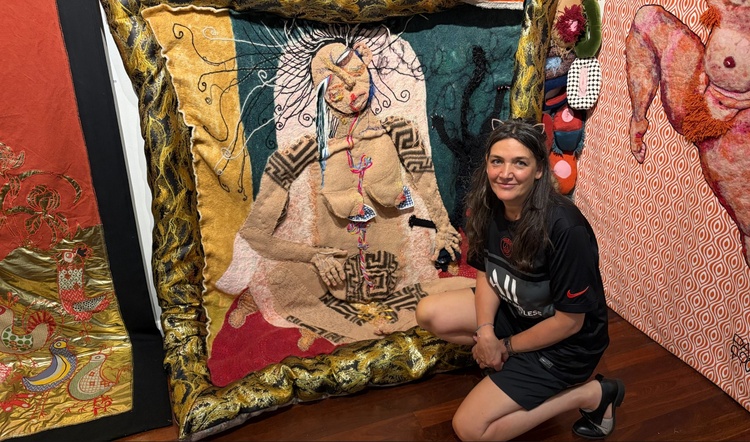
Her recent exhibition ABRACADABRA at Stirrup Gallery in Marrickville, which has just ended, confirmed this vision, presenting a collection of installations, sculptures and textile works that weave personal autobiography together with pressing social issues.
The title itself evokes transformation and magic, concepts that permeate Pasti’s work, where seemingly domestic materials such as fabric and paper become vehicles for critical reflection.
Born in Italy in 1969, Pasti brings with her a significant intellectual background. She holds a degree in D.A.M.S. (Disciplines of the Arts, Music and Performance) from the University of Bologna, where she studied under the renowned semiotician Umberto Eco.
This training is reflected in her constant search for “unexpected connections between different forms of cultural expression”, an approach that animates each of her works.
Her professional artistic journey has taken her across Europe—15 years between Luxembourg and Paris—before arriving in Australia, on Gadigal land, as she herself acknowledges with political awareness.
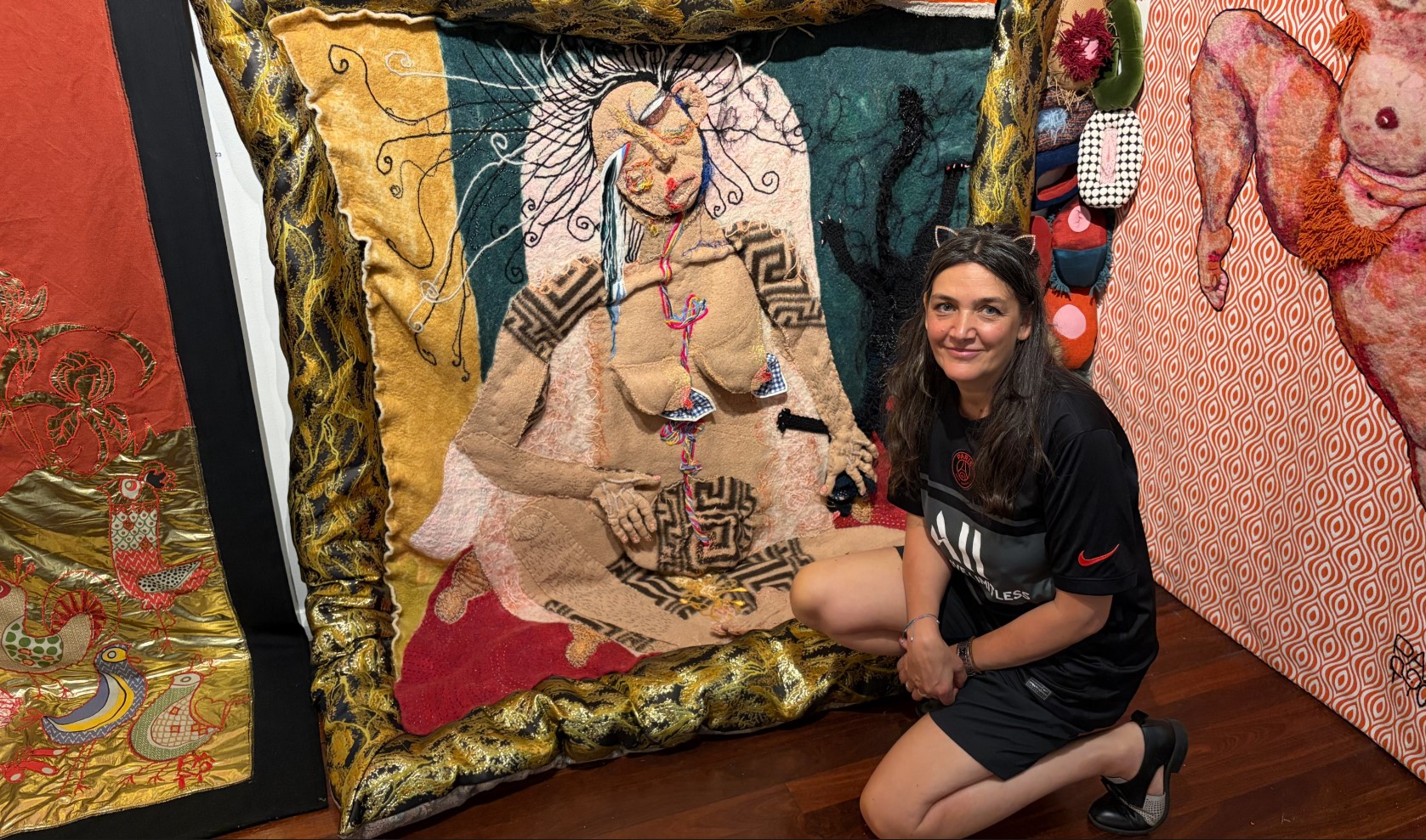
In ABRACADABRA, Pasti presented deeply personal works exploring themes of rebirth and inner healing. Rebirth, a piece completed only recently, depicts a kneeling figure made from 60-year-old mountain blankets, a direct reference to the artist’s childhood memories.
“The central concept is taking care of your inner child, of the feminine aspect of yourself, as if we were mothers to ourselves,” she explains.
The work includes an umbilical cord from which wool emerges, then returns into the throat and reappears from the eyes, symbolising a continuous cycle of emotions.
The artist’s commitment to sustainability is reflected in her use of recycled materials: wool purchased from op shops, recovered cotton pieces and other found objects that acquire new life and meaning.
Nameless, a sculpture reminiscent of a bird, emerged from a transformative experience Pasti had: a six-week artist residency in Broken Hill, in the Australian outback, supported by Create NSW.
“I played with the meaning of ‘broken’ and ‘healing’,” the artist shares. The work incorporates references to tarot cards that accompanied her during the residency: room number 9 (the Hermit), studio number 10 (the Wheel of Fortune) and the address 313 (card number 13, Death, traditionally ‘nameless’).
From the same Broken Hill experience came other significant works: a cage containing a bra found locally, symbolising “the woman who is caged, observed but not heard”, and a bra with a pickaxe paying tribute to the strength of local women who support their husbands in the physically demanding work of mining.
Since arriving in Sydney, Pasti has quickly made her mark on the local art scene. Her works, with provocative titles such as Dicktators, Man-Holes and Tinker, Tailor, Soldier, Sailor…, were shortlisted in 2024 for prestigious awards including the Woollahra Small Sculpture Prize, the North Sydney Art Prize and the Burwood Art Prize.
The influence of her mentor Umberto Eco is evident in the way Pasti treats materials and symbols. Just as the semiotician taught how to read cultural signs, the artist decodes and recodes fabrics, threads and forms to create new meanings.
Her art is a language that speaks of power, gender, memory and social transformation. With her uncompromising approach to artivism, Pasti represents an important voice in contemporary Australian art—one that continues to evolve, reflecting and challenging the society around her.