On January 10, Premier Jacinta Allan declared a state of emergency due to a wave of bushfires that has ripped through vast inland areas and placed enormous pressure on firefighters, resources and infrastructure.
Bushfires are nothing new in Australia: naturally flammable vegetation, dry heat and strong winds have long created ideal conditions for fast-moving, aggressive fires. But this time, authorities and firefighters say the combination has been brutal.
So much so that Country Fire Authority chief Jason Heffernan, in an interview with The Guardian, said that “in some parts of the state, we were exceeding the threshold recorded on Black Saturday”.
Among the most critical fronts, Longwood has quickly become a name making headlines. The fire has affected an enormous area—132,400 hectares, according to State Control Centre updates.
More than 630 firefighters and over 150 vehicles were deployed in a race against time to contain a blaze described as “extremely dynamic”, capable of changing direction and running across multiple fronts.
The fire, brought under control thanks to a massive effort by ground crews and supporting resources, came close to some homes but posed no danger to people in several areas that were evacuated in time.
Still, the scale of the emergency has upended life for entire rural communities, with fires also impacting the areas of Merton, Yarck, Molesworth and Alexandra, where the fire front shifted south-east, driven by wind and dry vegetation.
By January 15, according to reports in several newspapers, the fire had already devastated 137,000 hectares in central Victoria, destroying around 100 homes and damaging about a dozen more, with heavy consequences for agriculture and infrastructure.
Even popular tourist destinations were among the communities evacuated, alongside dozens of other towns.
At the same time, authorities are now trying to determine the cause of the Longwood fire. A State Control Centre spokesperson mentioned that a “truck trailer under investigation” could be the origin of the blaze—a lead being examined by Victoria Police’s Arson and Explosives Squad. It’s a complex investigation, they say, and will take time.
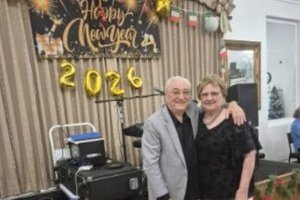
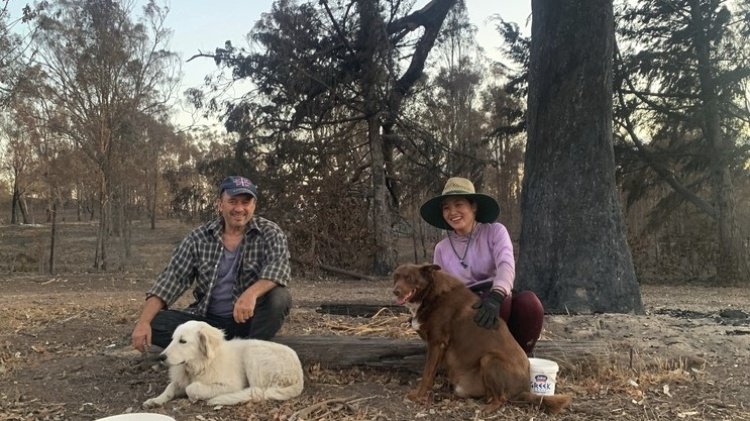
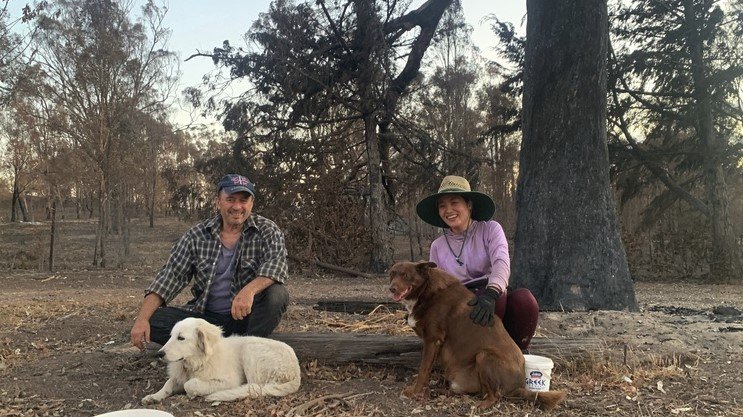
But behind the numbers are stories that statistics alone cannot capture. Like that of Pietro Porcu, owner of Italian restaurant Da Noi and the driving force behind a farm in the Yarck area, about 10 kilometres from the town centre, in the Gobur district.
“The warnings were saying, ‘Leave now, otherwise you won’t even be able to get out on the road.’ We weren’t ready. We grabbed the dogs, the kitten and went to Melbourne,” he said.
The fire, he added, did not immediately consume the property. “We had fires nearby, but they weren’t coming towards us. Then the wind changed and suddenly it took everything.”
When the news came through, there was nothing left to save: “We had the little house and unfortunately, it’s completely gone. Everything went, just like that, in an instant.”
Sheds, machinery, the tractor— “It all disappeared.”
And yet, amid the devastation, Porcu experienced an unexpected stroke of luck regarding his animals.
“We were incredibly lucky in the despair of it all—we found almost all of them alive,” he revealed.
But heartbreaking losses was inescapable. “We lost a small pig that didn’t manage to escape. It was a horrible thing to see,” he said.
Yet the goats, donkeys and most of the livestock survived: “I don’t know how they did it … we found them all a bit shocked, but they’re all here.”
The damage, however, is enormous. “Roughly estimating, at least a million dollars between the house, sheds and machinery,” he said.
Then there are the orchards cultivated for 30 years, the vegetable garden, the kilometres of fencing and a lifelong asset: “I grew seeds that I produce myself every year. Almost 30 years of seed stock … varieties I created myself. We lost everything, even the seeds.”
The olive grove was also hit. “It might recover, but for the next few years we won’t see olives,” he lamented. “We have 250 trees I planted when I first arrived here, 20 or 25 years ago, and they became—like the land itself—my joy.”
For Porcu, the farm was not just a place of work, but an extension of the restaurant: a direct supply chain from paddock to kitchen.
“For me it’s essential,” he said, “If love is given from the beginning—from the seed, from the little plant that bears the fruit—and then it reaches the plate, it’s a different flavour you offer your customers.”
Despite the damage, he remains steadfast: “The restaurant has to stay open. It’s a historic place.”
And historic it truly is: according to South Yarra history books, in 1865 Ricciotti Garibaldi, son of Italian revolutionary Giuseppe, is said to have opened a shop on the very premises that now house Da Noi, and the current kitchen is believed to have been his.
The difficulties in recent weeks have also been deeply practical. With no power and no refrigeration, even storing eggs has become impossible.
“We’re giving them away in the nearby town, they’re being distributed to those who need them, because I can’t keep them in this heat,” said Porcu.
The most urgent problem now is feeding the animals: “The paddocks are destroyed. Everything is black.”
Holding things together, though, is the network of solidarity that moves quietly in an emergency. “They’re bringing us so much help: neighbours, organisations from nearby councils,” he revealed.
“Grain, hay, a bit of everything. Everyone helps everyone. There are people who lost their property and they’re there helping others. Real altruism.”
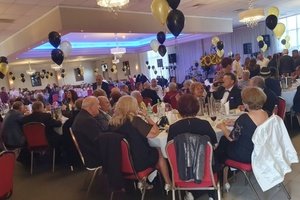
The Italian and Sardinian communities have also mobilised. Porcu’s daughter, Romey, has launched an online fundraiser through the restaurant’s social channels (danoi95 on Instagram or via this link), while associations and groups are organising support initiatives, including a charity lunch.
“You feel the community everywhere, here and also far away—Melbourne, Sydney—friends who want to do something for us,” Porcu said, visibly moved.
The vice-president of the Circolo Sardo di Melbourne, Mauro Sanna, has given this wave of solidarity a precise name drawn from an old Sardinian tradition.
“In Sardinia there is Sa Paradura,” he explained. “When a shepherd suffers a major loss due to fires, theft or disasters, the whole community mobilises—each family donates a head of livestock.
“It’s not charity, but an act of brotherhood, a social right and duty.”
It’s a concept that has become urgently relevant again in Victoria, where recent fires have forced evacuations, left behind hundreds of destroyed structures and thousands of livestock lost, as well as a heavy impact on farms and the mental health of affected communities.
In this context, Sa Paradura becomes a practical way to start again—a pact of unity and fairness that the Sardinian community in Australia is putting into action to support fellow Sardinian Porcu and his daughter Romey, devastated by the Longwood fire.
On the public assistance front, a support fund of more than $100 million has been announced for people and businesses affected.
For information on available support, the Emergency Recovery Hotline (1800 560 760) is active.
Updates on recovery hubs and open information centres can be found on the VicEmergency website, which remains the key reference point for official alerts and updates, together with the VicEmergency app for bushfires, floods and storms.
In a Victoria still burning and bracing for difficult days, Porcu is trying to turn his devastating loss into a drive forward.
“Not to despair over what’s been lost,” the restaurateur concluded, “but to find strength for what must come next.
“The fire has given us a page—not white, but grey—where we can redraw our future together.”