“The drum has truly been my most faithful companion in the world,” Alfio Antico says on air at Rete Italia, “It’s like my mother’s breast that taught me how to feed.”
These words explain, better than any technical analysis, the profound bond between the Sicilian artist and his music.
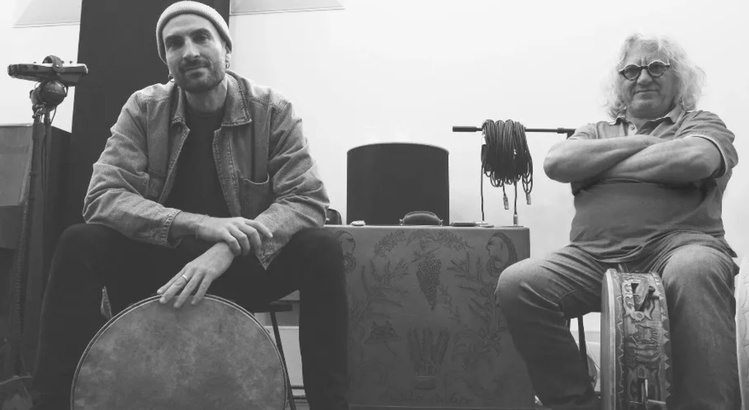
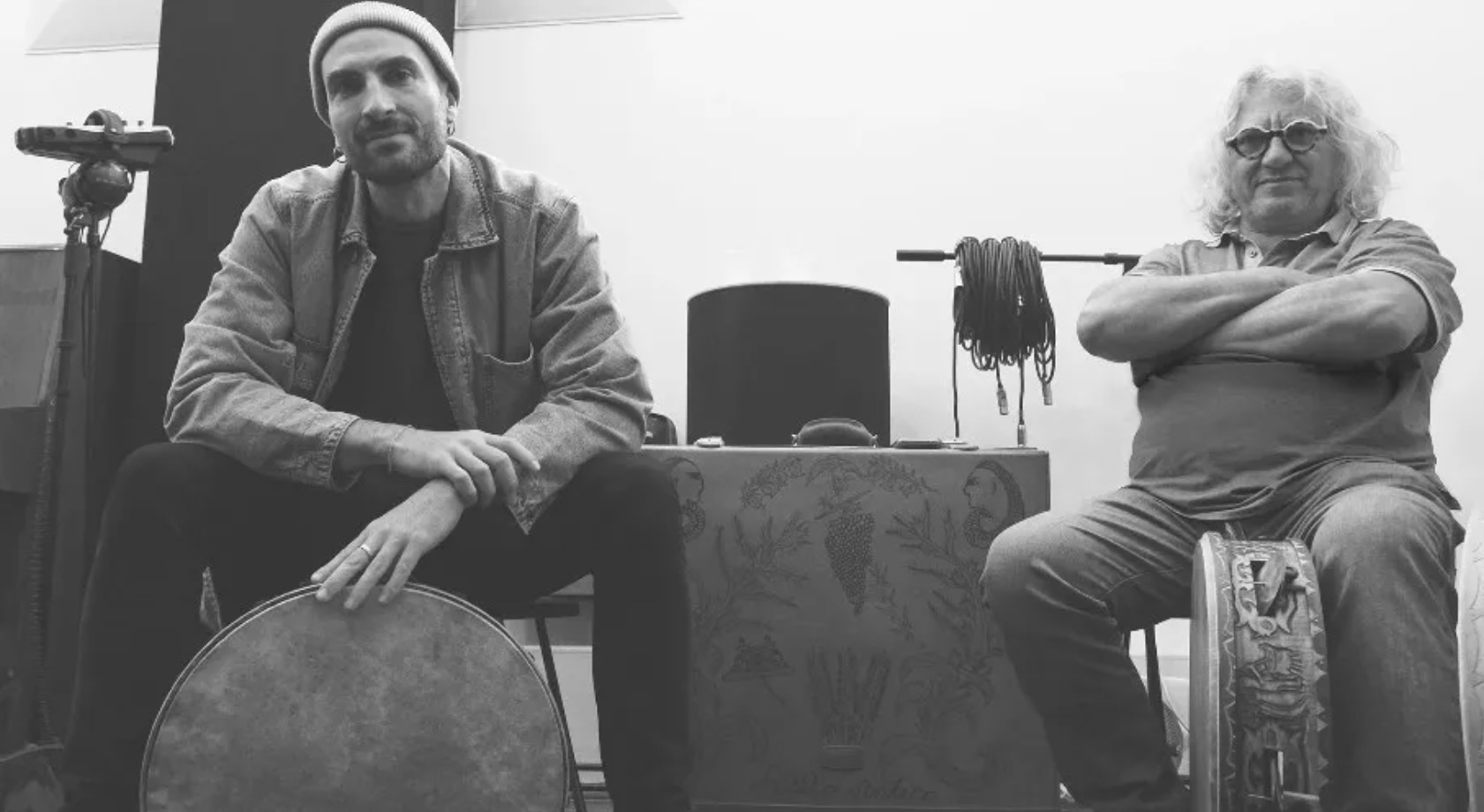
Antico’s latest album, La macchia, was born from the encounter between a musician and his producer, both coming from musically distant worlds.
The collaboration began almost by chance, thanks to Giulio Fonseca—known as Go Dugong—a friend of Antico’s son, Mattia.
“He asked if I could collaborate on a track and I said, ‘Of course, with pleasure.’” From there, over time, came the idea of a “somewhat electronic” album, moving between composition and improvisation.
Improvisation, however, is no incidental element—it’s the beating heart of the project. “It came later, when we recorded,” he explains.
And it’s there that Antico’s music inevitably returns to its origins: “Travelling through mythology, through my culture … like the sea, which is never the same—sometimes calm, sometimes violent.”
The starting point is always the drum. But in Antico’s case, this is no ordinary tambourine—it is a personal, unique instrument. “My drum is a proper instrument, not a tambourine,” he insists.
Deeply immersed in folk tradition, Antico has spent decades transcending, transforming and reinventing it, always with respect, care and study. His path has crossed the history of music—his drum features in Fabrizio De André’s Don Raffaè—but also theatre and diverse musical experiences. “I’ve developed every technique of sound through my drums,” he says.
In his story, the drum is born from the earth and from everyday life. The first drum Antico built was made from sheepskin. “My uncle helped me,” he recalls. The sheep was called Barulè—meaning baroness.
Barulè was a beautiful, strong animal that, after death, became sound. “If we put it in lime, we’ll make a fine drum,” his uncle told him.
Behind this story lies a vivid portrait of a rural Sicily that now feels distant, yet remains the matrix of everything for Antico. “I have always been connected to nature,” he says.
He also recounts the hardship of his childhood: a sick father, the need to work as a shepherd, poverty. “I had to face that life, but my dream was to become a musician,” he recalls.
Yet his music is not nostalgia; it is living memory, transformed into contemporary language. Even when it meets electronics, Antico never loses contact with the earth—he claims it with pride.
“I used to be ashamed to say where I came from,” he confesses. But today, that root is his strength. He builds his drums himself, and no one can reproduce them.
“No one knows how to play my drums,” he says. He has sold very few; to him they are almost sacred objects.
His inspiration comes from the fields: “When the wheat makes waves, I try to follow it with my left arm.” It is a poetic gesture, perfectly describing his aesthetic: music as imitation of nature and an attempt to follow a rhythm that existed before humanity.
In his playing, the left arm is central. “The left commands and the right enjoys itself,” he explains.
When the two meet, magic happens. His explanation is unexpectedly physical: “It’s like making love. If you let them caress each other… you get sound without causing harm.”
It’s in this balance that the theatrical dimension of his concerts emerges. Antico appears on stage like an archaic warrior, the drum pressed against his body.
“It’s like a shield,” he says. A shield that protects “the chest, where the heart is, and the belly”. The drum becomes struggle, resistance, discipline.
In the coming days, Alfio Antico will be in Australia at WOMADelaide, performing at the festival on March 6, 7 and 9. He promises an intense and powerful show.
“It will be beautiful,” he says enthusiastically. “It will all be built on improvisation, but we all know where we’re taking the music.” A game of freedom and rigour, where musicians pursue one another. “They follow me and I follow them,” he says.
Towards the end of the interview comes a more sombre reflection on the state of folk music in Italy. Antico does not mince words: “I see it as forced, a bit lost.”
In his view, truth has been replaced by repetitive formulas, trapped in musical stereotypes frozen in time. “I see it as cold, like a postcard. There’s no love, no truth.”
For him, folk music is not something to imitate, but to live, breathe and embody. Without that life, without that land, it risks becoming merely a mask.
Alfio Antico has always refused that mask. In his drum there are the farmhouses, the soil, the threshing floor, the ricotta sold at the market in his hometown of Lentini in Catania and the voices of street vendors.
There is deep Sicily, but also a possible future. A future where tradition is not a postcard, but a drumbeat—true, real, human and unrepeatable.