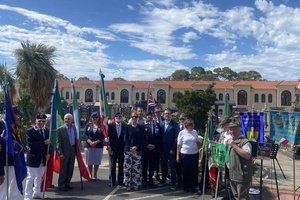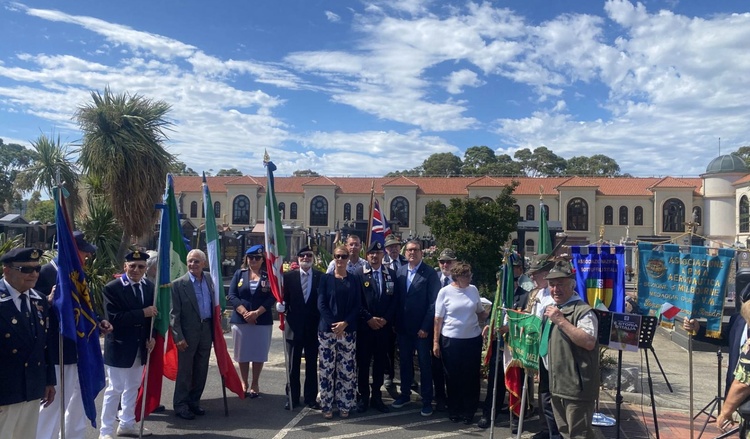
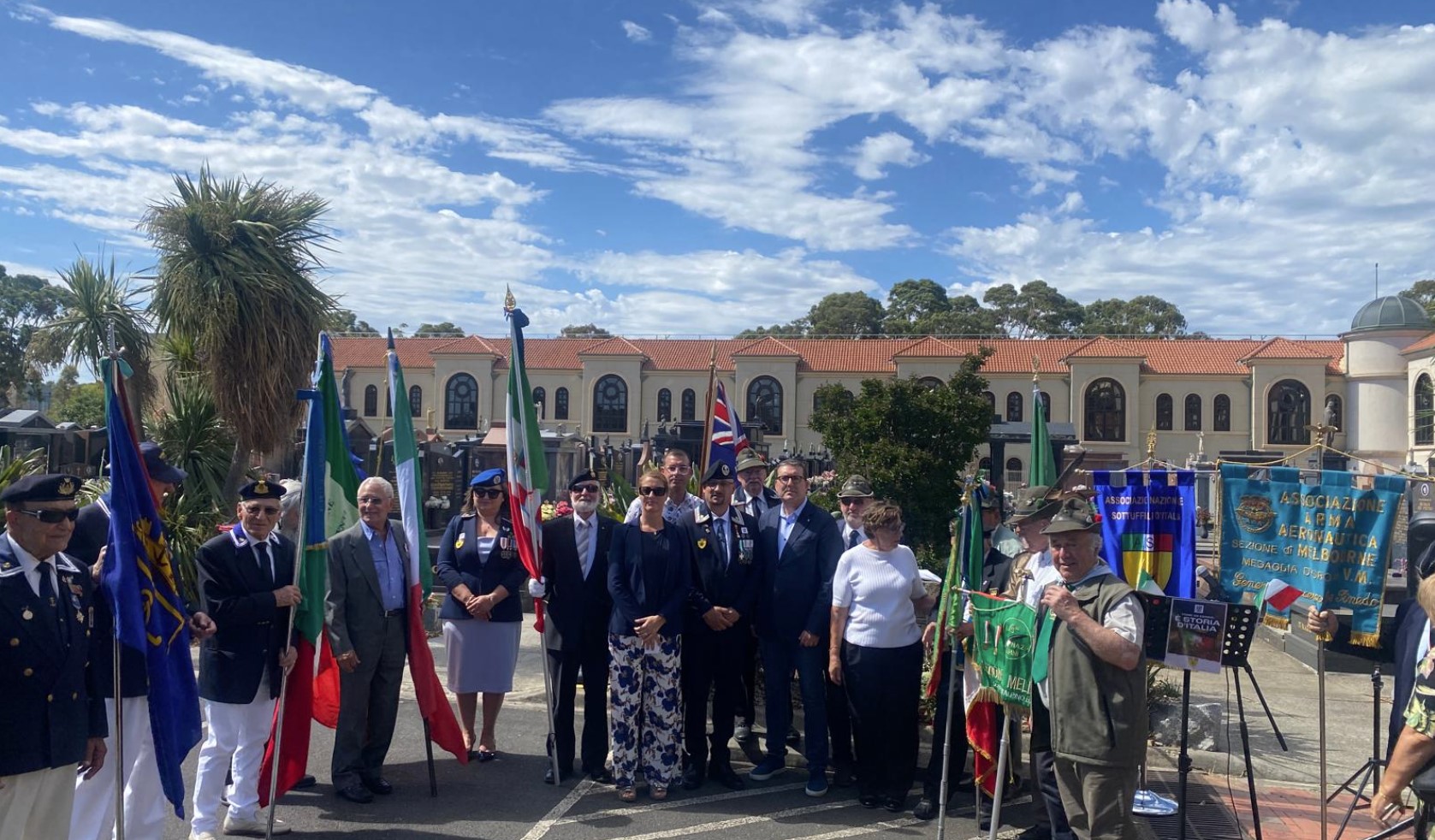
Present were Consul General of Italy for Victoria and Tasmania, Chiara Mauri, President of Com.It.Es Victoria and Tasmania, Ubaldo Aglianò, and President of A.N.S.I. Melbourne, Felice De Lucia.
The initiative was held on at Preston Cemetery and was organised by A.N.S.I. Melbourne, under the patronage of the Comitato 10 Febbraio. Also in attendance were A.N.S.I. Vice President Danilo Abrotonite, Secretary Simona Franghi and Vincenzo De Paolis, representing Senator Roberto Menia.
The commemorative moment was marked by the laying of a wreath, the sounding of the Last Post and the singing of the Australian and Italian national anthems, accompanying a moment of reflection.
The Day of Remembrance, observed each year on February 10, was established by Law no. 92 of March 30, 2004.
The occasion not only honours the victims—Italian men and women killed in the foibe sinkholes of the Friuli-Venezia Giulia and Istrian Karst regions—but also recalls, in a broader sense, the tragedy of the forced exodus of the Italian population from Istria, which took place between 1945 and 1956 following the transfer of the territory from the Italian State to the Socialist Federal Republic of Yugoslavia.
The mass displacement involved at least 250,000 people who were forced to abandon their homes, property and roots, finding themselves exiles in post-war Italy.
“A commemoration that invites reflection and recollection … to restore dignity to the memory of the victims and give voice to a chapter of European and Italian history that for too long remained on the margins,” said Consul Mauri, underlining that “a community that remembers is more aware”.
“Remembrance is important—it keeps oblivion at bay,” President De Lucia added.
“To memory we must add historical recognition, long denied,” observed Ubaldo Aglianò. “It is a necessary step to render justice to the victims and to ensure these events are finally studied and understood.”
And indeed, without remembrance and critical reflection, horror risks repeating itself. The past, after all, is never entirely past. Its meaning is not fixed, but depends on how we choose to interpret it and assume it in the present.
Historical memory, therefore, demands a sense of responsibility that does not merely recount what has already happened, but allows it to exist meaningfully in our lives today.
In this context, the testimony of Irene Rogers Lussetti proved especially poignant. Lussetti is the daughter of Marcello Agostinis, one of the founders of the Famiglia Istriana Social Club and builder of the burial niche where the ceremony was held.
“My father sought a simple life here in Australia, but he always kept Istria and Italy in his heart,” she said. In her words was also a call for vigilance, so that such tragic events can never be repeated.
At the close of the ceremony, one essential truth emerged: the past, however terrible, cannot be embalmed as a distant collection of facts, detached from our existence.
History challenges us. It offers a lesson that can and must inform our present. Without that living connection, any event would lose meaning and fade into nothingness.
“To separate remembrance from the responsibility of inheritance would be to empty it of its deepest significance,” Aglianò concluded. Top of FormBottom of Form