
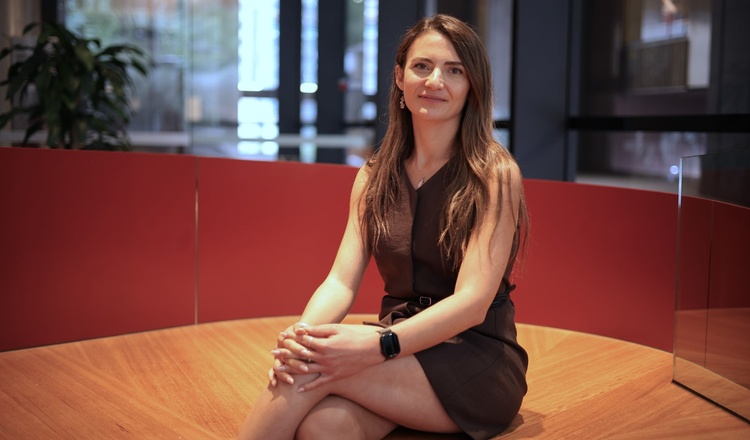

This person, within five or six minutes, can work out whether a transfer is money laundering, financing terrorism or committing fraud.
You also probably don’t imagine that this person is an Italian woman with a degree in economics who left her beloved Rimini in pursuit of the “Australian dream”.
Today, Tamara Angerame is a Financial Crime Analyst at National Australia Bank (NAB), one of the country’s four major banks.
Her job involves sifting through thousands of transactions every day, spotting red flags and helping to dismantle criminal networks that make headlines when the Australian Federal Police arrest drug traffickers or multimillion-dollar fraudsters.
“The most satisfying part is seeing the impact our work has on society,” Tamara explains.
“When you see news reports about federal police arrests, people caught with huge quantities of drugs or major money-laundering scandals … well, we help provide the pieces of the puzzle that are needed to build a case and make those arrests happen.”
Angerame’s story begins like many other Italian expat stories: with a suitcase, a working holiday visa and the idea of a temporary experience abroad.
It was May 2014 when she landed in Sydney, fresh from completing a master’s degree in economics, majoring in accounting & auditing.
“During university I started travelling and I knew that once I finished my studies, I wanted an experience overseas,” she says.
“For a long time, I thought it would be the United States. But during a trip there I met a group of Australians who made me curious about this far-away continent.”
The US didn’t win her over as much as she had hoped. Australia, praised so highly by those chance encounters, seemed more promising—plus, one of those Australians later became her partner.
Like many Italians arriving on a working holiday visa, the first months were about adjustment. Cafe work in West Ryde, babysitting in Burwood. These were honest jobs, but she was far from using her qualifications.
“You have to adapt to the language—I spoke English, but I certainly wasn’t used to the Australian accent,” Tamara recalls with a smile. “After six or seven months I said to myself: ok, it’s time to try and get into an office role.”
But in 2014 the situation was very different. In the corporate world, the working holiday visa was viewed with suspicion.
“You were basically not considered,” she explains. “You had to change employer every six months and companies didn’t see you as an investment.
“Today, doors are more open because there are short-term projects, but back then it was another story.”
Her first real breakthrough came with an administrative role at the University of New South Wales, one of Australia’s most prestigious universities. Her year of experience there opened doors in finance.
Then came a year at Deloitte—a heavyweight name on her CV before she found something she was genuinely passionate about.
“I was looking for something in corporate finance that really interested me,” she says.
“I also have a degree in accounting, and when I started researching financial crime—account monitoring, transaction analysis, the investigative side of anti-money laundering—I thought, ‘This is it. This is a field that could suit me.’
“I felt I could use my studies without leaving everything behind.”
Financial crime is a niche sector, so niche that in almost five years of experience, first at Commonwealth Bank and now at NAB, Tamara has yet to meet another Italian.
“We all kind of know each other in this field, because people move between banks,” she reveals.
“I’ve run into former CBA colleagues, seen current colleagues move on … but Italians? None. I’m the odd one out.”
So, what does it really mean to be a Financial Crime Analyst? Imagine analysing hundreds, sometimes thousands, of transactions a day, looking for suspicious patterns, connections and movements that make no economic sense.
“We monitor our customers’ transactions to make sure they’re legitimate and that there’s no money laundering, financing of terrorism or other criminal activity,” Tamara explains.
“We work with AUSTRAC, the government authority responsible for financial intelligence, with the Australian Federal Police and with ASIC (Australian Securities and Investments Commission).”
The job requires a sharp eye and steady nerves. “In my first year I thought, ‘I’m going to mess this up, I’ll miss suspicious transactions,’ she admits.
“Now, I open a case, look at the transactions and within five or six minutes I can tell if it’s suspicious or not. Experience teaches you where to look.”
There is also continuous training on so-called red flags—warning signs that may indicate illicit activity.
The hardest part, for Angerame, is the sheer volume. “The amount of data, the number of transactions you have to investigate every day and the pressure of not missing anything [is tough],” she says.
“Sometimes you’re analysing a case with just one customer; other times there are links and you have to open multiple investigations. I’ve had cases with 20 or 30 connected customers to investigate.
“In those moments you think, ‘I’ll never finish, it’s endless. Every time I analyse one customer I find more connections.’ You get a moments of anxiety.”
But there is always an end. And there is always that sense of satisfaction, knowing that your work has made a difference.
Ultimately, Angerame’s story shows that with determination and the ability to adapt, you really can go anywhere, even becoming the “odd one out” that quietly watches over the bank accounts of millions of Australians.