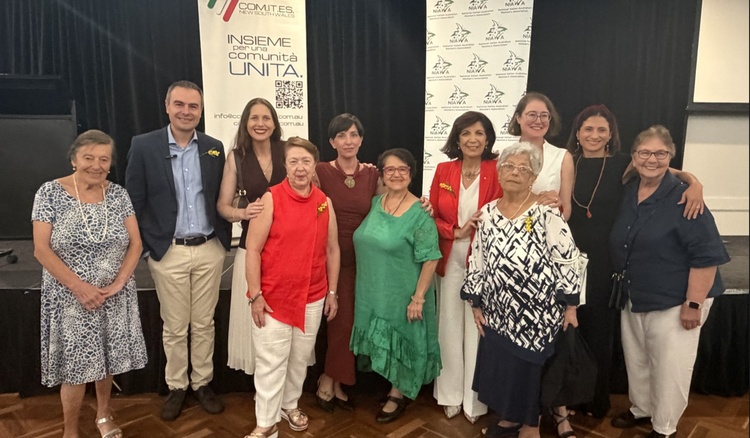
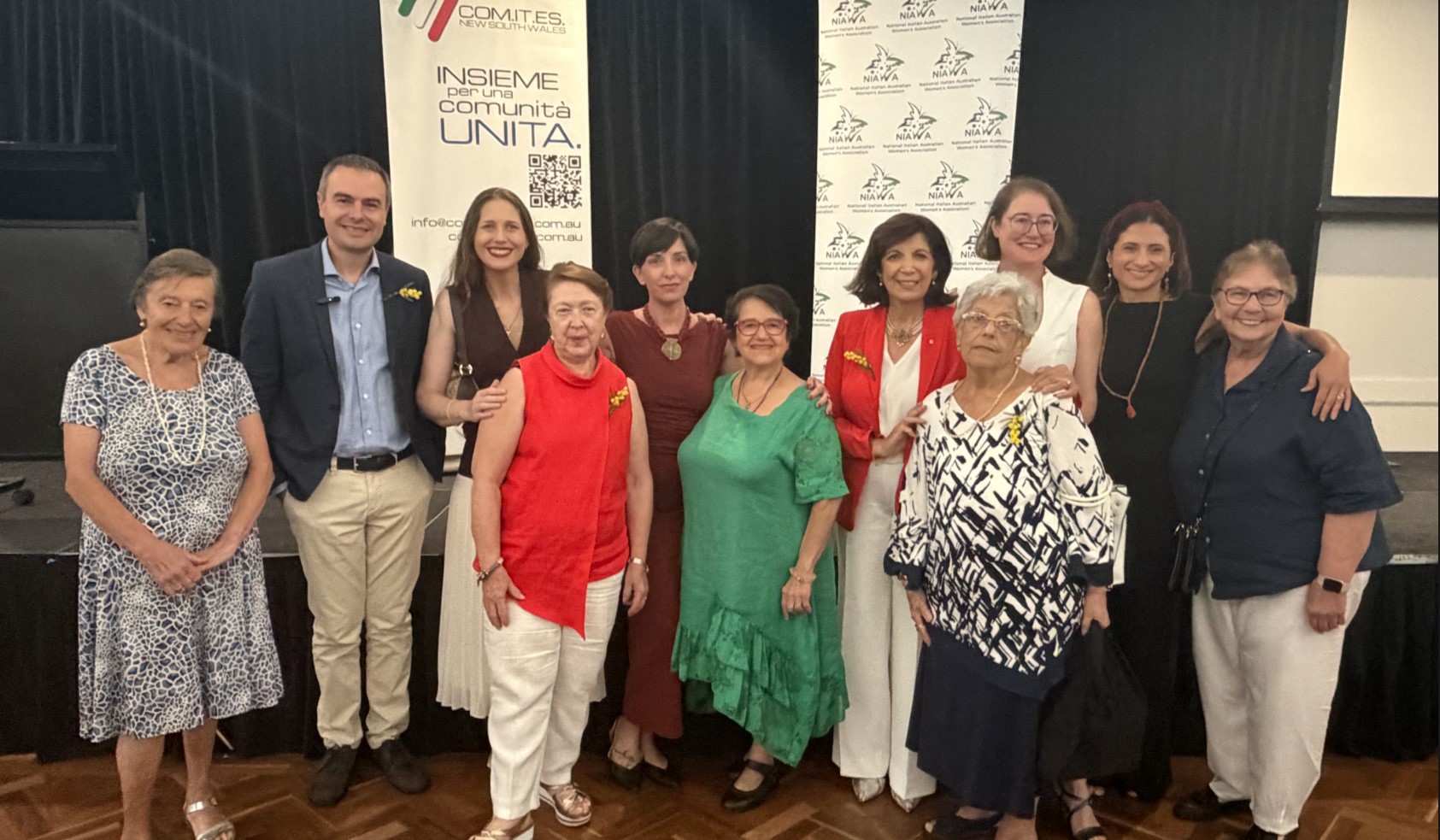
The event was centred on the screening of the short documentary Fili invisibili.
Directed by Fabio Schifilliti, the film tells the stories of two victims of femicide, seventy years apart: Graziella Recupero in 1956 and Sara Campanella in 2025. The director joined the event via Zoom, answering questions and engaging directly with the audience.
The director of the Italian Cultural Institute, Marco Gioacchini, and NIAWA honorary president Franca Arena were unable to attend due to prior commitments.
Following opening remarks by Com.It.Es president Luigi Di Martino, NIAWA president Concetta Cirigliano Perna traced the history of the term “femicide” in her address.
She also guided the audience through centuries of cultural narratives that have, at times, normalised violence against women, from Dante’s Divine Comedy with Paolo and Francesca, to Shakespeare’s Hamlet and Bizet’s Carmen.
“At the end of these works, we find ourselves applauding, captivated by the beauty of the music and performance, without always realising that what we have just seen is a femicide staged before us,” she said.
She noted that even popular music is not exempt, citing Tom Jones’ 1968 song Delilah, widely sung across generations, which in its original English lyrics tells the story of a femicide.
The song was performed during the event with an Italian translation, prompting reflection on how such narratives have been normalised.
Perna also recalled that Italy only abolished the “honour killing” law and forced marriage provisions in 1981—legal frameworks that for decades protected male power rather than women’s dignity.
At the centre of the event was the screening of the short film, which presents two parallel stories.
In 1956, Graziella enters a church seeking an adult who might see beyond her restrained smile. In 2025, Sara’s teacher senses her distress but fails to create a space where she can speak. Seventy years apart, the outcome is the same.
“The thread linking these two femicides is not only violence, but the silence that comes before it,” Perna said after the screening.
“A silence made up of fear, shame, isolation and lack of trust. A silence that is not the responsibility of the victims, but of a society that has yet to create safe spaces.”
After the discussion with Schifilliti, which also included questions from Com.It.Es vice-president Lisa Genovese, NIAWA committee member and psychologist Marina Zochil addressed the psychological dimensions of trauma.
She spoke about subtle forms of abuse that leave no physical marks but erode identity and confidence, the difficulty of speaking out and the importance of support networks.
The event offered an opportunity to reflect on how much remains to be done to build a safer and more just society.
“Silence protects the perpetrator, never the victim,” Perna concluded.