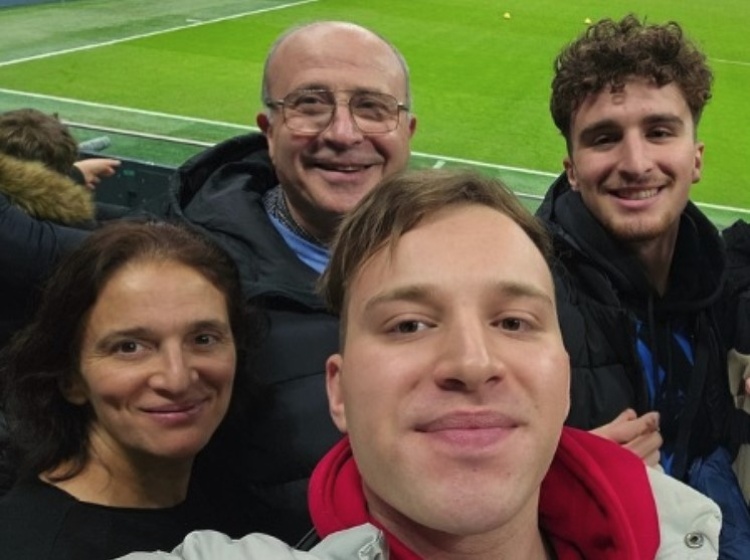
Born in Esine and raised in Cevo, a small mountain town in Val Camonica in the province of Brescia, Adam is now one of many young Italians who have made Australia their second home, settling with his family in Wollongong.
Unlike many of his Italian-Australian peers, however, he has made a conscious decision not to let his roots fade.
The Ammoune family’s story is typical of many migrant families, with one distinctive detail. “Every Italian summer coincided with the Australian winter,” Adam explains. “Basically, in June, July and August we were in Australia, then we went back to Italy for everyday life, school and work.”
His mother, who grew up in Australia with relatives in Sydney, had maintained a strong connection with the country, while his father, of Syrian origin, had built his life in Italy.
In 2018, as Adam was finishing middle school, the family decided to reverse course. “We did everything a bit backwards,” he says with a smile. “Our everyday life became Australia, and then every year we went back to Italy for Christmas.”
It’s often assumed that culture shock only affects those who move to countries that are radically different from their own. Adam discovered, however, that even Australia—despite being a Western country—holds deep differences.
“At the beginning it was hard,” he admits. “There was a culture I didn’t understand, and a school system I didn’t understand.”
For a boy raised in a small mountain village, even Wollongong represented a completely new world. “I had to quickly learn how to take the bus, how to navigate even a small city—I was used to village life.”
According to Adam, differences emerge in the details. In Italy, dates such as Holocaust Remembrance Day or Liberation Day are pillars of collective identity. In Australia, although Anzac Day exists, he feels those kinds of commemorations don’t carry the same cultural weight.
The school system also required adjustment: from the Italian, more memorisation-based approach to the Australian model, which prioritises critical thinking and practical application.
It was precisely this experience of uprooting and reintegration that gave Adam an early awareness: cultural identity is fragile and can disappear within a single generation.
“I see that kids my age, Italian Australians, don’t really know their culture very well,” he observes with a hint of sadness. “Maybe they know the food or things like that. But in my experience, many my age can’t really speak Italian well.”
This realisation led him to an initiative that is both personal and meaningful. In 2023, he began teaching Italian—initially as a freelancer, then in a more structured way.
“I wanted to strengthen my language because I was afraid of losing it while living abroad,” he admits. “You learn so much when you teach.”
His teaching approach is pragmatic and effective: assessing the student’s level, building a personalised pathway, starting with vocabulary expansion and gradually moving towards forming complete sentences. It is a method Adam knows well—he speaks Italian, English, Arabic and French.
What strikes him most is how quickly Italian identity fades in younger generations. “The few times I’ve spoken Italian in Australia, it’s either been with recent migrants or with grandparents,” he says.
For him, the solution lies in direct intergenerational contact: connecting young people with grandparents who still know Italy, even if it is the Italy of 40 or 50 years ago.
His message is directed at Italian-Australian parents: “If there are parents who know Italian, they should pass on their language and culture, because it can be lost very easily.”
It’s a warning born of firsthand observation. “Even though the community is large in numbers, I’d like to see a bit more spirit, a bit more culture in that sense,” he says.
“If you look at the Indian community, even second or third generation, I think they know their culture a bit better.”
Today, Adam is completing a double degree in International Relations and Finance at the University of Wollongong—a path that allows him to develop both his technical skills in the world of finance and his passion for cultures and international relations.
He’s happy about having moved to Australia, about the friendships he has built and the experiences lived.
“I don’t know yet what the future holds. I’d like to return to Europe, maybe to Italy itself, to live my adult life there, because I haven’t experienced Italy as an adult,” he shares.
In the meantime, Adam continues teaching Italian to anyone who wants to learn it. In an age of accelerated globalisation, Adam represents a generation striving not to lose its roots while building wings to fly wherever the wind may take them.