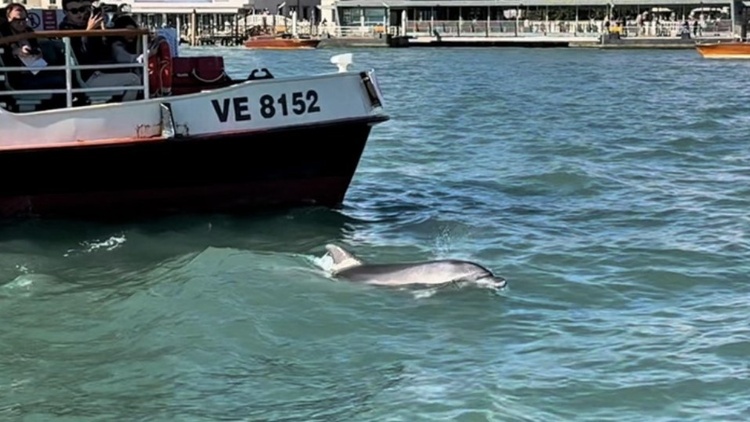
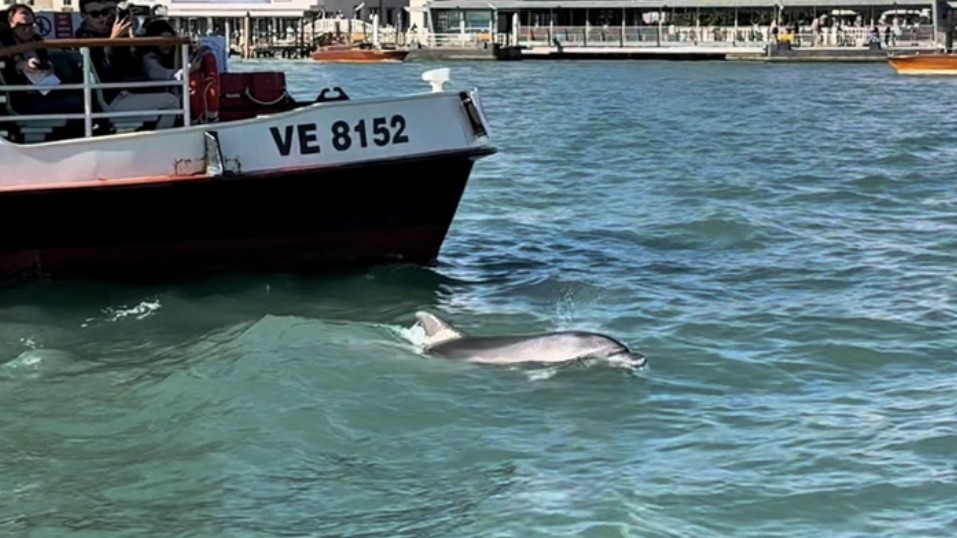
The animal has been performing acrobatics within view of St. Mark’s, dodging gondolas and vaporetti in one of the busiest areas of the Venice lagoon.
Since the beginning of October, sightings of the dolphin in St. Mark’s Basin have been frequent.
While bottlenose dolphins—the species to which “Mimmo”, as some have nicknamed him—are not uncommon in the ecosystem surrounding the Veneto capital, it’s more surprising that this individual has decided, at least a month ago, to move to one of the noisiest and most crowded areas, experts say.
The dolphin’s presence has attracted the attention of curious onlookers, tourists and even animal rights activists and experts concerned about the animal’s health.
Da qualche mese a Venezia c’è un delfino, appartenente alla specie protetta dei tursiopi. Dai veneziani è stato ribattezzato “Mimmo”, ed è diventato subito l’attrazione di migliaia di turisti che affollano ogni giorno la laguna pic.twitter.com/tWP9JsENqP
— L'Espresso (@espressonline) November 10, 2025
Its condition is currently good, and, according to the Venice Natural History Museum, it appears to have been released into the sea several times.
This would prove that the animal isn’t trapped in the lagoon but is staying in St. Mark’s Basin voluntarily.
Monitoring, also carried out by the local Cetacean strandings Emergency Response Team (CERT) and the Coast Guard, is ongoing.
But concerns remain, as the dolphin could be injured by boat propellers and, on a few occasions, vaporetti have had to make last-minute manoeuvres to avoid it.
On Saturday, a flash mob was held in St. Mark’s Square by a group of citizens demanding greater respect for the dolphin.
In recent days, they have started a petition calling for it to be returned to the sea as soon as possible.
“The normal traffic of gondolas, boats and vaporetti is now being joined by several boats, which come specifically to see and photograph it,” explains Cristina Romieri, one of the initiative’s promoters.
“Some even bring tourists—we even saw them absurdly throw a ball.”
These behaviours have prompted experts to issue a “handbook” for approaching the animal.
Among the precautions is maintaining a distance of at least 50 metres.
“We must try not to disturb the animal, not get too close and not cut it off if we’re on a boat,” warns Luca Mizzan, director of the Natural History Museum.
“Don’t try to feed it, or in any case turn a wild animal into something different, thus making it too familiar with humans.
“We also hope it will decide to return to the sea.”
This relocation toward the open sea could come as temperatures drop and fish leave the area.
ANSA