
Elena Camera, the school’s Italian teacher, once walked the very same halls as a student and even sent her own two daughters to the school. She recalls that even while she was a student, languages were highly valued.
“We studied Italian and French right through to Year 12, and it was during those high school years that my love for Italian really began to take root,” she shares.
Although Camera has Italian heritage, the language wasn’t spoken fluently at home.
“My parents met here in Melbourne after my father moved from Tocco da Casauria, in Abruzzo, at the age of 24. They worked in the same factory, and for my mother, who was just 16 at the time, it was love at first sight, even if she pretended not to care for a while,” she says with a smile. A few years later, the two married and started a family, raising Camera and her brother.
“At home, we spoke dialect with my mother and English with my father, so I really began studying proper Italian only at school,” she explains.
That passion continued into university, where she majored in Italian, and later into her professional life as a teacher.
Returning to the Academy of Mary Immaculate as a teacher four years ago, Camera brought with her years of classroom experience and infectious enthusiasm.
Camera is also the coordinator of the school’s trips abroad. Last year, she travelled with a group of students to Italy, visiting major cities and offering unforgettable experiences like a cooking class in Florence and a bike ride along the ancient walls of Lucca.
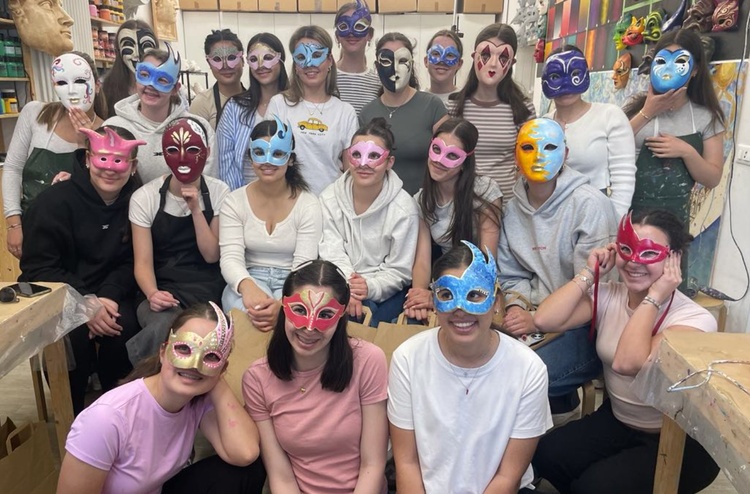
“We also made traditional Carnival masks in Venice during a workshop that was a real hit with everyone,” she adds.
Always looking for new ways to engage her students, Camera blends cultural exploration with language instruction, often reminding them that “learning a language is about so much more than memorising grammatical rules”.
She incorporates films like Roberto Benigni’s Pinocchio, Pixar’s Luca (set in Liguria) and Bianca come il latte, rossa come il sangue to tie language learning to modern Italian culture. Literature also plays a key role in her classes. This year, with the help of a language assistant provided by Co.As.It., students are reading Va’ dove ti porta il cuore (Follow Your Heart) by Susanna Tamaro.
“It inspired us to create a blog where students wrote stories based on memories. It was fascinating to see how they wrote about their grandmother’s moka pot, the smell of coffee or their grandfather’s garden that’s no longer there,” Camera reveals.
“With Year 9, we read Il piccolo principe (The Little Prince), and for Year 10, I’m planning to introduce Romeo and Juliet in Italian next year,” she adds.
Books are important, but music also plays a vital role in vocabulary building and cultural understanding. That’s why Camera brings the Sanremo Music Festival into her lessons, helping students connect with contemporary Italian music while sparking classroom discussions and deeper learning.
Another staple of the Italian program is participation in the Dante Alighieri Poetry Recitation Competition, a unique way for students to engage with Italian poetry and perform publicly.
“Some of them get very dramatic with it,” she jokes.
Always seeking to inspire and support her students, the work Camera does emphasises the value of an all-girls school like the Academy of Mary Immaculate, where young women can grow emotionally, academically and personally in a safe and supportive environment, guided by teachers who truly care.