
Italian teacher Maria Lyon, smiling and energetic, then accompanies me to her classroom, which is decorated with posters, photographs, vocabulary lists and maps. Shortly after, a group of Grade 1 and 2 students arrive.
After the welcome song, which the little ones know by heart, they review the days of the week and months of the year before talking about whose birthdays are on this week - a particularly interesting topic for young students.
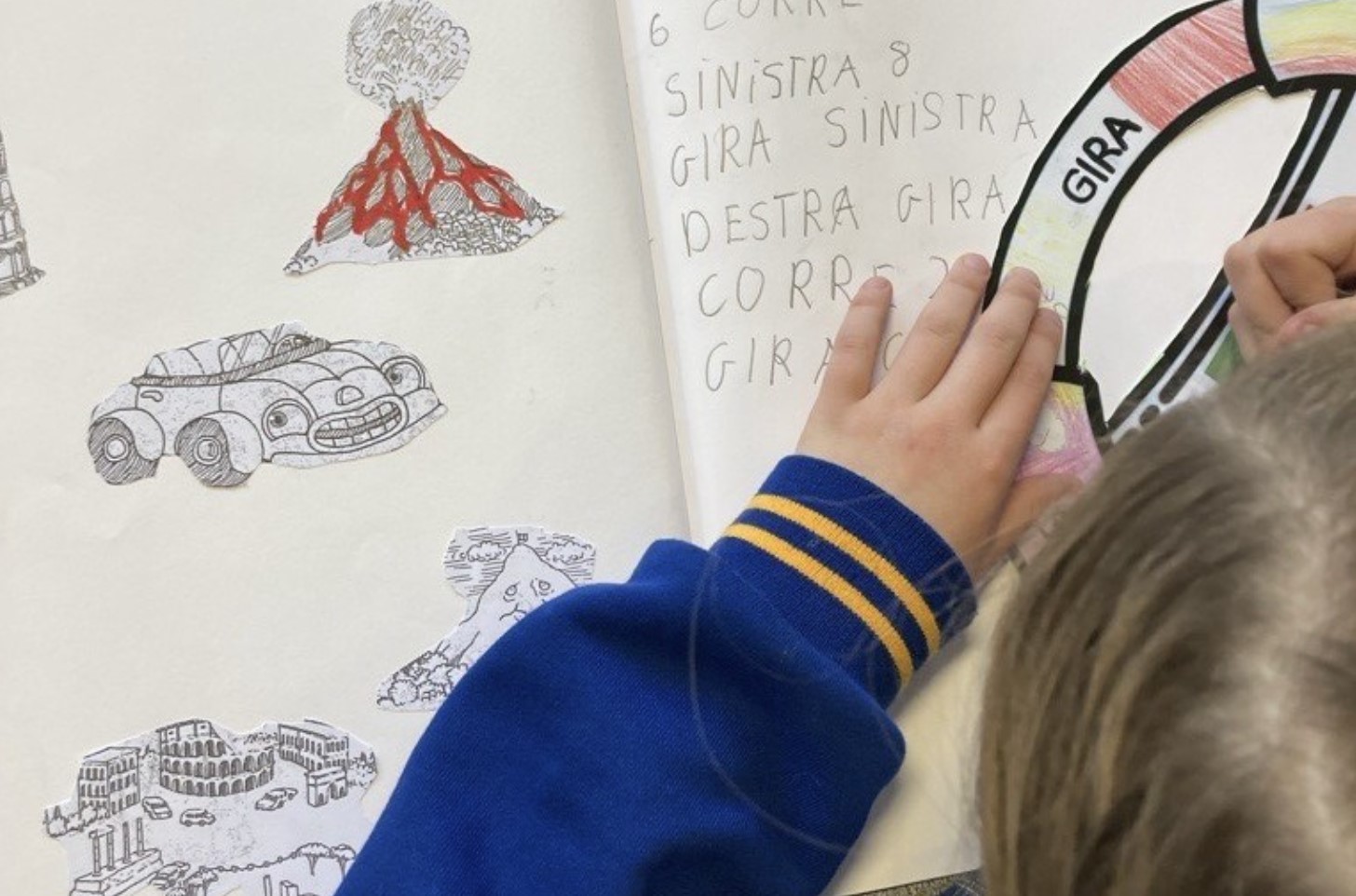
Next comes La Macchinetta Rossa, the song inspired by the book that tells the story of an exciting journey along the Italian Peninsula. The students remember all the cities visited by the little red car and listen carefully to the instructions in Italian that Lyon gives in preparation for a game she uses to teach directions.
Using a cardboard steering wheel as a prompt, the children write out an imaginary path for their classmates, deciding whether to send them right, left, forward or backward, and by how many steps. They then head outside to try and follow each other’s instructions. It’s fun to watch them wandering around the schoolyard, moving in every direction based on their classmates’ commands.
Once back in the classroom, the lesson ends with a dance, lots of energy and the use of Italian for most of the time. Lyon strongly believes in the importance of immersing her students in the language as much as possible, using gestures to help with memorisation.
“When I first started teaching Italian,” she recalled, “I spoke very little of the language with the students.
“Then I came across the AIM method (Accelerative Integrated Methodology) and realised the benefits of speaking Italian in class. That’s why I try to use Italian as much as I can, although I then repeat what I say in English as well, to make sure everyone understands me.”
Having spent her life behind a primary school desk, Lyon is aware of the responsibility she holds. Regarding languages, she believes in the “the importance of nurturing the ones we speak at home, because otherwise we risk losing them”.
At Pascoe Vale Primary School, they celebrate Carnevale, sing Italian songs in a children’s choir and learn new words under the guidance of the Language Leaders (a group of students who make sure everyone in class, including teachers, knows the words of the week). It’s a great way to expand their vocabulary.
The words are chosen from everyday objects and expressions, so every teacher at the school can invite the children to “pack their backpack” or “get their snack”, incorporating a bit of Italian into every lesson.
“It’s important to build the habit of listening to other languages as well, especially considering that so many are spoken in Australia,” Lyon emphasised.
In the little free time she has, Lyon writes Italian Storybooks 4 Teachers, a small and carefully curated range of classroom resources with engaging stories and games. The project was born from her classroom experience and the constant need to find original and stimulating ways to make children love the Italian language.