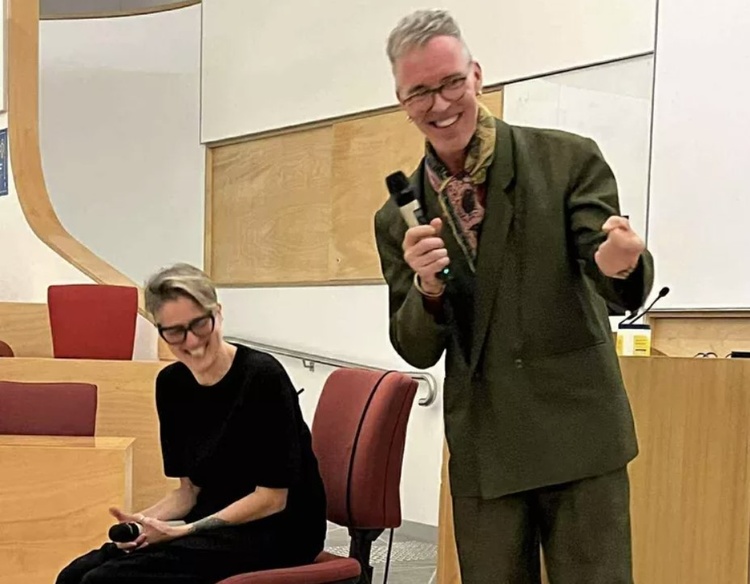
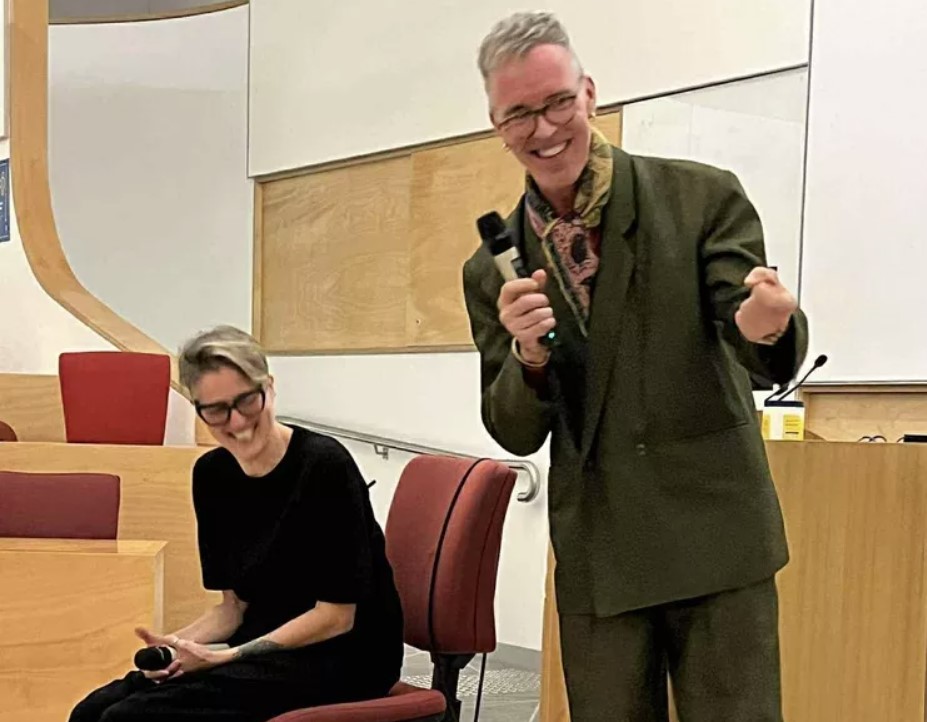
The project forms part of The Secret Life of Language, the podcast of the School of Languages and Linguistics, conceived as a broad and flexible space.
“It’s a very evocative title, but also a very wide one,” Absalom said, “and precisely for that reason it becomes a kind of container for different series or mini-series.”
Among these series is Matt’s Chitchats, a collection of informal conversations with guests from academic and cultural circles.
The idea grew out of a long-standing habit. “I’m someone who never stands still,” he shared.
“When I have guests at the university, I’m always thinking about different possibilities.”
So, when linguist Vera Gheno visited Melbourne some time ago, Absalom seized the opportunity.
“While she’s here, let’s have a chat as well,” he figured. From there, Absalom recorded a series of conversations and later shaped them into a structured project.
With Gheno, the discussion moved well beyond the topics for which she is best known. “We talked about music, about Italian, about identity,” Absalom revealed, noting that there is no fixed script—“it really depends on the guest”.
In an upcoming episode, he will host sociologist Cosimo Marco Scarcelli from the University of Padua, whose research focuses on media, adolescents and sexuality.
“It’s a very topical issue, especially in light of current debates,” Absalom observed, referring to the recent ban on social media access for under-16s.
Another episode will mark the centenary of Dario Fo’s birth, in conversation with Scottish scholar Joseph Farrell.
Farrell is the author of several major works on the Nobel Prize-winning playwright, including one of his most significant biographies.
Absalom’s connection to Fo’s work runs deep. He regularly brings it into the classroom, where each year his students stage a theatrical piece—an activity he sees as essential for fostering creativity and linguistic awareness.
The podcast has also featured Kerstin Pilz, a former academic now turned writer, and Amanda Burns, author of The Italian Affair. These conversations explored not only their books, but also the journey from academia to authorship—a transition that is far from straightforward.
Creative and inquisitive, Absalom possesses a rare gift: the ability to listen. It’s a skill nurtured by his enjoyment of “being with people and asking questions”. “For me, it’s wonderful,” he shared.
Combined with a strong creative instinct, it drives him to find new ways of expressing ideas and viewing the world from different perspectives.
While four episodes are already complete for this first season of Matt’s Chitchats, a new series is already in development—this time dedicated to food, a rich meeting point between language, culture and identity.
Among the names he hopes to involve are chef Stefano de Pieri and Julia Busuttil Nishimura, a former student who has since become a successful cookbook author.
“I know Stefano well,” Absalom said, “and I’d love to talk about his story and his relationship with Italian cuisine.”
When he mentions learning about a project centred on a collection of recipes created as a tribute to a Southern Italian grandmother, his eyes light up.
“As I looked through it, I immediately noticed some fascinating regional linguistic curiosities—dish names that don’t match what we might expect,” he explained.
Matt’s Chitchats is just one of Absalom’s many initiatives reflecting his view of language as something that cannot—and should not—remain merely an object of study. Instead, it’s a living space of connection and discovery.