SYDNEY – It was during her third year at the Antonio Pacinotti Science High School in La Spezia when her class was introduced to Patrizia Flandoli, a maths and physics teacher whose clarity and wit quickly sparked little Susanna’s passion for science.
That love for science was already present in the Guatelli household, as her father had studied physics and worked as a lab technician in La Spezia’s high schools.
“I grew up watching Superquark with Piero Angela,” said the scientist.
Angela, through the show, educated generations of Italians with captivating science lessons on TV from 1995 to 2022.
After finishing high school, Guatelli enrolled in a Computer Science degree. “But during that first year, I lost sight of the purpose behind what I was studying,” she recalled.
“So, I thought I’d switch to physics, which looks at natural phenomena and helps us understand the universe.”
The move gave her a deeper sense of meaning regarding her studies.
In her search to make sense of natural phenomena and the world around her, Guatelli came to appreciate how physics can be applied across a wide range of fields; from industry to technology, cancer treatment to radiation protection.
“It opened up an entire world for me,” she said.
“I think it’s important to point out that physics isn’t as abstract as many people think,” she added.
“Precisely because it has so many real-world applications, it also offers a wide variety of career paths from tech development in the corporate world to medical physics, defence departments and teaching.”
After graduating in 2002, Guatelli completed a PhD at Italy’s Institute of Nuclear Physics. “I was based at CERN in Geneva, doing a doctorate funded by Alenia Spazio and the European Space Agency,” she explained.
At CERN, Guatelli worked on physics simulations to calculate the damage that cosmic radiation could inflict on astronauts during missions to Mars - making her one of the early pioneers in this line of research.
CERN was full of excitement for Guatelli, as she was specialising in nuclear physics and had the opportunity to engage with the very best around.
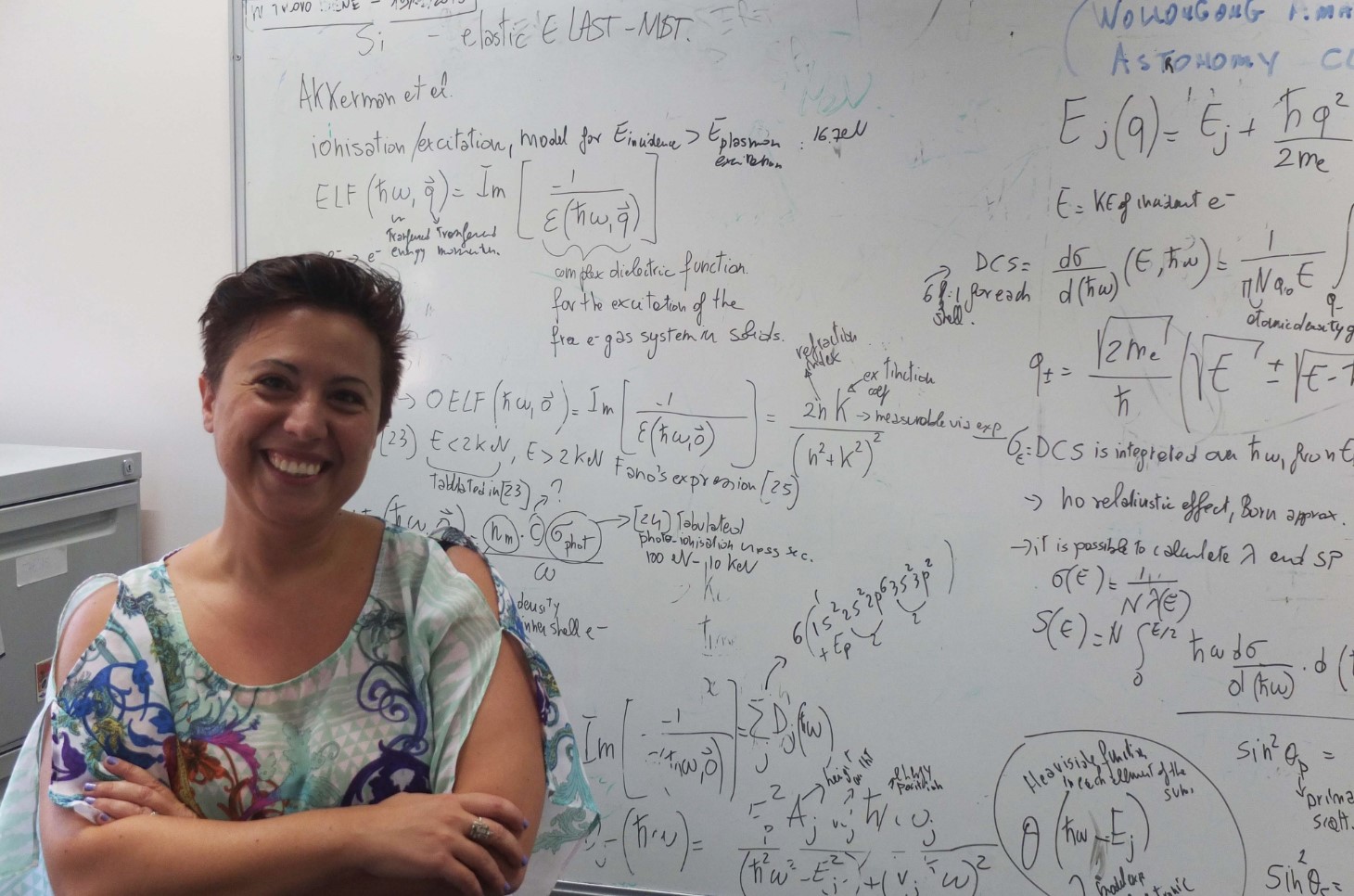
During those years, she became part of a team with whom she still collaborates today on the most important project of her career: working with over a hundred scientists to develop a physics simulation code called Geant4 - short for Geometry and Tracking - to describe how radiation interacts with matter.
“These simulations,” Guatelli explained, “can be used both to describe high-energy physics experiments at CERN and to calculate radiation doses during radiotherapy treatment, with the goal of improving those treatments.”
These simulations have numerous applications - in astrophysics, nuclear studies and medicine, just to name a few.
Over time, Guatelli has taken on increasingly senior roles within the Geant4 project, becoming one of the world’s leading figures in the field of medical physics.
“The code is open source, so it’s accessible to everyone,” she said, adding that thousands of physicists worldwide use it.
“It’s an extremely successful project, and the decision to make the code freely available comes from the belief that doing science also means giving back to society.
“That’s a very important principle for those who work in research centres and universities,” she shared.
For Guatelli, collaboration and hard work are non-negotiable foundations for being a good researcher.
“One of the things that gives me the most joy is mentoring the next generation of researchers. We need to create opportunities for them,” she stressed. “That’s the legacy we must leave.”
She believes it’s essential for researchers to learn how to communicate with people outside their field; to help the public understand the practical importance of discoveries and “their impact on everyday life”.
Guatelli’s most meaningful moments come when she shares her work and achievements with her family. “Because the sacrifices I’ve made affect them, too,” she explained.
“I love involving them and sharing the rewards of this demanding job, which often means taking time away from my family.”
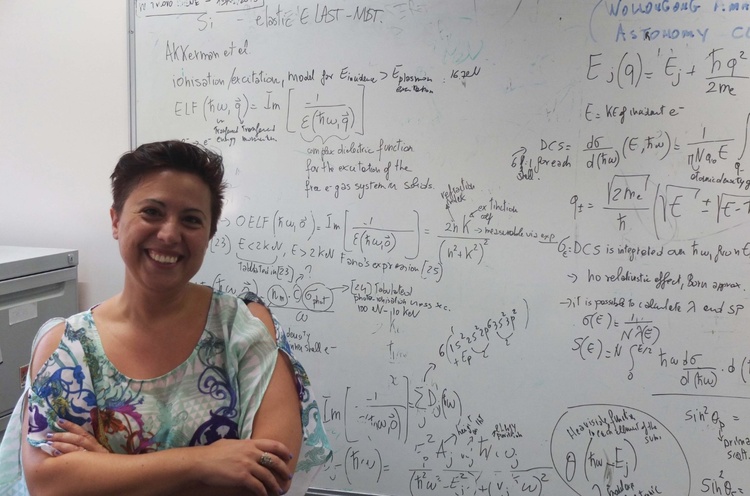
Thanks to her passion, sacrifices and remarkable accomplishments, Guatelli received the Women in Physics Award from the Australian Institute of Physics in 2021. The following year, she joined the expert panel of the ARC - the Australian Research Council.
Speaking on the role of women in STEM, Guatelli believes it’s crucial to help girls feel more confident by supporting and motivating them in their pursuit of independence and professional fulfilment.
“I never really felt the burden of being a woman,” she admitted. “It was other people who pointed it out. At home, my parents taught both my sister and me the value of hard work.
“[My sister] became an aerospace engineer, so I think it was the way we were raised that made the difference.”
Guatelli managed to put that lesson into practice by never settling, even after moving to Australia in 2007.
“Back then, I was looking for a change. I wanted to explore the world, see how other research groups worked,” she recalled.
“I met Professor Anatoly Rozenfeld at a conference and found out they needed someone with my background at ANSTO - the Australian Nuclear Science and Technology Organisation - in Sydney, for a two-year position.”
Originally planning to return to Europe after two years, Guatelli began her career Down Under and quickly realised that there was a wealth of research opportunities in Australia.
After finishing her contract with ANSTO, she accepted a lecturer position at The University of Wollongong - and the rest is history.
And even if she hadn’t dedicated her life to physics, she would’ve found a way to connect with it through other pursuits.
“I probably would’ve studied archaeology, which uses techniques to date artefacts or study their composition. Or philosophy, because physics is really just a branch of philosophy.”