Article by Caterina Squillace
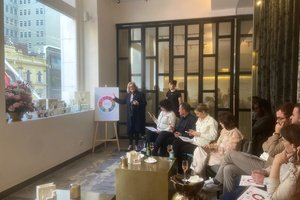
BRISBANE – The evening centred on the presentation by Professor Federica De Rosa from the Academy of Fine Arts in Naples, who explored the unique relationship between Italian cities and their surrounding landscapes — a bond that turns much of Italy into what is often called an ‘open-air museum’.
De Rosa argued that works of art are conceived, and often created, within the spaces they inhabit, making it impossible to detach them from their original contexts without altering their meaning or diminishing their essence.
Her lecture traced the evolution of the Italian city from the Middle Ages to the present, highlighting the deep connection between architecture, monuments and the natural environment.
For De Rosa, cities and their artistic heritage cannot simply be “packaged” and exhibited elsewhere without losing their historical and cultural resonance.
The professor also reflected on the idea of heritage, a word rooted in the notion of inheritance, reminding the audience that Italy’s artistic and cultural treasures represent the legacy of past generations and must be preserved as a cornerstone of national identity.
She cited Article 9 of the Italian Constitution, which calls upon all citizens to safeguard and promote cultural heritage.
De Rosa used vivid metaphors to express her ideas, comparing the city to the human body, made up not only of its physical structures but also animated by a living soul. Quoting art historian Tomaso Montanari, she reinforced her message: “Art is like an apple still attached to its tree — it belongs to its place of origin.”
The evening concluded with an invitation to experience Italy’s artistic masterpieces in the natural and cultural settings for which they were created, rather than within the confined and detached space of a museum.